
With Japan lifting export restrictions on the three key semiconductor materials to South Korea, attention is focused on whether this will open the way for the recovery of the deteriorated trade balance. Earlier, on the 16th, coinciding with the Korea-Japan summit, Japan lifted export restrictions on photoresists, hydrogen fluoride, and fluorinated polyimide to South Korea, and the South Korean government decided to withdraw its World Trade Organization (WTO) complaint against Japan's measures on these three items.
According to the Korea Customs Service on the 19th, exports from the 1st to the 10th of this month amounted to $15.791 billion, down 16.2% compared to the same period last year, while imports increased by 2.7% to $20.786 billion. With exports decreasing and imports increasing, the trade deficit recorded $4.995 billion. The annual trade deficit for this year has reached $22.775 billion in just two months, which is 48% of last year's trade deficit ($47.8 billion).
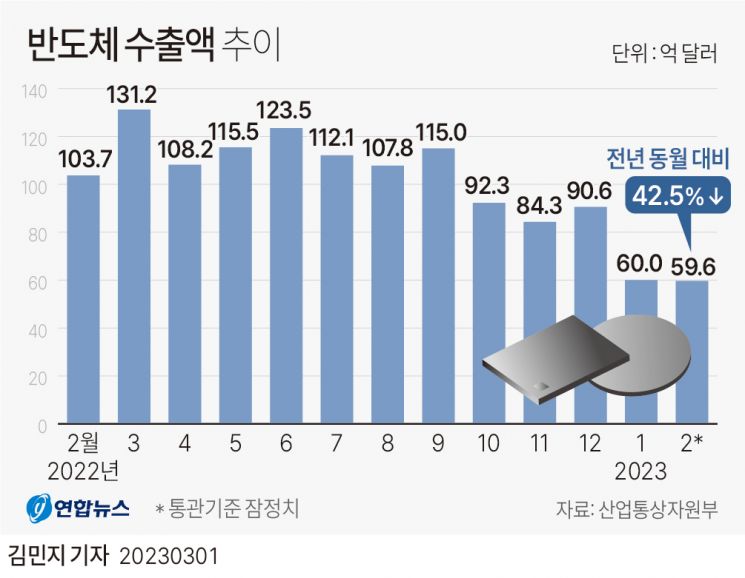
The main cause of the trade deficit is largely due to the semiconductor exports shrinking for eight consecutive months from August last year to this month. During this period, semiconductor exports amounted to $2.26 billion, down 41.2% compared to the same period last year, continuing a weak trend. Experts expect that if relations between the two countries improve, the supply chains of various material, parts, and equipment companies, including semiconductors, will expand. This is as both countries are conducting consultations on the effectiveness of export controls, including the systems, institutional operations, and post-management of export control authorities. There is also a prospect that Korea, the U.S., Japan, and Taiwan, which lead the semiconductor industry, can contribute to stabilizing the global supply chain through practical cooperation.
Some analysts argue that Japan's easing of regulations may not have a significant impact on the domestic semiconductor ecosystem. Considering that Japan is South Korea's largest trade deficit partner, there are concerns that increased trade volume between the two countries could actually widen South Korea's trade deficit. This is because imports from Japan have historically exceeded exports, including in materials, parts, and equipment. Despite these concerns, the government views the lifting of export restrictions as largely positive in terms of resolving supply chain uncertainties. The Ministry of Trade, Industry and Energy explained, "The export restrictions from Japan led to a strong push for materials, parts, and equipment policies, resulting in domestic technological development and strengthening of the domestic supply chain in these areas. Nevertheless, uncertainties due to Japan's export restrictions still remain, and this decision is expected to resolve those uncertainties."
Domestically, efforts are being strengthened with a large-scale semiconductor industry enhancement. The government has decided to establish a semiconductor mega cluster in Yongin, Gyeonggi Province, which is 2.4 times the size of Yeouido. To foster advanced industries such as semiconductors, future cars, and space, 15 candidate sites for a national advanced industry belt covering a total area of 40.76 million square meters (12 million pyeong) have also been announced. To this end, 340 trillion won will be invested over five years until 2026, including the creation of the semiconductor mega cluster with new national industrial complexes and 24 trillion won of private investment for building advanced packaging hubs.
Momentum is also building for additional tax support for semiconductor facility investments, known as the 'K-Chips Act' (Amendment to the Restriction of Special Taxation Act). The National Assembly's Planning and Finance Committee recently approved the K-Chips Act at the Tax Review Subcommittee. According to the amendment, the tax credit rate for semiconductor investments will increase from the current 8% to 15% for large corporations and from 16% to 25% for small and medium-sized enterprises. The business community expects that this amendment will serve as a catalyst to promote investment across industries, including advanced fields like semiconductors, thereby enhancing corporate international competitiveness.
© The Asia Business Daily(www.asiae.co.kr). All rights reserved.


















