The United Nations Security Council (UNSC) will hold a public meeting on North Korea's non-proliferation issues at 10 a.m. local time on the 20th at the UN Headquarters in New York, USA.
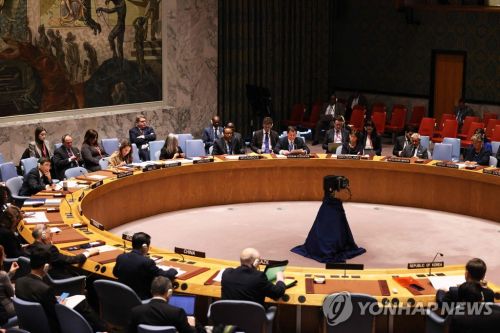 The UN Security Council meeting on the North Korean ICBM launch held on the 20th of last month.
 [Photo by Yonhap News]
According to the schedule posted on the UNSC website on the 19th, the Council will hold its 9287th meeting at 10 a.m. on the 20th to discuss non-proliferation regarding North Korea.
This meeting appears to have been convened in response to North Korea's intercontinental ballistic missile (ICBM) test launch on the 16th (local time).
According to the South Korean Joint Chiefs of Staff, on the morning of the 16th, when the South Korea-Japan summit was held, the military detected one long-range ballistic missile launched at a high angle from Sunan, Pyongyang, toward the East Sea.
North Korea stated that this missile, launched just before President Yoon Suk-yeol's visit to Japan, was an Hwasong-17 ICBM. This is North Korea's first ICBM launch in nearly a month since the Hwasong-15 on the 18th of last month.
This is also the first public UNSC meeting on North Korea's nuclear and missile issues in a month since the 20th of last month, and the second such meeting this year.
Since North Korea's ballistic missile launches violate multiple UNSC sanctions resolutions, the Council members including the United States and Japan, as well as the concerned party South Korea, are expected to attend the meeting to strongly condemn the launches and call for official UNSC-level responses.
However, it is considered unlikely that the meeting will produce outcomes such as additional sanctions resolutions, presidential statements, or press statements. This is because China and Russia, permanent members of the Security Council with veto power, oppose such measures.
The United States, citing the "fuel trigger" clause in UNSC Resolution 2397?which mandates automatic discussion of strengthening fuel supply sanctions if North Korea launches an ICBM?proposed an additional sanctions resolution in March last year and brought it to a vote in May, but failed due to opposition from China and Russia.
In November last year, the US shifted from pursuing additional sanctions to pushing for a UNSC presidential statement in response to North Korea's ICBM launch, but this also failed due to lack of consent from China and Russia.
The US expressed its intention to re-pursue a presidential statement at last month's UNSC meeting, but no visible progress has been reported yet.
China and Russia have defended North Korea's ballistic missile test launches, citing joint South Korea-US military exercises as justification.
© The Asia Business Daily(www.asiae.co.kr). All rights reserved.

![User Who Sold Erroneously Deposited Bitcoins to Repay Debt and Fund Entertainment... What Did the Supreme Court Decide in 2021? [Legal Issue Check]](https://cwcontent.asiae.co.kr/asiaresize/183/2026020910431234020_1770601391.png)