Starting with a Meeting of Zainichi Koreans, Japan-Korea Summit Addresses Export Controls and More
Meeting Business Leaders, Pledges "Full Support for Business Opportunities"
President Yoon Suk-yeol concluded his 1-night, 2-day visit to Japan, including a summit meeting with Japanese Prime Minister Kishida Fumio, and departed for home on the 17th. Around 5 p.m. that day, President Yoon and his wife Kim Kun-hee boarded the presidential aircraft, Air Force One, at Tokyo Haneda Airport, where they were seen off by Ambassador Yoon Deok-min to Japan and his spouse. Before boarding the plane, Ambassador Yoon said, "The schedule was very busy," to which President Yoon replied, "Thank you for your hard work."
Arriving in Japan the previous day for the Korea-Japan summit and other engagements, President Yoon first visited the Korean residents in Japan, emphasizing his commitment to restoring Korea-Japan relations by saying, "Your unwavering affection and support for the homeland will be a great strength in building a future-oriented Korea-Japan relationship." President Yoon’s visit to the Korean residents in Japan before the summit with Prime Minister Kishida was intended to encourage the residents who have felt the strain in bilateral relations.
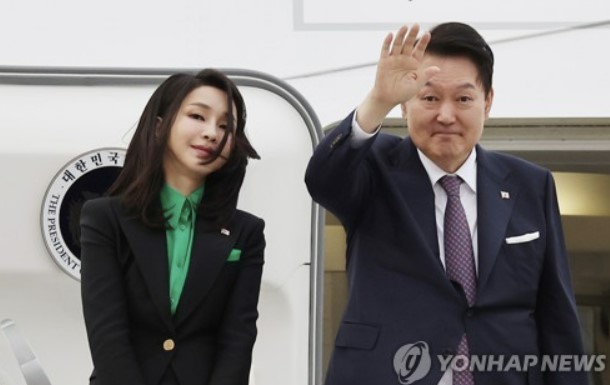 President Yoon Suk-yeol and First Lady Kim Keon-hee, having completed a 2-day visit to Japan, are boarding Air Force One at Tokyo Haneda Airport on the afternoon of the 17th, greeting the farewell crowd.
 [Photo by Yonhap News]
Following this, President Yoon held a summit meeting with Prime Minister Kishida and declared the restoration of shuttle diplomacy between the two leaders for the first time in 12 years. Taking this summit as an opportunity, both countries plan to progressively inherit the Kim Dae-jung-Obuchi Declaration and seek a developmental relationship through cooperation across all fields including economy, security, science and technology, culture, and future generations. In a joint press conference held immediately after the summit, President Yoon and Prime Minister Kishida clearly stated their intention to swiftly resolve existing conflicts such as the forced labor issue, export controls, and the Korea-Japan General Security of Military Information Agreement (GSOMIA).
In particular, Prime Minister Kishida positively evaluated the South Korean government's announcement to have a third party compensate the victims of forced labor during the Japanese colonial period. Prime Minister Kishida said, "Recently, the South Korean government announced measures related to the issue of former workers from the Korean Peninsula," adding, "From the Japanese government's perspective, this measure is evaluated as an effort to restore Korea-Japan relations, which had been in a very serious state, to a sound relationship."
A senior official from the presidential office explained regarding Prime Minister Kishida’s remarks on inheriting the Kim Dae-jung-Obuchi Declaration and third-party compensation, "He said that the statement inherits the declarations of previous administrations. Within that, there is a meaning of apology." The official further added, "Moreover, President Yoon expressed a strong will to resolve the issue not by old formulas but by new ones, with the intention of creating a new historical chapter considering the future generations of Korea-Japan relations."
On the 17th, President Yoon met with figures from the Korea-Japan business community and promised, "The governments of both countries will spare no support so that you can exchange freely and create innovative business opportunities." President Yoon attended the Korea-Japan Business Roundtable held at Keidanren in Tokyo that afternoon and stated, "I met with Prime Minister Kishida Fumio to discuss various cooperation measures for normalizing Korea-Japan relations and shared a common will for the development of a future-oriented Korea-Japan relationship."
This was the first time in 14 years that a Korean president attended a Korea-Japan business event since President Lee Myung-bak’s visit to Japan in June 2009, when the ‘Korea-Japan Business Leaders Meeting’ was held. However, the much-anticipated joint attendance of Prime Minister Kishida Fumio did not materialize. Representatives from Nippon Steel and Mitsubishi Heavy Industries, companies defendants in the forced labor compensation lawsuits, also did not attend.
For his final engagement, President Yoon gave a lecture to Korean and Japanese university students at Keio University in Tokyo. Korean and Japanese students began entering the venue about an hour before the lecture started, and the seats were nearly full about 30 minutes prior. At this event, President Yoon said, "I am very honored to meet you at Keio Gijuku University, which has a tradition of practicality and openness, and to have the opportunity to talk with you not only about the significance of this visit to Japan but also about the future that Korea and Japan should build together." He added, "This visit to Japan, Korea’s closest neighbor, is significant in itself as it aims to normalize the previously strained bilateral relations."
The presidential office explained that during the subsequent Q&A session with Keio University students, President Yoon exchanged candid opinions on the concerns of Korean and Japanese university students regarding bilateral relations, the shared interests of Korea and Japan, and the future of Korea-Japan economic cooperation.
© The Asia Business Daily(www.asiae.co.kr). All rights reserved.
![Clutching a Stolen Dior Bag, Saying "I Hate Being Poor but Real"... The Grotesque Con of a "Human Knockoff" [Slate]](https://cwcontent.asiae.co.kr/asiaresize/183/2026021902243444107_1771435474.jpg)
















