Failure of Unity Among Presidential Candidates
Pro-Yoon Leadership Lacks Critics
Disappointing Gender Balance Aspects
Kim Ki-hyun, leader of the People Power Party, has been promoting 'Solidarity, Inclusion, and Balance (Yeonpotang)' since his inauguration, but evaluations suggest that his efforts have so far only resulted in stagnation. He has failed to form a 'one team' with candidates who competed with him in the party leadership race and has not demonstrated sufficient policy capabilities as the ruling party. However, since it is still early in his term, there is speculation that the situation could be reversed depending on the choices Kim makes in appointing the remaining party leadership.
① Meetings with Ahn Cheol-soo, Chun Ha-ram, and Hwang Kyo-ahn all ended empty-handed= On the 13th, Kim met with Ahn Cheol-soo, who had competed against him in the party leadership race, and they spoke in unison about joining forces for next year’s general election. Although the meeting appeared amicable on the surface, Ahn told Kim pointedly that winning in the metropolitan area next year is crucial but "the situation is currently very difficult." He also rejected a proposal for role division. Kim asked Ahn to take the position of chair of the Special Committee on Science and Technology, but Ahn declined, saying he wanted "time to consider."
The meeting with former United Future Party leader Hwang Kyo-ahn also ended without results. Since Hwang had persistently raised allegations of 'land speculation in Ulsan' against Kim during the leadership race, restoring relations between the two was a difficult task. After their meeting, Hwang stated he would continue to engage in 'opposition struggles' and regarding the party convention vote-rigging allegations, he said, "I will provide detailed remarks once the verification is complete."
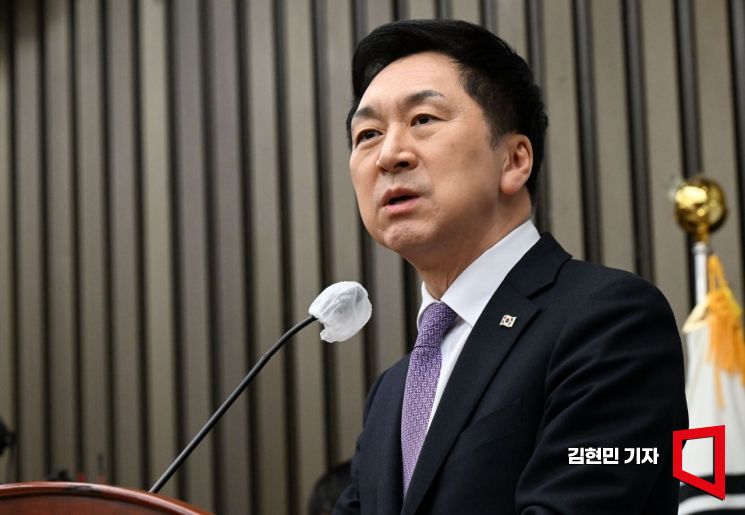 Kim Ki-hyun, leader of the People Power Party, is giving an opening speech at the members' meeting held at the National Assembly in Yeouido, Seoul on the 16th. Photo by Kim Hyun-min kimhyun81@
A meeting with Chun Ha-ram, former chairman of the Suncheon Gap district party committee in Jeollanam-do, failed to materialize. Despite Kim’s efforts to arrange a meeting, Chun declined, saying it was not the right time. In a KBS Gwangju radio interview on the 16th, Chun said, "A meeting without any resonance is actually meaningless," and pointed out, "Kim emphasizes solidarity and inclusion, but people like Kim Jae-won, Cho Soo-jin, and Jang Ye-chan, who are Supreme Council members, are saying I should be permanently expelled. Inclusion and permanent expulsion are very contradictory and opposing ideas." He added, "It is a matter of coordination and sincerity. Meeting after those issues are resolved would be meaningful."
② Leadership dominated by pro-Yoon faction, who will offer criticism? The leadership, composed entirely of pro-Yoon members, has effectively failed to play a proper check-and-balance role regarding government policies. The '69-hour workweek' policy is a prime example. This policy was discussed in December last year under Emergency Committee Chairman Jeong Jin-seok, where a high-level party-government meeting agreed to improve wage and working hour systems. At that time, the party and government agreed to allow legal working hours, currently capped at 52 hours per week, to be extended up to 69 hours and to reform the wage system to be job- and performance-based.
Until public opinion worsened, no one within the ruling party raised concerns about the 69-hour workweek system. On the contrary, it was even praised as something the MZ generation would like. On the 8th, Seong Il-jong, chairman of the People Power Party Policy Committee, said in an MBC radio interview, "From my perspective, even the youth in their 20s and 30s like it," adding, "It is a system already widely implemented in advanced countries."
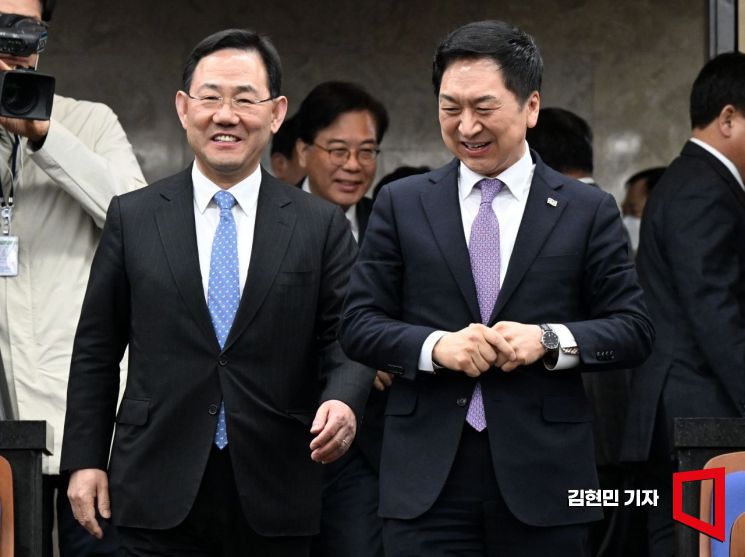 Kim Ki-hyun, leader of the People Power Party, and Joo Ho-young, floor leader, are entering the members' meeting held at the National Assembly in Yeouido, Seoul on the 16th. Photo by Kim Hyun-min kimhyun81@
With the new leadership formed entirely of pro-Yoon members, the challenge remains whether they can properly convey public opinion going forward. There are concerns that the leadership has effectively become a 'management-type leadership.' On the previous day’s SBS radio interview, Yoon Sang-hyun, a People Power Party lawmaker, claimed, "Kim Ki-hyun’s leadership has become one with the party and government, and in terms of party appointments, it is almost unified," adding, "I see this as a demonstration of the party’s strong will to firmly support the president."
③ Can women’s voices be represented? Among the elected leadership, only Cho Soo-jin, a Supreme Council member, is a woman. Diversity could have been supplemented through appointed Supreme Council members or other means. Lee Jae-myung, leader of the Democratic Party of Korea, appointed Seo Eun-sook, chairwoman of the Busan city party committee, and lawyer Im Seon-sook as appointed Supreme Council members.
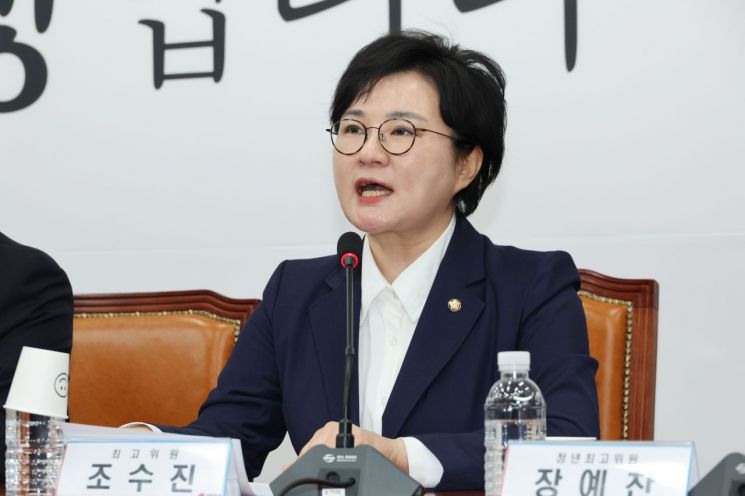
If appointing Kang Dae-sik as an appointed Supreme Council member was a token gesture to accommodate the Yoo Seung-min faction, diversity could have been pursued through other appointed party positions. Among the 10 major party officials approved on the 13th, only two were women (Bae Hyun-jin, deputy head of organization; Kim Ye-ryeong, spokesperson). In the last party convention, the gender ratio of the electorate was 59.39% male and 40.61% female. At the first Supreme Council meeting, Cho Soo-jin, who was re-elected, mentioned International Women’s Day on March 8 and said, "I will make the Republic of Korea a place where women are happy."
© The Asia Business Daily(www.asiae.co.kr). All rights reserved.



















