Residents in the Cheongdam-dong area of Gangnam-gu, Seoul, through which the Metropolitan Express Railway (GTX) Line A passes, filed an administrative lawsuit demanding the cancellation of the implementation plan for GTX Line A running beneath their apartments, but they lost the case. The ruling was finalized as the residents did not appeal.
According to the legal community on the 17th, the Administrative Court of Seoul, Administrative Division 5 (Presiding Judge Kim Sun-yeol) recently ruled against the plaintiffs in the first trial of the lawsuit filed by about 240 Cheongdam-dong residents, whose residential area is crossed underground by GTX Line A, against the Minister of Land, Infrastructure and Transport, seeking cancellation of the approval of the private investment project implementation plan. This came four years after the lawsuit was filed in March 2019.
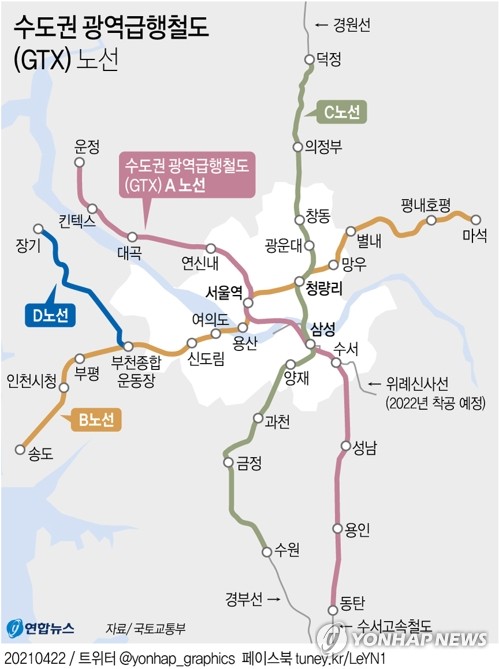
The GTX project was promoted with the purpose of alleviating traffic congestion in the metropolitan area and strengthening the competitiveness of the metropolitan area by constructing a metropolitan express railway connecting major hub stations in Seoul and Gyeonggi Province. The government has started construction on parts of GTX Line A (Unjeong~Dongtan), Line B (Songdo~Maseok), and Line C (Deokjeong~Suwon), aiming for completion in 2027. However, due to repeated complaints from local residents regarding route decisions, some sections of the project have been delayed.
Among them, Line A involved in this lawsuit connects an 83.1 km section from Unjeong Station in Paju-si, Gyeonggi Province, passing through Gangnam-gu, Seoul, to Dongtan Station in Hwaseong-si, Gyeonggi Province. In 2016, the Ministry of Land, Infrastructure and Transport selected a route passing through the Cheongdam-dong area by utilizing the lower part of Olympic-daero as the optimal route for the 'Han River crossing section' of GTX Line A. In 2018, the approval and announcement of the 'private investment project implementation plan' were completed, and in the following year, the project area and scale were partially changed twice.
During this process, the apartment complex of the Cheongdam-dong residents who filed this lawsuit was newly included in the project land acquisition. The plaintiffs argued, “If GTX passes through, problems such as ground subsidence and building cracks may occur,” and filed an administrative lawsuit demanding cancellation of the implementation plan approval.
During the trial, they claimed that “the opinion hearing procedure was either absent or insufficient, and the procedures for sending and viewing related documents were not followed, making it procedurally illegal,” and also argued that “the environmental impact assessment regarding noise and vibration is not reliable.”
In particular, they contended that the ‘balancing of interests’ was not conducted in the process of deciding the route passing through Cheongdam-dong. Balancing of interests is a principle that when multiple fundamental rights conflict, the higher-value fundamental right should be protected over the lower-value one.
However, the Administrative Court did not accept their claims. The court ruled that “the defendant Ministry of Land, Infrastructure and Transport made related documents available for viewing at the local district office and sent notices for opinion hearings via registered mail,” deeming the procedure legally proper. It also stated, “The program used for the environmental impact assessment simulation was verified by the Korean Tunnel Engineering Society, and the review method cannot be considered contrary to the Private Investment Act or other relevant laws, nor unreasonable.”
Furthermore, “Before this disposition, the Ministry conducted investigations on safety, noise, vibration, etc., and performed balancing of interests. It is difficult to view the balancing of interests conducted through collaboration or feasibility studies as lacking legitimacy or objectivity.”
The court added, “The Ministry planned the route and appropriate distances between stations while considering securing the function of the metropolitan express railway, future north-south railway connections, prevention of complaints, and cost reduction.” It explained that “the Cheongdam-dong route was proposed as an alternative route minimizing overlap with large apartment complexes such as the Hannam redevelopment district and Apgujeong large apartment complex, and considering connection with the GTX basic plan route.”
Additionally, “Gangnam-gu Office proposed the ‘Han River detour route’ as an alternative route minimizing private land overlap, but this route is about three times longer than the Cheongdam-dong route (1,070m) under the Han River, which limits train speed, increases accident risk, makes accident response difficult, and requires speed reduction. It is difficult to perform the role of a metropolitan express railway, fundamentally undermining the purpose of the project,” the court added. Since the plaintiffs, including Mr. Lee, did not appeal, the residents’ loss was finalized as is.
© The Asia Business Daily(www.asiae.co.kr). All rights reserved.
![Clutching a Stolen Dior Bag, Saying "I Hate Being Poor but Real"... The Grotesque Con of a "Human Knockoff" [Slate]](https://cwcontent.asiae.co.kr/asiaresize/183/2026021902243444107_1771435474.jpg)
















