Yoon Prioritizes Practical Benefits... Kishida Hopes for Improved Relations
High Possibility of Return Visit After June... Focus on Historical Issues and Korea-Japan Joint Declaration
The joint press conference statement from the Korea-Japan summit announced on the 16th by President Yoon Suk-yeol and Japanese Prime Minister Kishida Fumio contains approximately 1,750 characters each, totaling about 3,500 characters, reflecting a clear intention to improve future-oriented bilateral relations. The core is to seek a progressive relationship through cooperation across all fields including economy, security, science and technology, culture, and future generations. However, the sensitive issue of historical disputes was postponed until Kishida’s anticipated reciprocal visit. During Kishida’s visit to Korea, there is also speculation that a Korea-Japan joint declaration reflecting Japan’s advanced stance may be issued.
According to the Presidential Office on the 17th, President Yoon mentioned cooperation 8 times, future 6 times, economy 6 times, and security 5 times in the press statement the previous day, while Prime Minister Kishida mentioned relations 11 times, exchanges 6 times, security 4 times, expectations 4 times, and economy 3 times most frequently. While President Yoon emphasized ‘practical benefits’ and ‘future’ repeatedly, highlighting the importance of cooperation and the future as he has stressed several times before, Prime Minister Kishida repeatedly expressed expectations for a virtuous cycle of bilateral economic and security cooperation for future generations, as well as private exchanges and relationship improvement.
The two leaders clearly stated that they would progressively inherit the spirit of the Kim Dae-jung?Obuchi declaration and that bilateral relations should move beyond reconciliation and healing to cooperate and coexist together in the future. A senior official from the Presidential Office explained, "They said they would inherit the statements of past administrations. There is an implication of apology in that," adding, "Furthermore, President Yoon expressed a strong will to resolve the relationship with a new formula rather than the old one, with the intention of building a new historical chapter considering future generations of Korea-Japan relations."
They also emphasized the need to consider the future rather than immediate tangible benefits. In preparation for situations such as the global supply chain restructuring, the US-China hegemonic rivalry, and the intensification of security instability due to North Korea’s nuclear and missile tests, the two countries, as close neighbors sharing fundamental values such as freedom and human rights, must join forces to overcome challenges.
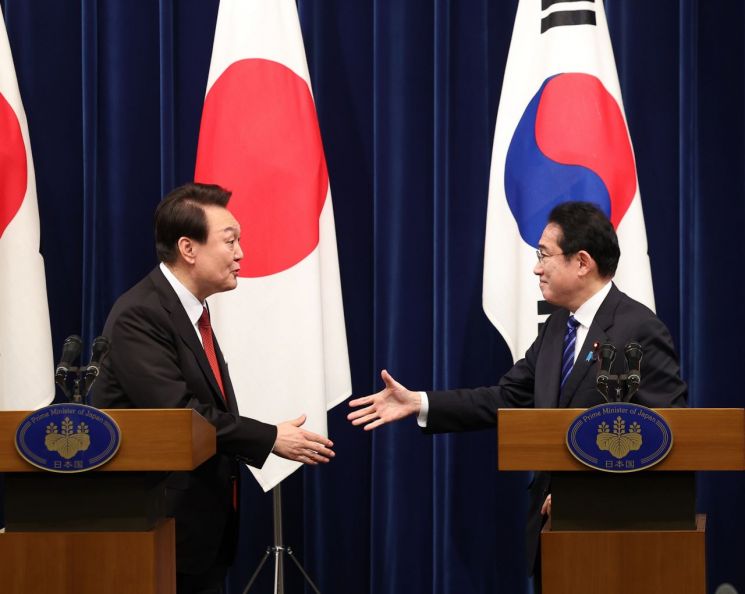
The Korea-Japan leaders agreed to use this summit as an opportunity to lift Japan’s export restrictions on Korea for the three major semiconductor items and officially restore GSOMIA (General Security of Military Information Agreement). In particular, they plan to restore shuttle diplomacy between the two leaders and continue various consultations, including launching Korea-Japan economic security talks at the National Security Council (NSC) level. President Yoon stated, "Following the national consensus to prepare the future of both countries together, we decided to accelerate discussions to enhance cooperation in various fields such as security, economy, and human and cultural exchanges," adding, "To prepare for a prosperous future, we will work together not only on economic security and advanced science but also in finance and foreign exchange." Prime Minister Kishida also mentioned the agreed points between the two governments, such as early resumption of Korea-Japan security talks, Korea-Japan vice ministerial strategic talks, and the high-level Korea-China-Japan process, expressing his expectation that "President Yoon’s visit to Japan will be a significant step toward normalizing Korea-Japan relations."
With the restoration of shuttle diplomacy between Korea and Japan after 12 years through this summit, Kishida’s reciprocal visit has come into sight. The key issue during Kishida’s expected visit to Korea this summer will be whether there will be an advanced expression of Japan’s stance on historical issues and whether that stance will be included in the Korea-Japan joint declaration. In the joint press conference held the previous day, Prime Minister Kishida only repeated a passive expression that "we will inherit the October 1998 declaration (Kim Dae-jung?Obuchi declaration)."
The core agenda for the reciprocal visit is the level of direct apology related to historical issues. Since there was no advanced apology statement from Prime Minister Kishida during the joint press conference, some interpret this as a procedural reserve for when he visits Korea in the future. Choi Eun-mi, a research fellow at the Asan Institute for Policy Studies, said, "Japan’s decision-making process is, as Prime Minister Kishida said, to do things one by one, so it was probably impossible to express a progressive stance on historical issues at this time," adding, "There was no expression of consolation for forced labor victims, and no clear procedure to interpret the historical awareness of the Kim Dae-jung?Obuchi declaration. If he makes a statement when he comes to Korea, it will be more meaningful."
Attention is also focused on the Korea-Japan joint declaration, which the two governments are coordinating through a ‘preparatory committee.’ The declaration will be drafted in a documented form detailing specific agreements, and it may include recognition of historical issues. If Prime Minister Kishida’s visit occurs within this year, it is expected to take place after June. President Yoon is scheduled to visit the United States next month, and Prime Minister Kishida will hold elections in April and preside over the G7 summit in Hiroshima in May. Realistically, a reciprocal visit within one to two months is difficult, making a June visit the most likely.
© The Asia Business Daily(www.asiae.co.kr). All rights reserved.


















