"US and European Financial Market Restructuring Inevitable"
Worst-Case Scenario if Inflation Persists Despite High Interest Rates
Although the Silicon Valley Bank (SVB) and Credit Suisse (CS) crises in the United States have entered a calming phase, domestic institutional investors such as pension funds and mutual aid associations have warned that they must prepare for systemic risks in the globally interconnected financial markets. Unlike in the past, it is now difficult for central banks around the world to step in as rescuers, and failure to manage risks properly could escalate into an uncontrollable crisis. There are also forecasts that the polarization of financial markets will deepen as the financial markets in the U.S. and Europe undergo restructuring.
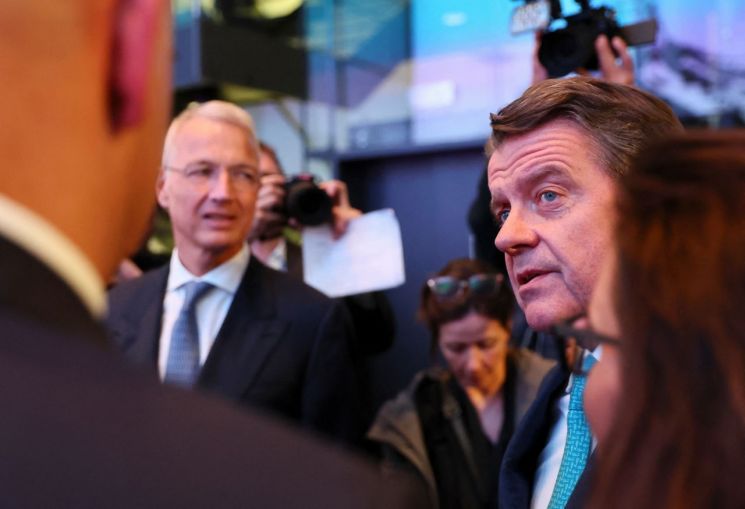 Axel Lehmann, Chairman of the Board of Credit Suisse (CS) (left), stands next to Colm Kelleher, Chairman of UBS, at a press conference held in Bern, Switzerland, on the 19th (local time). Photo by Reuters Yonhap News
On the 20th, the Chief Investment Officer (CIO) of Institution A said, "A sense of unease that this is just the beginning is creeping in," adding, "Looking only at the SVB case, one might mistakenly see the effect of halting aggressive interest rate hikes as turning bad news into good news, but the credit risk, a side effect of rapid rate hikes, is now becoming a reality."
He said, "Considering the U.S. central bank, which is stumbling over the seemingly incompatible missions of inflation control and financial system stability, the future looks worrisome." He added, "The CS case has reflected risks over a long period since last year, so it is unlikely to cause a shock on the scale of Lehman Brothers," and emphasized, "What is clear is that the SVB incident is serving as an 'early warning'." He also noted, "If lenders such as banks tighten lending and scramble to secure liquidity, entities with lower credit ratings will find refinancing difficult and interest rates will rise, ultimately highlighting credit risk. The problem is exacerbated because central banks cannot play an active rescuing role as they did in the past."
In a situation where global financial markets are interconnected, the domestic financial market is naturally exposed to such systemic risks. It is a time to carefully examine the degree of risk exposure not only in stocks and bonds but also in various derivative contract counterparties and to take proactive measures.
The CIO of Institution B expressed concern, saying, "Everyone is vulnerable to systemic risk, and no one can avoid it," adding, "The scale of CS's derivatives is enormous." He emphasized, "We need to make decisions not only about CS exposure but also about the overall financial positions. It is necessary to review positions in stocks, bonds, and derivatives." He pointed out that, in particular, there are many over-the-counter derivatives in addition to simple derivatives like futures, so those areas must be closely monitored. Furthermore, he warned, "Domestic banks are relatively sound, but securities firms and savings banks could pose problems."
The most worrisome scenario is that interest rates rise to the point where major financial companies go bankrupt, yet inflation remains unchecked. In this case, the U.S. Federal Reserve (Fed) may not be able to lower rates again, increasing the likelihood of more financial companies and businesses going bankrupt due to prolonged high interest rates. In such a situation, there are also forecasts of market polarization where large banks acquire small banks through mergers and acquisitions (M&A).
The CIO of Institution C said, "The scariest situation is when credit risk spreads but inflation is not controlled," adding, "In such a scenario, rates cannot be lowered, so credit events spread more severely, and more financial companies and businesses must collapse before the situation can be resolved." He advised, "During the rate hike period, we have been cleaning up poor companies and unfavorable portfolio positions, and we need to continue this process while maintaining a conservative stance and tightening risk management."
The CIO of Institution D warned, "If the U.S. central bank fails to properly tighten policy at the crossroads of financial system stability and inflation control, it could pay a greater price later," adding, "Bailouts for SVB and others are already targeted money injections for specific sectors, and premature easing could exacerbate bigger problems beneath the surface." He said, "Governments around the world have been proactive in preventing financial turmoil, so the worst-case scenarios for both SVB and CS have been avoided," but criticized, "If government intervention and moral hazard, which go against capitalism, lead to a chain of next CS and next SVB cases, it will be questionable whether continuous intervention is possible."
The CIO of Institution E said, "The financial markets in the U.S. and Europe will undergo strong restructuring," and predicted, "The financial market risks will be resolved through large banks absorbing smaller banks."
© The Asia Business Daily(www.asiae.co.kr). All rights reserved.
![Clutching a Stolen Dior Bag, Saying "I Hate Being Poor but Real"... The Grotesque Con of a "Human Knockoff" [Slate]](https://cwcontent.asiae.co.kr/asiaresize/183/2026021902243444107_1771435474.jpg)

















