Summer Expected Visit of Prime Minister Kishida Fumio in Return
With the restoration of shuttle diplomacy between Korea and Japan after 12 years through the Korea-Japan summit, Prime Minister Kishida Fumio's reciprocal visit has also come into view.
During Prime Minister Kishida's expected visit to Korea this summer, the key issue will be whether there will be any progress in expressing positions related to historical issues and whether those positions will be included in the Korea-Japan Joint Declaration. In the joint press conference held on the 16th, Prime Minister Kishida only repeated a passive expression that he "will inherit the October 1998 declaration (Kim Dae-jung?Obuchi declaration)."
On the previous day, after the summit with President Yoon, Prime Minister Kishida said at the joint press conference, "President Yoon's visit to Japan can be seen as the 'first step,'" and added, "Since we agreed to resume shuttle diplomacy, we will consider the appropriate timing for the reciprocal visit."
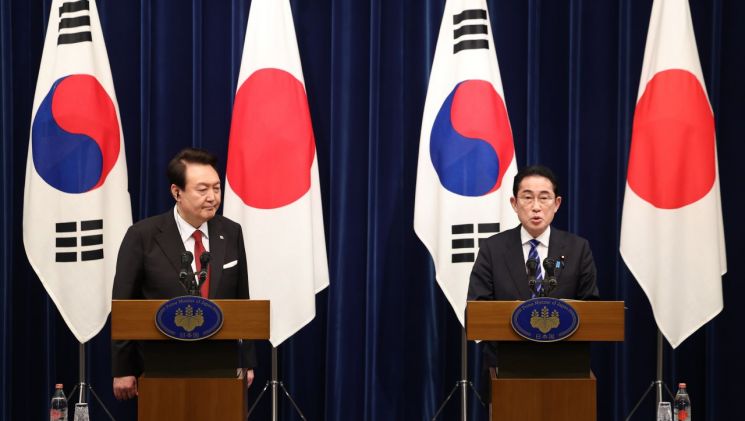
The core agenda of the reciprocal visit is the level of direct apology related to historical issues. There was no advanced apology statement from Prime Minister Kishida at the joint press conference the day before, which some interpret as a procedural step reserved for when he visits Korea in the future.
Choi Eun-mi, a research fellow at the Asan Institute for Policy Studies, said, "Japan's decision-making process is, as Prime Minister Kishida said, done step by step, so it would have been difficult to express a progressive change in position on historical issues immediately," adding, "If he makes a statement when he comes to Korea, it will be more meaningful."
However, there are also opinions that the possibility of mentioning an apology expression, which was not properly expressed even at this press conference, during the reciprocal visit is low. Hosaka Yuji, a professor at Sejong University, said, "He said he would 'inherit the cabinet's position,' but the overall position of the Japanese Liberal Democratic Party cabinet is that the Japanese colonial rule was legal. That is also a hidden expression."
Park Ji-won, former director of the National Intelligence Service who participated in drafting the 1998 'Kim Dae-jung?Obuchi Joint Declaration,' also appeared on the radio that day and strongly criticized the lack of a progressive stance on historical issues, saying, "'Inheriting the past cabinet's position' can also be interpreted as inheriting Abe's cabinet."
Accordingly, attention is focused on the Korea-Japan Joint Declaration, which the two governments are coordinating by forming a 'preparatory committee.' The declaration will be drafted in a documented form regarding specific agreements, and the key point is whether the recognition of historical issues will be included in this content.
Meanwhile, if Prime Minister Kishida's visit to Korea takes place within this year, the timing is expected to be after June. President Yoon is scheduled to visit the United States next month, and Prime Minister Kishida will hold elections in April and preside over the Group of Seven (G7) summit in Hiroshima in May. Realistically, it is difficult for the reciprocal visit to occur within 1 to 2 months, so a visit in June is the most likely.
© The Asia Business Daily(www.asiae.co.kr). All rights reserved.

















