"If It Had Been Like This, Moon Would Have Done It Too"
Yoon Geon-young, a member of the Democratic Party of Korea, criticized the outcome of the Korea-Japan summit, calling it "a humiliating diplomacy where the perpetrator Japan remains passive while we, the victim, are desperately trying to appease them."
On the 17th, during MBC's 'Kim Jong-bae's Focus,' Yoon said, "President Yoon stated that 'the national interests of South Korea and Japan are the same, practically the same,' and the moment I heard that, the phrase 'Naeseon Ilche' from the Japanese colonial era came to mind."
Naeseon Ilche was a slogan used during the Japanese colonial period to signify the complete integration of Korea into Japan.
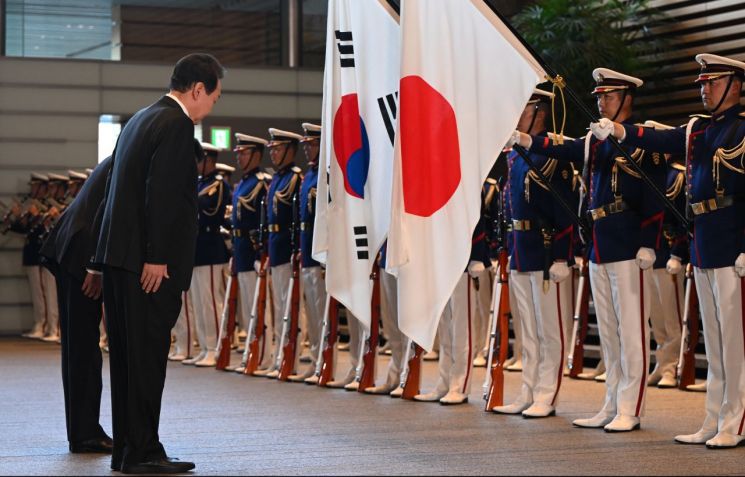
The ruling party praised the summit as a decisive move by President Yoon Suk-yeol. Yoon said, "A decision implies something difficult, but this was too easy. If the intention was to restore Korea-Japan relations in this manner, the previous Moon Jae-in administration would have done it hundreds or thousands of times."
He added, "The Moon Jae-in administration had five principles," and "I won't go into detail about the five principles, but they were victim-centered and included principles regarding forced labor. Under those principles, negotiations were conducted, and Japan even made proposals. Japan's proposals were much better than those presented by the current Yoon Suk-yeol administration."
Yoon, who also served as the Chief of the National Situation Room at the Blue House during the Moon administration, noted, "Assuming these were unofficial proposals, the Japanese government initially suggested that the perpetrator companies, i.e., Japan's war crime companies, comply with the rulings of South Korea's Supreme Court, and then the Korean and Japanese companies would compensate each other. Of course, we could not accept that."
Regarding the restoration of GSOMIA, he said, "It was giving too much of a gift," and "Japan removed South Korea from its whitelist in 2019, effectively considering us a potential adversary. It is inappropriate to provide military secrets to a country that regards us as an adversary. Naturally, that is why we had to withhold it, but to normalize it unconditionally is like having our pockets emptied."
He explained, "The United States and Japan were the most eager for the GSOMIA issue," and "For example, regarding North Korea's ballistic missile launches, Japan made incorrect analyses, and the Korea-US-Japan military alliance and cooperation form the foundation of the US strategy. Therefore, from South Korea's diplomatic standpoint, GSOMIA is a significant bargaining chip."
Yoon interpreted the Korea-Japan summit as influenced by the strategic intentions of the United States. He said, "In the case of the Korea-Japan summit, I believe the US strategy and Japan's intentions aligned. The US strategy is to have South Korea and Japan form a scrum to contain China," adding, "In that scrum, Japan is to play the role of the big brother, and South Korea is to follow well, not to fight over historical issues. That is the US strategy, and Japan aims to regain hegemony in East Asia using North Korea's provocations as an excuse. What do we gain from this?"
He concluded, "The path we must take is thorough practical diplomacy and balanced diplomacy," and "We should not engage in one-sided or submissive diplomacy but pursue practical diplomacy that thoroughly follows South Korea's national interests."
© The Asia Business Daily(www.asiae.co.kr). All rights reserved.

















