[Upcoming Hydrogen Economy]
Considering Hydrogen Price and Efficiency
Less Economical than Electric Vehicles
High Dependence on Subsidies and Marketability
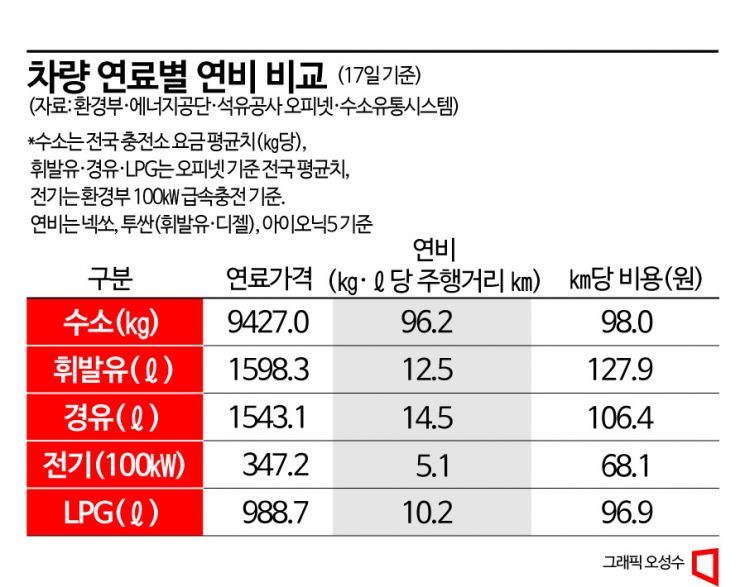
It is generally true that hydrogen cars are environmentally friendly, but there are question marks regarding their economic viability. This is because the hydrogen used as fuel is not cheap. The market price for hydrogen distribution varies, with some places charging less than 8,000 KRW per kilogram, while more expensive regions exceed 12,000 KRW. As of the 17th, the national average price is 9,427 KRW (Hydrogen Distribution Information System). Hynet, which operates the most hydrogen charging stations in the country, raised the price of hydrogen from 8,800 KRW to 9,900 KRW per kilogram by about 13% last December. This is the first increase in hydrogen prices in over three years since the domestic hydrogen car market began in 2019.
At present, electric vehicles have the lowest maintenance costs. Considering the electricity rates based on the Ministry of Environment’s 100 kW fast chargers and the fuel efficiency of Hyundai’s pure electric vehicle Ioniq 5, the fuel cost per kilometer is about 68 KRW. Although electricity rates increased by about 10% in the second half of last year, they remain the most economical. Slow charging is slightly cheaper than this.
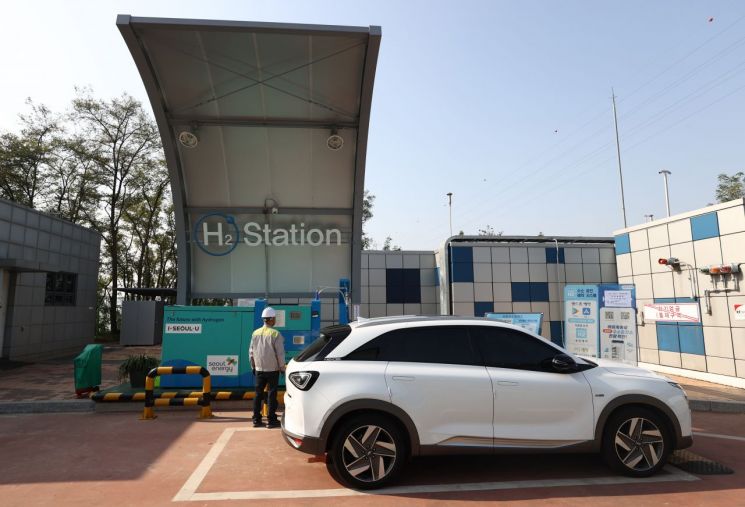
It costs about 98 KRW to drive 1 km in a hydrogen car. This is similar to the cost for liquefied petroleum gas (LPG) vehicles, which are commonly used as taxis or vehicles for the disabled. The hydrogen car figure is based on the compact SUV Nexo, while the LPG vehicle figure is based on the mid-size sedan Sonata.
Internal combustion engine vehicles are the most expensive. Driving 1 km costs about 128 KRW for gasoline and 106 KRW for diesel. The vehicles used for comparison were the Tucson, similar in size to the Nexo, and the gasoline and diesel prices were based on average data from the Korea National Oil Corporation’s Opinet. Hybrid vehicles, which have large fuel cost variations depending on driving habits, were excluded from this calculation. Although it varies with mileage, hybrids are generally perceived to have higher maintenance costs than electric vehicles.
Despite hydrogen prices not being cheap and charging being inconvenient, those who choose hydrogen cars continue to do so because the government and local authorities provide substantial subsidies and the vehicles themselves have good market appeal. Conversely, this means that if subsidies decrease or if the vehicle’s appeal diminishes after a certain period post-launch, sales could sharply decline at any time. Although hydrogen cars are quiet and emit no pollutants, making them environmentally friendly, vehicle buyers do not place much importance on these factors.
However, commercial vehicles that mainly travel fixed long-distance routes tend to benefit more from hydrogen. Because their driving patterns are consistent, charging stations can be strategically placed at key points. When buses or large trucks are made as pure electric vehicles, the battery capacity and size inevitably increase, reducing cargo space and requiring long charging times. Hydrogen cars use electricity generated by fuel cell stacks as their power source, making them more efficient in terms of vehicle design compared to pure electric vehicles.
For hydrogen vehicles to become more economical than they are now, not only must hydrogen prices decrease, but fuel efficiency such as mileage must also improve. However, since the market is still small, there are limits to improving fuel cell performance. Even Hyundai, which produces the most mass-produced hydrogen vehicles, is experiencing delays in developing next-generation hydrogen fuel cell systems compared to the original schedule.
© The Asia Business Daily(www.asiae.co.kr). All rights reserved.


















