[Upcoming Hydrogen Economy]
US to Produce 1kg of Hydrogen for $1 Within 10 Years
Production Costs Vary by Hydrogen Production Method
Hydrogen Consumption Price Also a Key to Popularization
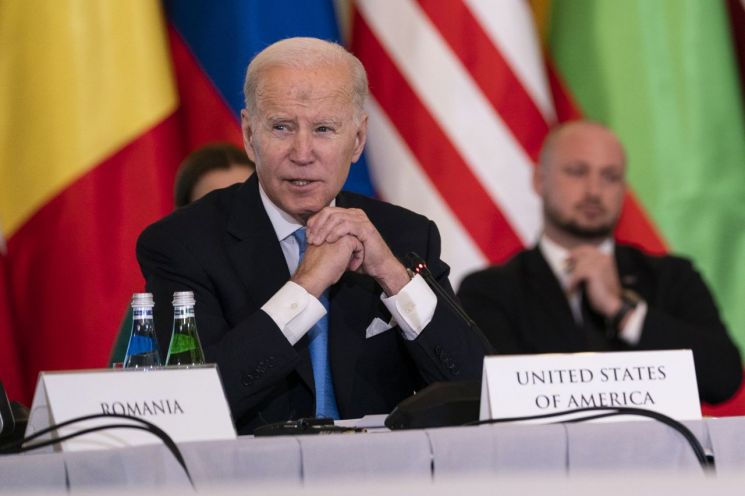
U.S. President Joe Biden signed the Bipartisan Infrastructure Law (BIL) in November 2021, a roughly $1 trillion infrastructure bill. This law includes an investment of $9.5 billion in clean hydrogen. The goal is to reduce the production cost of 'green hydrogen'?produced via water electrolysis?to around $1 per kilogram within the next 10 years. This aims to lower costs below those of 'gray hydrogen,' which is produced from fossil fuels. The Inflation Reduction Act (IRA), enacted this year, provides a tax credit of up to $3 per kilogram for hydrogen produced without carbon emissions. This also aims to reduce hydrogen prices.
To enter the hydrogen economy that utilizes hydrogen as an energy source, hydrogen prices must be lowered. Advanced countries, including the U.S., have rolled up their sleeves to reduce the price of clean hydrogen. Lowering production costs can accelerate the point at which hydrogen can replace fossil fuels.
Hydrogen production costs vary widely depending on the production method. The cheapest hydrogen is byproduct hydrogen emitted during petrochemical or steelmaking processes, costing less than 2,000 KRW per kilogram. However, large-scale production is impossible. It literally comes as a byproduct in the production of petrochemical products or steel. Increasing production requires massive investment.
Gray hydrogen, produced from fossil fuels like natural gas, costs between 2,700 KRW and up to 5,100 KRW per kilogram. Costs fluctuate with raw material prices. Additionally, significant carbon dioxide is emitted during production, meaning it is not environmentally friendly.
Blue hydrogen, which captures carbon dioxide emitted during gray hydrogen production, adds the installation and operation costs of carbon capture and storage (CCS) facilities to production costs. Depending on how the captured carbon dioxide is utilized or stored, costs may increase further.
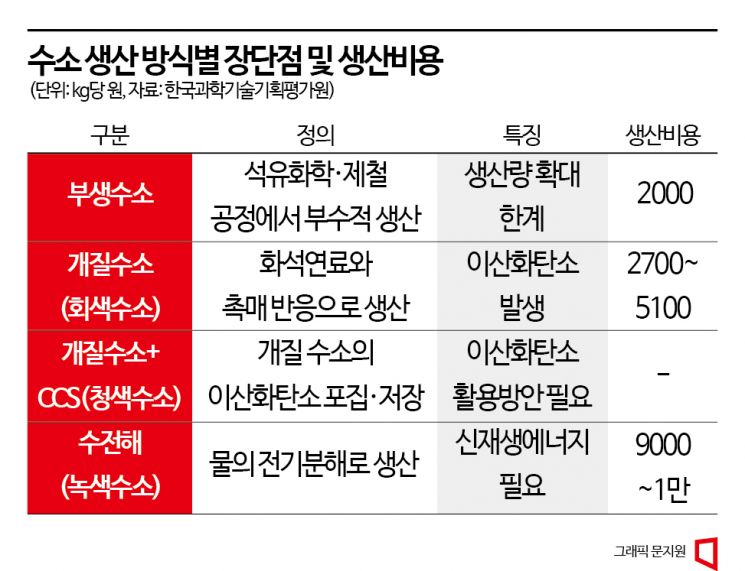
The production cost of green hydrogen, considered an eco-friendly energy, currently reaches up to 10,000 KRW with existing technology. It is produced by water electrolysis using electricity generated from renewable energy. Simply put, it is hydrogen obtained by splitting water with electricity generated in an environmentally friendly way, such as solar power. Experts believe that if electrolysis production costs can be lowered to the level of byproduct hydrogen, it will be economically viable.
The problem is electricity rates. Assuming an electricity rate of 100 KRW per kWh and an electrolysis facility operation rate of 60%, hydrogen production costs are estimated to decrease to 9,100 KRW per kilogram.
Sangkyung Kim, a principal researcher at the Korea Institute of Energy Research, said, "If electricity costs are assumed to be zero, hydrogen production prices can be reduced to 3,400 KRW with current technology." He added, "The U.S. has set a target of $1 per kilogram of hydrogen, but to achieve this, electrolysis facility costs must be reduced by about 80% from current levels, and electricity rates must drop to 2 cents per kWh."
This means that low electricity rates are essential to lowering green hydrogen production costs. In other words, South Korea, where large-scale cheap electricity production is difficult, finds it challenging to produce inexpensive hydrogen with current technology.
For example, the cost to produce 1 kWh of electricity from renewable energy in South Korea is 150 to 160 KRW, whereas in Saudi Arabia, it is 20 to 30 KRW per kWh. Because of such differences in power generation costs due to geographical conditions, there are arguments that importing cheap hydrogen from overseas is more economical.
However, market research firm MarketsandMarkets predicts that due to falling renewable energy prices, the production cost of green hydrogen will drop from $4.6?4.9 per kilogram in 2020 to $2.5?2.9 per kilogram by 2026. The South Korean government also plans to set the hydrogen supply price at around 3,000 KRW per kilogram by 2040.
The consumer price of hydrogen is also a decisive key to hydrogen popularization. However, hydrogen prices are on the rise due to increases in raw material costs.
South Korea has 134 hydrogen refueling stations, with prices varying slightly by region. According to the Ministry of Trade, Industry and Energy's Hydrogen Distribution Information System, the nationwide average hydrogen price on the 15th was 9,427 KRW per kilogram, about 5% higher than the average price of 9,000 KRW in the third week of January. Prices are set depending on the operator of the refueling station and proximity to hydrogen production facilities, but recent increases in costs, logistics, and labor have pushed prices up.
© The Asia Business Daily(www.asiae.co.kr). All rights reserved.
![Clutching a Stolen Dior Bag, Saying "I Hate Being Poor but Real"... The Grotesque Con of a "Human Knockoff" [Slate]](https://cwcontent.asiae.co.kr/asiaresize/183/2026021902243444107_1771435474.jpg)


















