China's largest portal Baidu unveiled its AI chatbot 'Ernie Bot,' a Chinese rival to 'ChatGPT,' on the 16th.
Baidu founder and CEO Robin Li asked questions to Ernie Bot at an event in Beijing and explained how this AI chatbot would integrate with cloud and content businesses.
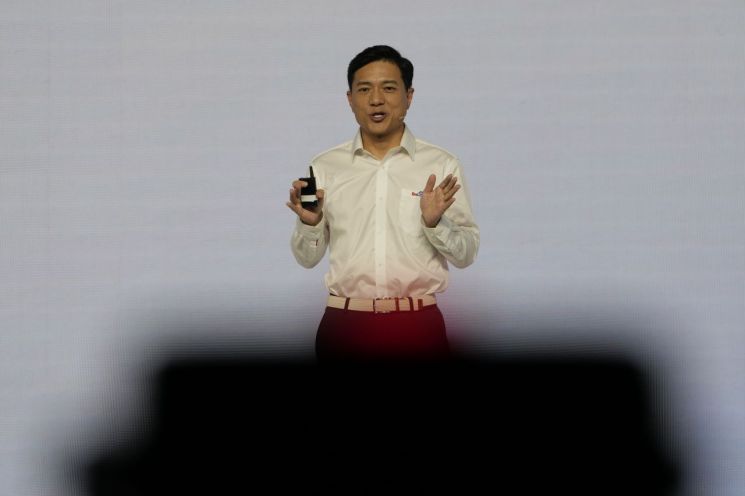
With this event, Baidu has become the first to enter the competition for the next-generation AI platform in China, alongside Alibaba, the country's largest e-commerce company, and Tencent, the largest IT company.
Baidu plans to combine Ernie Bot with its key businesses such as search, cloud computing, and autonomous vehicle software, and partner companies including automakers and news sites have announced plans to utilize Ernie Bot in their own businesses.
Macquarie forecasted in a report on the same day that if Ernie Bot is integrated with Baidu Search, Baidu could reverse its declining market share in the online advertising market.
Macquarie stated, "In the months following the launch of Ernie Bot, commercialization and monetization strategies will play a key catalytic role."
According to anonymous sources, Baidu executives internally assess that Ernie Bot has reached the level of OpenAI's ChatGPT when it was unveiled in November last year, and that it holds advantages in Chinese language and culture.
Before the launch of Ernie Bot, Baidu deployed employees under non-disclosure agreements (NDAs) for trial operations and conducted final fine-tuning work to prevent errors or inaccuracies that occurred during demonstrations of AI chatbots by Google or Microsoft (MS).
Bloomberg pointed out that Baidu and its competitors face challenges not only regarding accuracy concerns but also ensuring their AI chatbots do not violate Chinese government censorship.
In this regard, ChatGPT is currently unavailable in China, and online platforms such as Tencent's WeChat have blocked software developers who introduced ChatGPT into their own services.
Meanwhile, the US daily The Wall Street Journal (WSJ) reported that Chinese AI chatbots face a censorship wall, avoiding answers to questions related to Chinese and US politics.
WSJ tested four AI chatbots using pre-ChatGPT generation technology, including 'Gipi Talk,' developed by developers in the Shenzhen area.
As a result, when asked whether "President Xi Jinping is a great leader," these chatbots responded not with a direct answer but by saying "It cannot pass the safety assessment," then steering the conversation elsewhere, WSJ reported.
Furthermore, when asked about Chinese and US politics, all responded only with "It cannot pass the safety assessment," and these answers were attributed to Baidu, which WSJ requested confirmation from Baidu on but was declined.
WSJ added that Chinese chatbots face a censorship wall similar to internet searches, and from the Chinese authorities' perspective, the results generated by these AI chatbots could be far more complex to control than search or social media, posing a new challenge.
© The Asia Business Daily(www.asiae.co.kr). All rights reserved.
![Clutching a Stolen Dior Bag, Saying "I Hate Being Poor but Real"... The Grotesque Con of a "Human Knockoff" [Slate]](https://cwcontent.asiae.co.kr/asiaresize/183/2026021902243444107_1771435474.jpg)











