Non-permanent committees and special committees (special task forces) are pouring out within the Democratic Party of Korea. While it is inevitable for the party to activate internal committees and task forces (TFs) at the party level to criticize and check the government's policy direction and propose alternatives, there are criticisms that they are being overused in a manner of "let's just create a special committee first" whenever a specific issue arises.
Democratic Party operates 28 special committees and TFs... launched at a rate of 'once every two days'
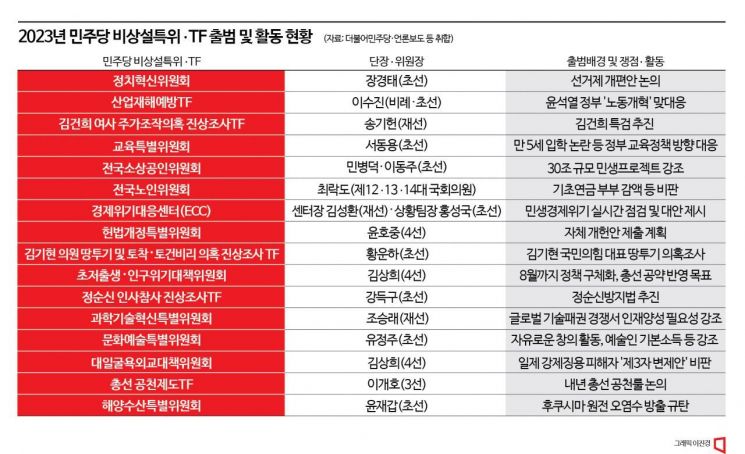
According to political circles on the 17th, the Democratic Party currently operates a total of 22 non-permanent committees (including special committees) and 6 TFs. A total of 28 committees and TFs are in operation, with 16 of them launched this year alone. Seven special committees and TFs were launched this month as well, averaging one every two days. As a result, lawmakers find it difficult to engage deeply due to overlapping activities, or in some cases, these committees cause internal party discord contrary to their initial goals, thereby increasing confusion.
The first special committee to be activated earlier this year was the Political Innovation Committee, which put "political reform" at the forefront. The Innovation Committee, composed of 16 members including 6 floor leaders and 10 advisory and expert members, was launched to prepare reform plans reflecting intra-party democracy and the will of popular sovereignty. The Innovation Committee plans to prepare reform measures related to next year's general election nominations and share and propose them to the party's supreme council. Recently, it has become controversial as it is known to be reviewing the deletion of Article 80 of the party constitution.
Article 80 of the party constitution essentially states that "party officials indicted for violations related to corruption can have their duties suspended," but it was amended last August, before Lee Jae-myung's inauguration as party leader, to allow exceptions. It recognizes exceptions by stating, "In cases where it is recognized that there are unjust reasons such as political oppression, it can be otherwise decided through a resolution of the party affairs committee." At that time, there was criticism that it was a "self-immunity" for Lee, but the Innovation Committee is now advocating for complete deletion. This is interpreted as an attempt to settle the controversy over Lee's resignation if he is indicted. Jang Kyung-tae, the Innovation Committee chairman and a pro-Lee faction member, said regarding various proposals within the Innovation Committee, "Not all proposals are necessarily discussed or decided," adding, "We plan to discuss after the nomination system is finalized."
However, another TF handling nomination rules is mainly composed of the anti-Lee faction, signaling signs that internal party conflicts over related matters may resurface. On the 14th, the Democratic Party officially launched the "General Election Nomination System TF" to set next year's general election rules, appointing Lee Gae-ho, a member of the Lee Nak-yeon faction, as the head. This was a measure to reconcile internal strife following a mass defection in the vote on the arrest warrant for Lee Jae-myung. However, since the Innovation Committee is dealing with the deletion of Article 80 of the party constitution, which likely provoked backlash from the anti-Lee faction, there are concerns that this could dampen attempts at party unity. Previously, the Innovation Committee proposed expanding the proportion of party member evaluations related to nominations but withdrew it amid concerns that it was an attempt to block nominations of anti-Lee faction lawmakers.
Proliferation of overlapping activities... weight on 'politics' over policy... launched in response to 'Lee Jae-myung's judicial risk'
Committees formed to monitor and propose alternatives for the people's livelihood economy also largely overlap. At the end of last month, the Democratic Party launched the Economic Crisis Response Center (ECC), criticizing the Yoon Seok-yeol government's complacent economic awareness. The representative office even installed a situation board that "can only be seen in securities analysts' rooms (Rep. Kim Byung-wook)" to monitor and prepare responses to the economic crisis. However, the party already operates the People's Livelihood Economic Crisis Countermeasure Committee chaired by Rep. Kim Tae-nyeon. Rep. Hong Sung-guk, the secretary of the People's Livelihood Economic Crisis Countermeasure Committee, also serves as the head of the Economic Crisis Response Center.
There are cases where chairpersons overlap. Rep. Kim Sang-hee chairs both the Ultra-Low Birthrate and Population Crisis Countermeasure Committee and the Anti-Japan Humiliation Diplomacy Countermeasure Committee.
The problem is that these special committees often do not lead to legislative activities. They are frequently launched as one-off responses to issues and then fade away. They tend to be formed centered on 'politics' rather than policy, raising concerns that they only fuel political strife. In fact, since February, when Lee Jae-myung's judicial risks began to intensify, the launch of special committees and TFs within the Democratic Party has become more frequent.
After the prosecution notified Lee to appear regarding the Daejang-dong suspicion, the party strengthened its confrontational stance. The "Kim Kun-hee Stock Price Manipulation Suspicion Investigation TF," launched on February 1, was also formed as a countermeasure against the government. The Kim Kun-hee TF demanded a "Kim Kun-hee special prosecutor," and the Democratic Party is currently pushing for a dual special prosecutor investigation along with the Daejang-dong 5 billion club special prosecutor in March.
The two TFs launched afterward were both aimed at the People Power Party. On the 26th of last month, the Kim Ki-hyun Land Speculation and Local Construction Corruption Suspicion Investigation TF was formed, and on the 7th of this month, the Jeong Soon-shin Personnel Disaster Investigation TF was established to criticize the school violence issue involving the son of Jeong Soon-shin, who was appointed and then dismissed as head of the National Investigation Headquarters.
Among the five TFs launched this year, three are for criticizing the government and ruling party. Following the recent announcement of the "third-party compensation plan" for forced labor victims during the Japanese colonial period, criticism poured in, leading to the creation of the Anti-Japan Humiliation Diplomacy Countermeasure Committee. On the 16th, the Maritime and Fisheries Special Committee was also activated to condemn Japan's discharge of contaminated water from the Fukushima nuclear power plant. The Democratic Party already has the History and Justice Special Committee, which has dealt with forced labor and past issues since 2018, as well as the Peace and Security Countermeasure Committee. A Democratic Party official said, "Even individual lawmakers sometimes get confused about which special committees they belong to," adding, "It should be a special committee that genuinely produces sincere policies, not just a showy special committee."
© The Asia Business Daily(www.asiae.co.kr). All rights reserved.

















