Grandson of Jeon Du-hwan Raises Suspicion of Jeon Du-hwan Family's Slush Fund
Died Without Paying Forfeiture... Difficult to Recover Funds
The controversy continues as Jeon Woo-won, the grandson of former President Jeon Du-hwan, exposes the corruption of the Jeon Du-hwan family. Jeon raised suspicions that his family is using 'black money' of unclear origin. Since the former president died without paying over 90 billion won in fines, the focus is on the 'illegal slush funds.'
Recently, Jeon has been posting videos and photos on various social networking services (SNS) such as Instagram, Twitter, and YouTube, continuing to reveal the Jeon Du-hwan family's corruption. Contrary to the former president's claim that his total assets were only 290,000 won, Jeon stated that they lived a luxurious lifestyle and claimed that there is slush money inside the Jeon Du-hwan and his wife Lee Soon-ja’s residence in Yeonhui-dong, Seodaemun-gu, Seoul.
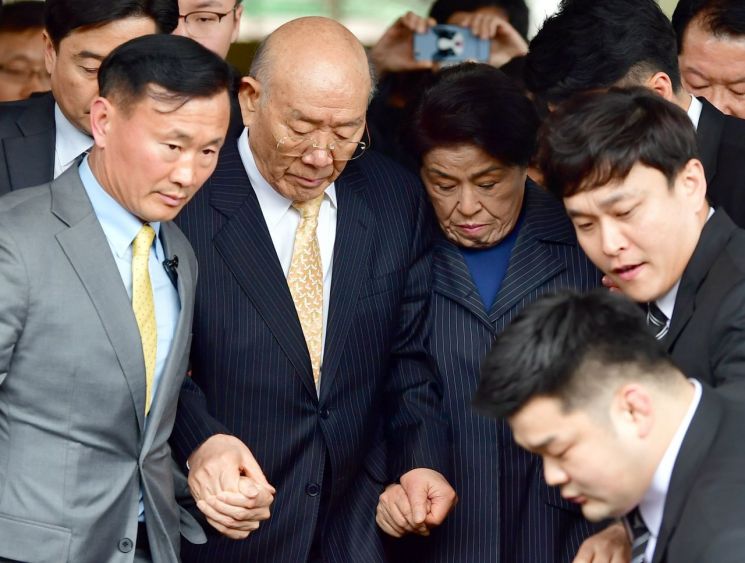 On March 11, 2019, former President Jeon Du-hwan is seen leaving the courthouse after attending a criminal trial related to the May 18 Democratic Movement at the Gwangju District Court. Photo by Yonhap News
Earlier on the 13th, he criticized his grandfather, former President Jeon, calling him a 'mass murderer' and saying, "He is not a hero who protected the country but merely a criminal." Regarding Jeon Jae-yong, the former president’s second son and Jeon Woo-won’s father, he said, "He calls himself a preacher but is engaged in fraudulent activities," and asked, "Please help so that the slush funds hidden in the U.S. cannot be used to pretend to be good on the surface while continuing to do devilish deeds behind the scenes."
Jeon continued with further revelations. On the 15th, he posted on his SNS a photo of two children lying side by side on a bed with the former president and said, "My father and stepmother (Park Sang-ah) live using black money of unknown origin." He also disclosed that there is a screen golf facility inside the Jeon Du-hwan residence in Yeonhui-dong, Seodaemun-gu, Seoul.
Jeon questioned the former president’s claim that he only had 290,000 won during his lifetime. The former president died in November 2021 without paying over 90 billion won in fines. In April 2003, during a trial, he claimed his total assets were 290,000 won, effectively refusing to pay the fines. The prosecution recovered an additional 2 billion won in unpaid fines after his death last November, and the remaining unpaid fines amount to 92.5 billion won.
Jeon said, "Since I was young, we rented luxury hotels for several days and had full-course meals, and the entire family, sometimes several dozen people, went on family trips. We went on family trips every year until I was in middle school." He added, "I cannot understand how people who claimed to have only 290,000 won in total assets could have done that." He also said, "According to my mother, there is a hidden safe somewhere in the Yeonhui-dong residence."
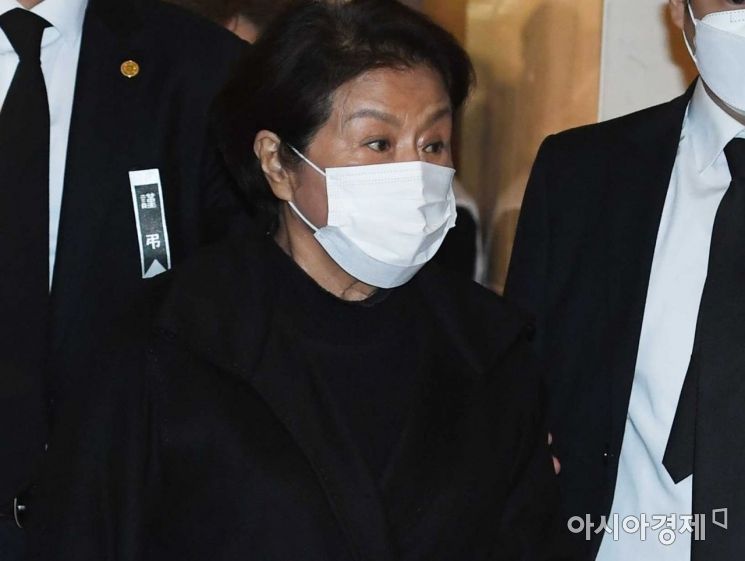 On the afternoon of November 23, 2021, Lee Soon-ja, the wife of the late former President Jeon Du-hwan, is entering the funeral hall at Severance Hospital Sinchon Funeral Home in Seodaemun-gu, Seoul. Photo by Kang Jin-hyung aymsdream@
Jeon claimed that although he received tuition support from Lee Soon-ja, the former president’s wife, the money was sent through a third party’s account due to the former president’s fine issues. He said, "When grandmother (Lee Soon-ja) supported my tuition, she used the account of a housekeeper working at the Yeonhui-dong residence to send the money," and "My mother (Choi Jeong-ae) divorced my father and received alimony, but she could not withdraw it from the bank and could only receive it through acquaintances."
Jeon has stated that he will disclose all accounts for investigation purposes, but even if slush funds are found, recovering the unpaid fines is difficult. Under current law, the enforcement of unpaid fines stops when the liable person dies.
In July last year, the Supreme Court ruled that the annex of the Yeonhui-dong residence was rightfully seized as illegal property, but also stated, "The enforcement of property penalties such as confiscation or fines is generally carried out against the convicted person, so if the convicted person dies, enforcement cannot be carried out unless there are special provisions."
In the National Assembly, the 'Jeon Du-hwan Property Recovery Act 3 Laws,' which would allow property recovery even if the liable person is deceased, was proposed in 2020 but remains pending in the Legislation and Judiciary Committee.
On the 15th, Yoo Ki-hong, a Democratic Party lawmaker who was the main proposer of the 'Jeon Du-hwan Property Recovery Act 3 Laws,' urged on his Facebook, "Although it was once submitted to the subcommittee of the Judiciary Committee, it is still pending due to opposition from the Court Administration Office and some lawmakers, and the Special Act on Forfeiture of Public Officials' Crimes has not been reviewed even once. The National Assembly Judiciary Committee must promptly review and pass the 'Jeon Du-hwan Property Recovery Act 3 Laws' pending in the subcommittee to recover the 'black money' used by the Jeon Du-hwan family."
© The Asia Business Daily(www.asiae.co.kr). All rights reserved.
![Clutching a Stolen Dior Bag, Saying "I Hate Being Poor but Real"... The Grotesque Con of a "Human Knockoff" [Slate]](https://cwcontent.asiae.co.kr/asiaresize/183/2026021902243444107_1771435474.jpg)












