Limiting from 'Financial Companies or Employees' to 'Financial Companies' Only
Establishing Fine Grounds by Obligation and Action
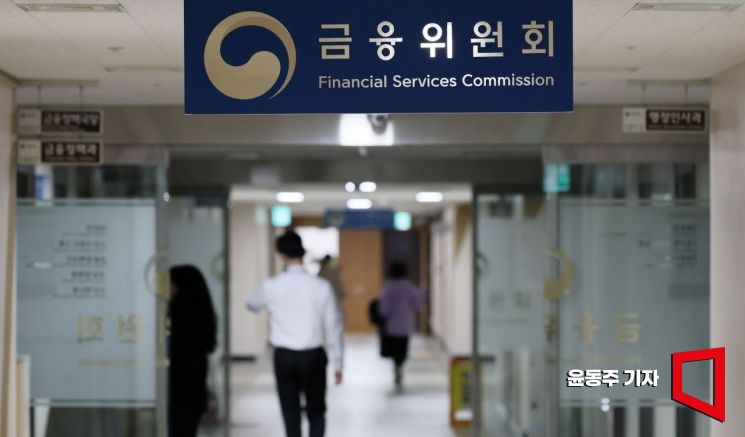 On the 9th, officials were busy moving in the corridor of the Financial Services Commission at the Government Seoul Office in Jongno-gu, Seoul, where financial authorities decided to promote a plan to include mortgage loans (Judaemae) in the 'debt refinancing' infrastructure scheduled to be launched in May by the end of the year. Financial authorities explained that the purpose is to reduce the interest burden on mortgage loans by building a debt refinancing platform that allows users to compare financial sector loan interest rates at a glance and switch loans easily. Photo by Yoon Dong-joo doso7@
On the 16th, the Financial Services Commission announced that going forward, when banks impose fines, the target will be uniformly adjusted from 'employees of financial companies' to 'financial companies' themselves.
Currently, the Bank Act and the Real Name Financial Transactions Act stipulate that fines for administrative duty violations can be imposed on 'financial companies or their employees.' However, there has been an issue where fines are imposed on employees even when the legal obligation is on the financial company. To resolve this issue, fines will henceforth be uniformly imposed on financial companies.
The basis for fines will also be specified. Some laws have imposed fines through broad provisions without detailing specific acts or legal clauses related to fines. To enhance predictability and reliability in law enforcement, these broad fine provisions will be removed. Instead, fine bases will be established according to each obligation and act.
The criteria for fine amounts will also be revised. Some enforcement ordinances have set base amounts that are excessively low compared to the statutory maximum fines, causing inconsistencies with the intent of higher laws. Since the law sets maximum fines considering the severity of violations, the enforcement ordinances will adjust the base amounts to at least 30% in line with this intent.
To ensure consistent standards when calculating the number of violation cases for fines, standards and examples for each violation type will be presented based on analysis of past cases. Additionally, measures to initially provide opportunities for improvement for simple and minor violations will be considered.
© The Asia Business Daily(www.asiae.co.kr). All rights reserved.
![Clutching a Stolen Dior Bag, Saying "I Hate Being Poor but Real"... The Grotesque Con of a "Human Knockoff" [Slate]](https://cwcontent.asiae.co.kr/asiaresize/183/2026021902243444107_1771435474.jpg)
















