Joint Korea-Japan Press Conference Held on the 16th
Attention on the Level of Apology Expression
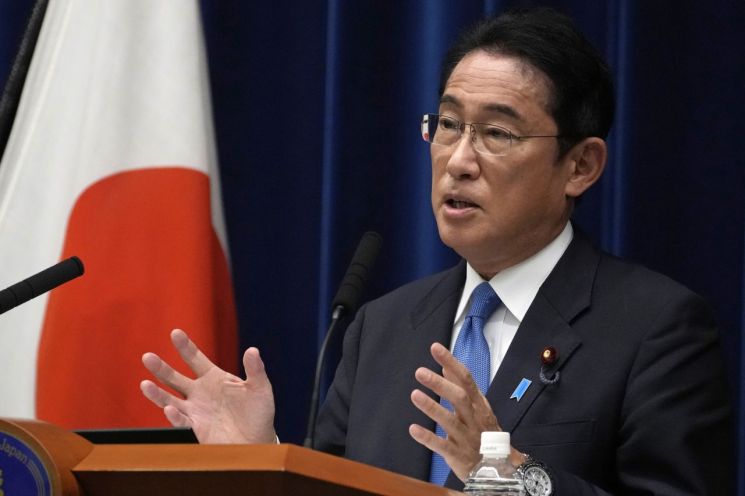
On the afternoon of the 16th, attention is focused on the “words” of Japanese Prime Minister Kishida Fumio, who will hold a joint press conference with President Yoon Suk-yeol. Since President Yoon proposed “third-party compensation,” where Korean companies’ donations would be used to compensate forced labor victims, as a solution to the forced labor issue and firmly stated that no claims for reimbursement would be made, having conceded a significant portion to Japan, the key question is whether Japan will take corresponding measures.
On that day, the two countries agreed to hold a joint press conference after the summit without a separate “joint declaration.” The absence of a joint declaration means that Japan will not provide a documented position on forced mobilization and related issues. Therefore, the level of apology expressed through Prime Minister Kishida’s remarks is expected to be a “gauge” for the restoration of relations through this Korea-Japan summit. Earlier, on the 6th, Prime Minister Kishida briefly stated regarding the solution proactively announced by our government, “We will comprehensively inherit the awareness of past cabinets.”
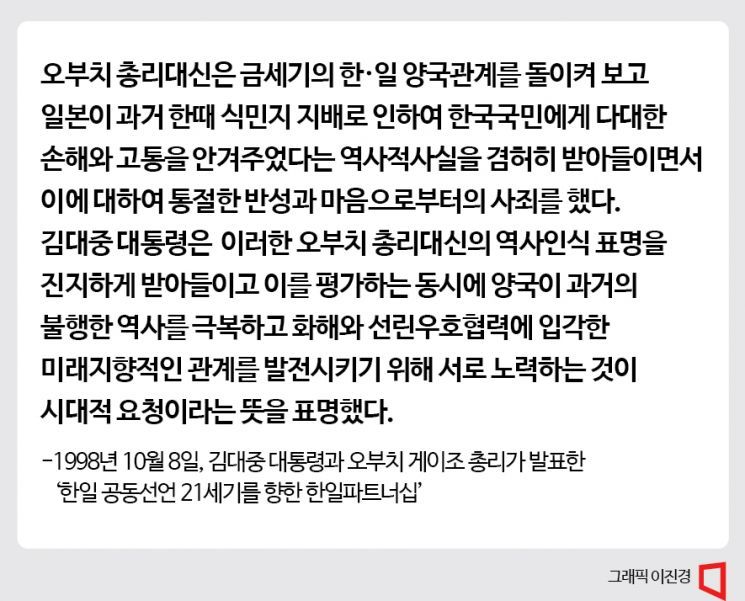
If at the joint press conference the apology is replaced by merely inheriting the statements of past governments, it may be seen as an insufficient response from our perspective. This is because it could be interpreted not as “apologizing now” but as merely reaffirming that “past governments apologized.” In fact, the “Joint Declaration on a New Korea-Japan Partnership for the 21st Century (1998)” between President Kim Dae-jung and Prime Minister Obuchi Keizo and Prime Minister Murayama Tomiichi’s “50th Anniversary Statement on the Postwar Period (1995)” contained very clear expressions of apology, but Japan’s recognition of its past history has not significantly changed since then.
Professor Hosaka Yuji of Sejong University said, “There is a considerable difference between expressing inheritance of past statements and offering a new apology in terms of ‘sincere responsive measures.’” Researcher Choi Eun-mi of the Asan Institute for Policy Studies also said, “If it remains at the level of inheritance without a new apology, there should be explicit expressions specifying which past statement and which expressions are being inherited.”
It is also noteworthy whether Prime Minister Kishida will mention other issues such as the UNESCO World Heritage registration of Sado Mine and the discharge of contaminated water from the Fukushima nuclear power plant. It is important to see whether Prime Minister Kishida will take a somewhat progressive stance on sensitive bilateral issues in the future, such as visits to Yasukuni Shrine or territorial claims over Dokdo.
The problem lies in the domestic political situation faced by Prime Minister Kishida. Since the death of former Prime Minister Abe Shinzo and issues related to the Unification Church, the stability of the Liberal Democratic Party’s long-term rule has significantly weakened, and Kishida’s political base within the party is weak. His approval rating is also low, around 30%. Considering the support of conservative right-wing forces in Japan, there are expectations that even if an apology is made, it will be toned down. In fact, since the formation of his cabinet in 2021, Prime Minister Kishida has consistently maintained a tough stance on the forced labor issue from the Japanese side.
Meanwhile, POSCO officially announced the donation of 4 billion won to the Foundation for Victims of Forced Mobilization by Japan the day before. This payment of 4 billion won is part of the 10 billion won that POSCO had agreed to contribute when the foundation was launched in 2014 but had delayed paying until now. The foundation plans to compensate victims by receiving donations from companies, including POSCO, that benefited from the 1965 Korea-Japan Claims Agreement. This is in accordance with the government’s third-party compensation solution.
© The Asia Business Daily(www.asiae.co.kr). All rights reserved.
![Clutching a Stolen Dior Bag, Saying "I Hate Being Poor but Real"... The Grotesque Con of a "Human Knockoff" [Slate]](https://cwcontent.asiae.co.kr/asiaresize/183/2026021902243444107_1771435474.jpg)

















