"Only Student Rights Highlighted" vs "Regulation and Corporal Punishment May Return"
Efforts to Repeal or Amend Student Rights Ordinances Underway in Jeonbuk and Chungnam
Are teachers' rights and students' rights conflicting values? Such a debate is taking place over the Student Human Rights Ordinance.
Recently, the Seoul Metropolitan Council proposed an ordinance to abolish the Seoul Student Human Rights Ordinance, which provides the basis for protecting student rights. This move came amid criticism that teachers' rights are being excessively restricted as only student rights are emphasized. Similar efforts to abolish or amend student human rights ordinances are underway in Jeonbuk and Chungnam for similar reasons.
The background of these claims includes recent cases of violence against teachers and sexual harassment in teacher evaluations, among other incidents of declining teachers' rights. In December last year, Teacher A, working at a middle school in Gunsan, Jeonbuk, filed a complaint with the police after being assaulted by a student and diagnosed with injuries requiring two weeks of treatment. However, the student claimed that A only responded after A grabbed the student's collar and verbally abused them.
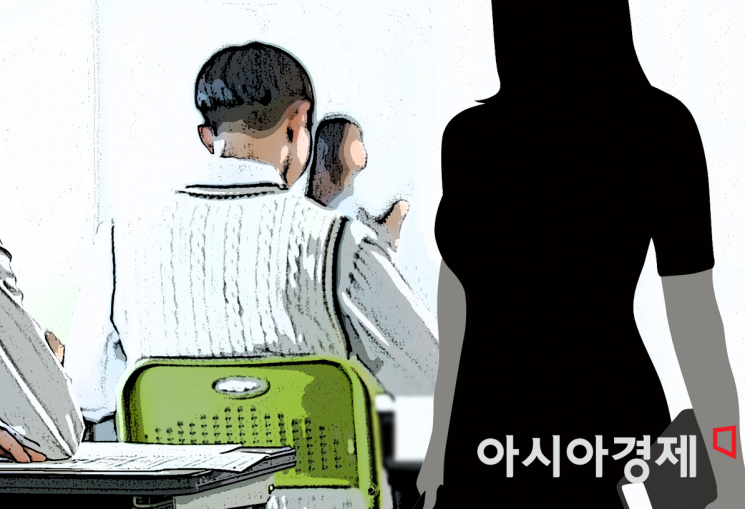
In November last year, an incident occurred where B, a third-grade student at an elementary school in Gunwi County, Gyeongbuk, punched his 40-year-old homeroom teacher in the face. The homeroom teacher had reprimanded B for hitting a classmate during gym class due to dissatisfaction with the game results, and B protested, saying, "Why don't you take my side?" before punching the teacher.
There have also been repeated cases of anonymous personal attacks and sexual harassment against teachers exploiting the anonymity of the descriptive section in the Teacher Competency Development Evaluation. Such incidents occurred last month at a high school in Chungju, Chungbuk, and in November last year at a high school in Sejong City.
In response, the education sector has pointed out the problem of declining teachers' rights. Basic disciplinary actions, such as telling students who are talking during class to stand at the back or waking up sleeping students, have become impossible. While not necessarily calling for the abolition of the Student Human Rights Ordinance, there is a consensus that measures are needed to prevent teachers' rights from falling below a critical threshold.
The Student Human Rights Ordinance was enacted successively starting with Gyeonggi in 2010, followed by Gwangju, Seoul, Jeonbuk, and Chungnam. It includes rights such as freedom from discrimination based on gender, age, religion, or gender identity; the right to be free from violence; and the right to privacy and self-expression. The ordinance has been positively evaluated for changing school malpractices such as corporal punishment and regulations on hair and clothing.
However, those advocating for the abolition of the Student Human Rights Ordinance seek to restore teachers' rights by abolishing the ordinance. They argue that the ordinance emphasizes student rights to the extent that teachers' rights are excessively restricted.
The 'Seoul Citizens' Coalition for the Abolition of the Seoul Student Human Rights Ordinance,' composed of religious groups and parent organizations, submitted a petition to the city council last August, claiming that the ordinance infringes on constitutionally guaranteed freedoms of expression and religion, as well as parental educational rights. The city council accepted this petition last month.
If the ordinance abolition bill, referred to the Education Committee on the 15th, passes the review and is approved at the city council plenary session, the Seoul Student Human Rights Ordinance will be abolished. Depending on the speed of the process, this could be finalized within this year.
Opponents of abolishing the Student Human Rights Ordinance argue that teachers' rights and student rights are not conflicting and call the move a "retreat of democracy." They fear that if the ordinance is abolished, excessive regulation and corporal punishment of students will become rampant again, returning to the past.
There are also concerns that discrimination against minorities in classrooms will not be prevented. In a letter sent to the Korean government in January, the UN Human Rights Council's Special Procedures stated, "The movement to abolish the Student Human Rights Ordinance weakens protections against discrimination based on sexual orientation and gender identity, violates international human rights standards and principles of non-discrimination," and warned, "Especially, the abolition of the Seoul Student Human Rights Ordinance could open the door to abolishing other human rights ordinances, which is alarming."
© The Asia Business Daily(www.asiae.co.kr). All rights reserved.

![A Woman with 50 Million Won Debt Clutches a Stolen Dior Bag and Jumps... A Monster Is Born [Slate]](https://cwcontent.asiae.co.kr/asiaresize/183/2026021902243444107_1771435474.jpg)















