Power Companies Request Household Rate Hikes... Government Rejects
Electricity Price Surge Hits Universities... Supplementary Budget Planned
As major electric power companies in Japan simultaneously raise electricity rates, controversy over electricity bill shocks is spreading. Public facilities such as universities across the country are experiencing operational difficulties due to soaring electricity costs, and it is reported that Tokyo University of the Arts, one of the prestigious universities, even sold pianos. Dissatisfaction is further intensifying as news emerges that electricity rates for households may also increase.
On the 16th, NHK reported that seven out of ten major electric power companies in Japan applied to the government for a 28-46% increase in regulated electricity rates, but the Ministry of Economy, Trade and Industry (METI) rejected the applications, asking them to be resubmitted with reduced increases. In privatized Japan, electricity rates are divided into regulated and free rates; regulated rates, mainly applicable to households, require government approval for any increase to protect consumers.
Due to METI's rejection, there is currently no prospect of electricity rate hikes until April, but public opinion continues to worsen. Earlier, when power companies implemented a price increase in January, the hashtag "electricity bill is too expensive" trended in real-time search rankings on social networking services (SNS).
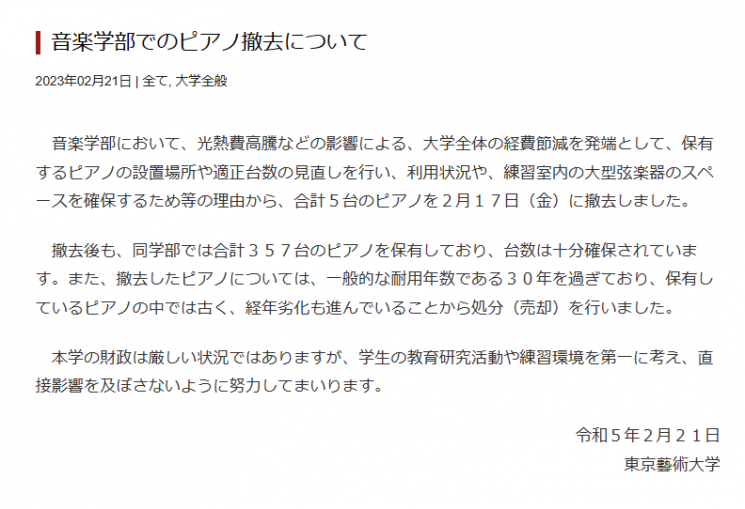 Notice Regarding the Discontinuation of the Piano Department at Tokyo University of the Arts. Although financial difficulties exist, efforts will be made to ensure that students are not affected. (Photo by Tokyo University of the Arts official website)
Public facilities such as universities have already been hit hard in their operations. At Tokyo University of the Arts, which has produced many artists and has a long history, reduced government subsidies combined with soaring electricity costs led to the sale of practice room pianos. A representative from Tokyo University of the Arts stated, "Due to the sharp rise in electricity rates, electricity expenses have increased by 237 million yen (approximately 2.35 billion KRW) beyond the budget." To cut costs, heating is not used, and blankets and hand warmers are distributed during research presentations, indicating the severity of the situation.
Other universities face similar circumstances. Osaka University has shortened library operating hours since December last year. Nagoya University has temporarily suspended the operation of its supercomputer, which consumes a large amount of electricity. In response, the Ministry of Education, Culture, Sports, Science and Technology has allocated an additional budget of 5 billion yen (approximately 49.6 billion KRW) to cope with the electricity price surge, but the problem does not seem easily resolved.
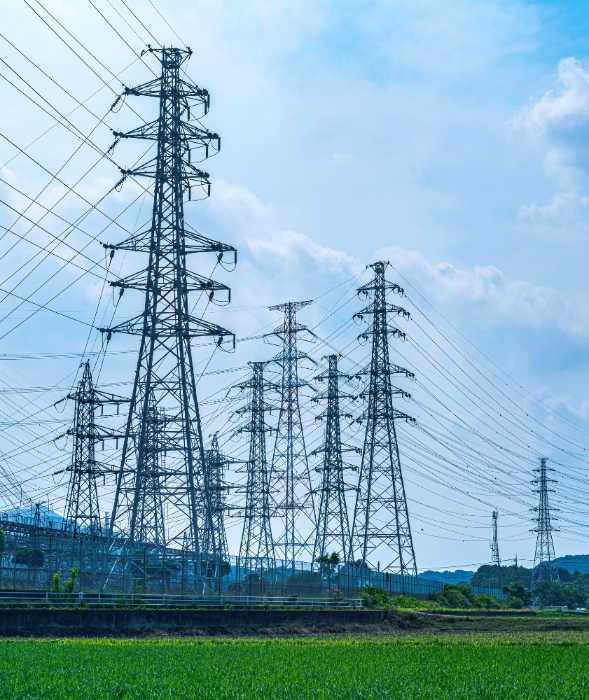
Electric power companies argue that electricity rates must be raised due to the sharp rise in LNG gas and oil prices used in thermal power generation, caused by Russia's invasion of Ukraine and the weak yen. In fact, Japan's natural gas import price in December last year was 2.5 times higher than in December 2019, and coal prices increased fivefold. The problem is that for regulated rates, companies cannot arbitrarily raise prices, so they cannot reflect fuel price increases in electricity rates. Tokyo Electric Power Company (TEPCO) has been running deficits since September last year due to soaring fuel costs, and Hokkaido Electric Power is also expected to face a deficit for the first time in nine years.
As a result, voices calling for the restart of nuclear power plants are emerging again in Japan, which experienced the pain of the Fukushima nuclear accident. Kansai Electric Power and Kyushu Electric Power, which have relatively higher proportions of nuclear power compared to other regions, did not join this round of price hikes because their thermal power generation ratios are low. Professor Hidetomi Tanaka of Jobu University stated, "One of the causes of this electricity rate increase is the delay in restarting nuclear power plants," adding, "Excessive reliance on renewable energy is not advisable. Efforts should be focused on restarting nuclear power plants."
© The Asia Business Daily(www.asiae.co.kr). All rights reserved.


















