AI for Writing Emails Released... 85% Accuracy Medical AI Too
ChatGPT Concerns..."AI Integrated into All Products"
[Asia Economy Reporter Oh Su-yeon] As OpenAI announced the super-large artificial intelligence (AI) 'GPT-4', Google is struggling to catch up with Microsoft. By unveiling a large number of products equipped with the latest generative AI (AI that creates new content by learning from existing data) technology, Google has begun expanding its super-large AI ecosystem.
On the 14th (local time), Google Cloud unveiled generative AI features provided in Google Workspace.
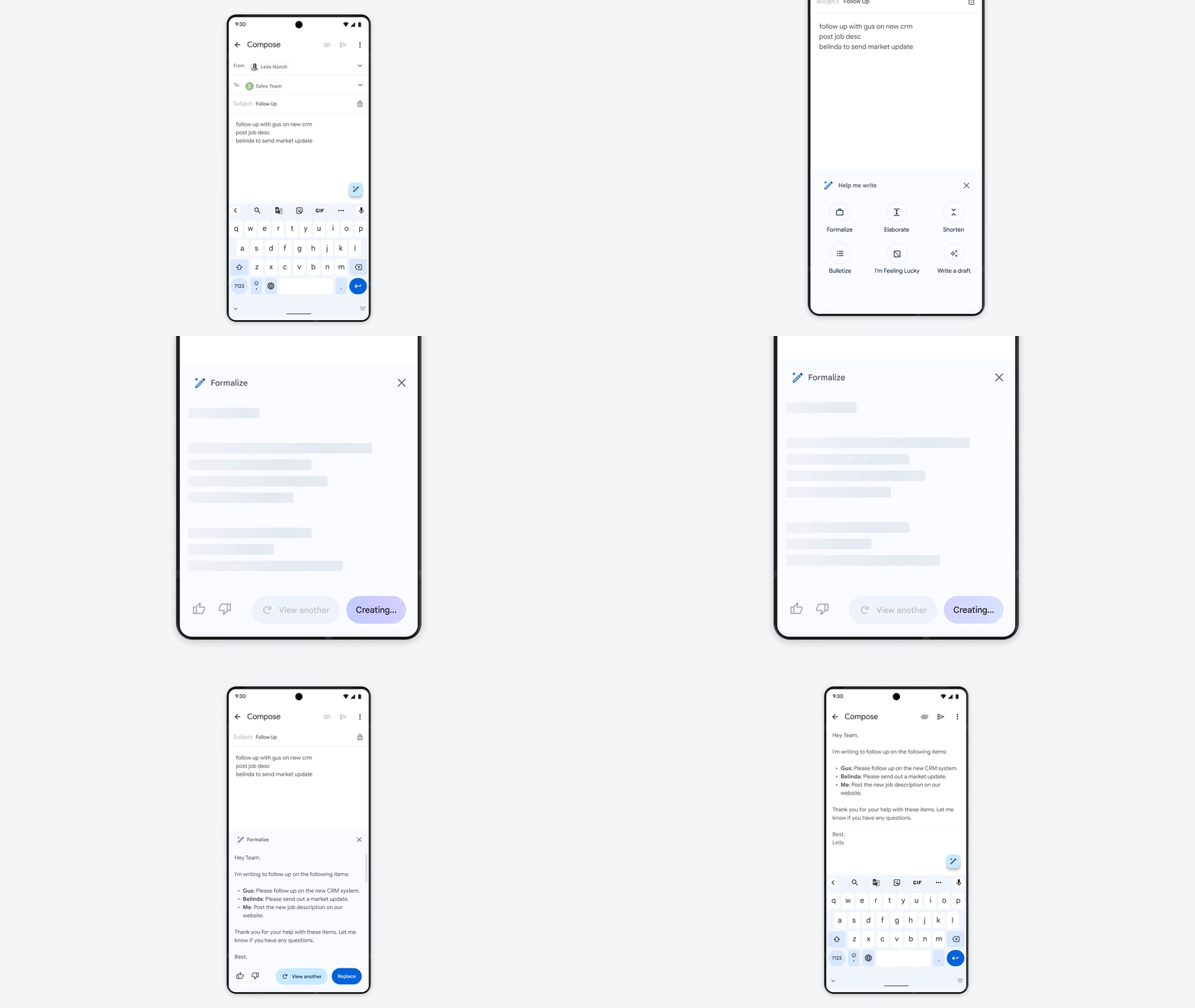
Also, Google Workspace offers writing assistance features using generative AI. When you enter a desired topic, a draft is immediately generated. By editing the draft to complete the email, the time spent on writing is reduced. For example, when a recruiter writes a welcome email for new employees in Workspace, using generative AI allows them to make the email content more detailed or concise with just a click, and they can also change the tone to be more fun or professional.
Google also unveiled the product 'Generative AI App Builder' that enables developers and companies to build generative AI easily and quickly. The machine learning tool platform 'Vertex AI' also supports generative AI. It plans to provide a new foundational model capable of generating text and images, and will expand the generation scope to audio and video in the future.
Furthermore, Google released the 'PaLM API', which allows easy utilization of Google's large language models in various fields such as content creation or chatbot development. This is the application programming interface (API) for PaLM, the super-large model launched by Google in April last year, enabling developers to enter the Google AI ecosystem by using it. To make adapting to the PaLM API easier, Google also launched MakerSuite. MakerSuite allows the creation of sample codes to provide to developers.
At the 'The Check Up' event held that day, Google also introduced the medical large language model 'Med-PaLM'. Med-PaLM is the first AI to achieve over 60% accuracy on multiple-choice questions similar to those used in the US medical licensing exam. The second version, Med-PaLM 2, was unveiled this time, and Google stated that it consistently demonstrated expert-level performance with over 85% accuracy on health screening questions. CNBC reported that in some cases, Med-PaLM 2's answers were more detailed than those of clinicians, but in other cases, they were inaccurate.
Google's aggressive move into generative AI stems from a sense of crisis over ChatGPT. As OpenAI's ChatGPT, invested in by Microsoft, caused a worldwide sensation, Google hurriedly released the generative AI 'Bard' based on the super-large language model LaMDA on the 6th of last month. However, Bard gave incorrect answers during demonstrations, causing Google embarrassment. This even led to a drop in Google's stock price.
Google is determined and is putting effort into generative AI. Bloomberg recently reported that Google has created guidelines requiring all major products to include generative AI. Neil Mohan, CEO of YouTube, also announced earlier this month that AI features will be added to YouTube. The overseas IT media Nine to Five Google reported last month that Google is preparing to introduce Bard-powered conversational search features in the Chrome web browser.
© The Asia Business Daily(www.asiae.co.kr). All rights reserved.
![Clutching a Stolen Dior Bag, Saying "I Hate Being Poor but Real"... The Grotesque Con of a "Human Knockoff" [Slate]](https://cwcontent.asiae.co.kr/asiaresize/183/2026021902243444107_1771435474.jpg)

















