"Smartphone Payment Also Takes a Long Time"
Reflecting the Characteristic of Evaluating Efficiency Over Time
Even in Japan, known as a "cash society," payment methods are changing, especially among Generation Z. Japanese Gen Z has moved beyond using credit cards or smartphone payments instead of cash, and has started using instant payments such as 'Face Pay,' which uses facial recognition, and wearable devices like rings for immediate payment. With the emergence of a 'cashless' Gen Z even in cash-kingdom Japan, Japanese media are paying attention to whether this will bring changes to the financial system.
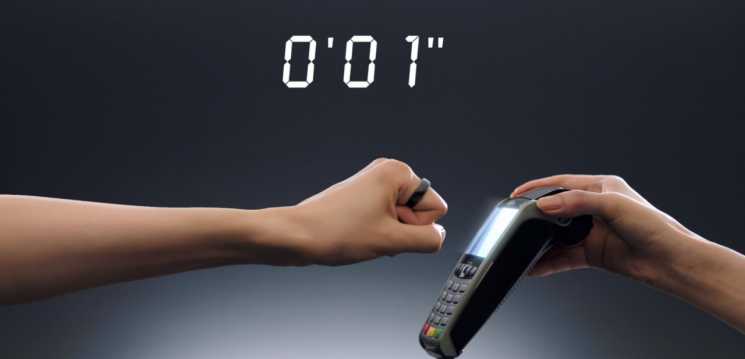
On the 15th, Nihon Keizai Shimbun (Nikkei) reported that biometric authentication payments and wearable payment terminals, known as "1-second payments," have recently become popular among Gen Z. Nikkei analyzed that Gen Z considers the process of entering passwords when using cards or smartphone payments as time-consuming, and thus they have become enthusiastic about instant payment systems that can save even that time.
Among Japanese Gen Z, it is becoming a trend not to carry cash. According to a survey by the Ministry of Economy, Trade and Industry, 26% of people in their teens and twenties answered that they "do not carry cash at all in daily life," the highest rate among age groups. The proportion of people not carrying cash was inversely proportional to age: 17% in their thirties, 14% in their forties, 10% in their fifties, and 5% in their sixties.
In line with this trend, there have been cases where schools have introduced such systems. According to Nikkei, a middle school store in Aichi Prefecture has had a facial recognition payment system since 2022. Most responses have been positive, noting the convenience of being able to pay without carrying cash or cards. Currently, about 600 students and staff freely purchase snacks by simply showing their faces to a camera.
Wearable payment terminals with automatic payment are also gaining great popularity. The trending device is a ring-type terminal. Wearing a ring-shaped terminal called a "smart ring," users just need to bring it close to a card reader to pay. The company advertised that "it takes 25 seconds to take a card out of a wallet, 10 seconds to present the card, and 5 seconds for smartphone payment, but with this ring, payment can be completed in just 1 second," which has boosted its popularity. As word of convenience spread, sales of the device have recently increased significantly. The COO of the selling company, Evering, stated, "From October to December last year, sales of the terminals increased by 40% compared to July to September of the same year."
Nikkei analyzed that this phenomenon is due to the young generation's emphasis on efficiency relative to time. According to a 2021 survey conducted by Merpay, a subsidiary of the Japanese e-commerce company Mercari, one in four people in their twenties and thirties answered that they have a "Taipa" tendency to complete purchases of items under 3,000 yen (about 29,000 won) within 5 minutes. "Taipa" is an abbreviation of "time performance," meaning minimizing the time spent on activities to use time efficiently.
Nikkei added, "Gen Z thinks even the time spent entering passwords for smartphone payments should be reduced," and "As payment methods evolve, smartphone operators must also redevelop services and reset strategies to survive."
© The Asia Business Daily(www.asiae.co.kr). All rights reserved.
![Clutching a Stolen Dior Bag, Saying "I Hate Being Poor but Real"... The Grotesque Con of a "Human Knockoff" [Slate]](https://cwcontent.asiae.co.kr/asiaresize/183/2026021902243444107_1771435474.jpg)
















