Statistics Korea Announces 'February Employment Trends'
Employment Decreases by 125,000 for Ages 15-29
Employment Increases by 413,000 for Ages 60 and Over
"Possibility of Base Effects and Frictional Unemployment"
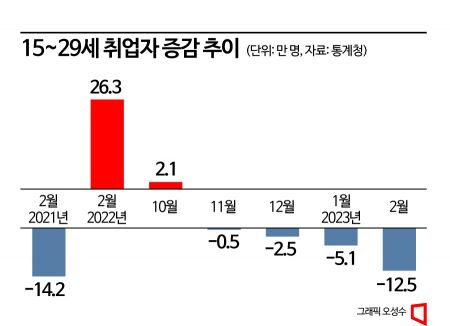
The number of new employed individuals aged 15-29 decreased at the largest rate in two years. Amid worsening economic conditions and a slowdown in employment growth for nine consecutive months, youth employment difficulties are intensifying.
According to the 'February Employment Trends' released by Statistics Korea on the 15th, the number of employed youth aged 15-29 was 3,853,000, down by 125,000 compared to the previous year. This is the largest decrease since February 2021, when the number fell by 142,000. The decline has continued for four consecutive months.
The youth employment rate was 45.5%, the lowest in 1 year and 2 months since December 2021's 45.1%. The unemployment rate rose by 0.1 percentage points year-on-year to 7.0%.
Seo Woon-ju, Director of the Social Statistics Bureau at Statistics Korea, explained, "The number of unemployed people and the unemployment rate among those in their 20s and 30s have increased, but there is a base effect because employment was very high and unemployment was low in February last year." He added, "We need to observe the trend a bit more, but there may be frictional unemployment and waiting unemployment due to more experienced hires than new hires." This means that employment decreased and unemployment increased during the process of preparing for job changes.
There is also an analysis that more young people who were balancing work and studies have quit their jobs to return to school. Director Seo also stated, "Many young people who were engaged in delivery work such as retail and wholesale or transportation and warehousing have left, and the scale of this decrease had an impact."
By age group, the number of employed people aged 60 and over increased by 413,000 compared to the same month last year, the highest among all age groups. Employment among those in their 50s and 30s also increased by 77,000 and 24,000 respectively. However, those in their 20s and 40s decreased by 94,000 and 77,000 respectively.
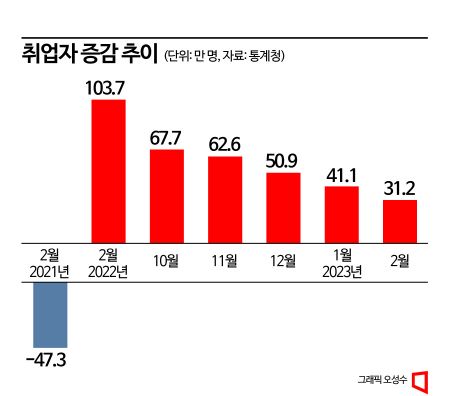
The total number of employed people aged 15 and over was 27,714,000, an increase of 312,000 (1.1%) compared to the same month last year. The increase in employment peaked at 935,000 in May last year, then slowed to 841,000 in June, and has decreased for nine consecutive months. The employment rate rose by 0.5 percentage points year-on-year to 61.1%.
By industry, the number of employed in manufacturing decreased by 27,000 compared to the same month last year. This marks a decline for two consecutive months following January (-35,000). Statistics Korea attributed this to the downturn in the semiconductor industry. Wholesale and retail trade (-76,000, -2.3%), agriculture, forestry and fisheries (-44,000, -3.5%), and transportation and warehousing (-44,000, -2.6%) also recorded decreases. On the other hand, health and social welfare services (192,000, 7.3%), accommodation and food services (176,000, 8.4%), and information and communication (43,000, 4.5%) sectors saw increases.
The number of unemployed was 890,000, down by 64,000 (-6.7%) compared to the same month last year. The most significant improvement was among those aged 60 and over, decreasing from 243,000 to 180,000, a reduction of 63,000. The unemployment rate fell by 0.3 percentage points to 3.1%.
The economically inactive population was 16,751,000, down by 106,000 (-0.6%) compared to the same month last year. Those preparing for employment also decreased by 120,000 (-14.9%) to 685,000.
© The Asia Business Daily(www.asiae.co.kr). All rights reserved.
![Clutching a Stolen Dior Bag, Saying "I Hate Being Poor but Real"... The Grotesque Con of a "Human Knockoff" [Slate]](https://cwcontent.asiae.co.kr/asiaresize/183/2026021902243444107_1771435474.jpg)

















