5x Reduction in Stenosis and 2.5x Increase in Blood Flow in Animal Experiments
A domestic research team has developed a dialysis vascular creation device that prevents complications from hemodialysis.

On the 15th, the research team led by Professor Seong Hakjun, Lecturer Ha Hyunsoo, and Researcher Lee Chanhee from the Department of Medical Engineering at Yonsei University College of Medicine announced that they have developed a vascular scaffold that can prevent vascular stenosis during dialysis vascular creation surgery for patients with end-stage renal disease.
The blood volume for hemodialysis in patients with end-stage renal disease is about 200 ml per minute. Since the blood vessels cannot withstand such a large volume, arteriovenous fistula creation surgery is performed, which artificially connects arteries and veins in the wrist or elbow to widen the blood vessels. However, stenosis frequently occurs in the artificially created dialysis vessels because the veins cannot withstand the high pressure of the fast and strong arterial blood flow.
The research team developed a new medical device that supports the dialysis vessel from the outside, controls venous expansion, and induces good blood flow. Through a design called the bridge structure, the force applied to the device was regulated, preventing excessive venous dilation and abnormal blood flow. Additionally, shape-memory polymers were utilized so that the device can autonomously wrap around the blood vessel inside the body.
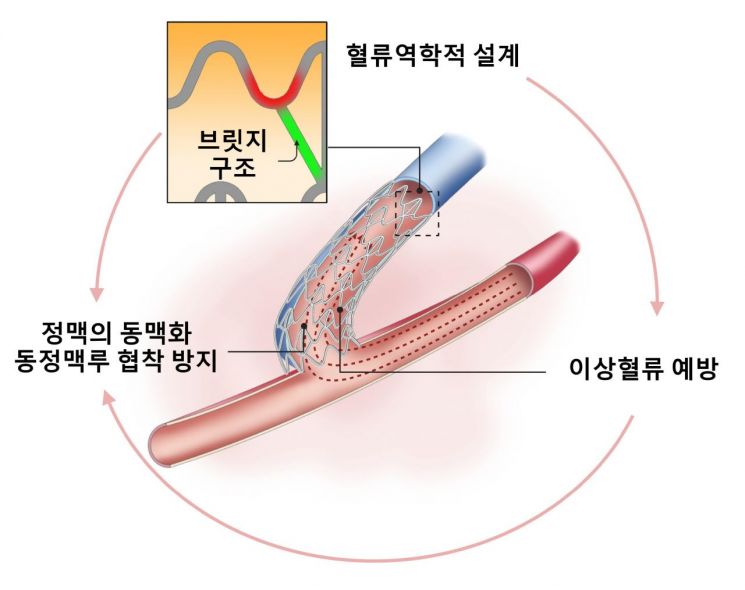 Overview diagram of the dialysis vascular composition surgery device developed by the research team. [Photo by Yonsei Medical Center]
The research team then confirmed the function of the newly developed device through animal experiments of various sizes. In animals that underwent arteriovenous fistula creation surgery using the developed device, vascular stenosis did not occur compared to the control group using existing devices, smooth muscle increased outwardly around the blood vessels, and the dialysis vessels were successfully established. The incidence of stenosis decreased fivefold, and when comparing blood flow volume six months after the procedure, it improved by 2.5 times.
Professor Seong Hakjun said, "We created a new concept medical device using computational fluid dynamics and shape-memory polymer new material technology," adding, "Not only did it improve blood flow and increase blood volume, but it also prevented stenosis, a representative complication of vascular access surgery for hemodialysis."
The results of this study were published in the international journal in the field of materials science, Advanced Science (IF 17.521).
© The Asia Business Daily(www.asiae.co.kr). All rights reserved.
![Clutching a Stolen Dior Bag, Saying "I Hate Being Poor but Real"... The Grotesque Con of a "Human Knockoff" [Slate]](https://cwcontent.asiae.co.kr/asiaresize/183/2026021902243444107_1771435474.jpg)

















