North Korea Condemns ROK-US Drills... Likely to Escalate Provocations
US CSIS Forecasts ICBM Launch During Yoon's Japan Visit
"High-Intensity Provocations Expected with Strategic Asset Deployment"
In response to the South Korea-U.S. joint exercise 'Freedom Shield (FS)', North Korea, which has launched a series of provocations, is likely to conduct a high-intensity military demonstration by launching an intercontinental ballistic missile (ICBM) at a normal trajectory timed with President Yoon Suk-yeol's visit to Japan. Since North Korea defines the South Korea-U.S. military drills as 'war exercises,' it is expected to raise military tensions in various ways, including increasing the frequency of provocations in line with the training schedule.
On the 15th, the Korean Central News Agency reported, "The Korean People's Army missile unit responsible for important operational missions on the western front conducted a missile demonstration firing training for unit education on March 14," adding, "The 11th Fire Assault Company under the military unit participated in the training, conducting two ground-to-ground (surface-to-surface) tactical ballistic missile demonstration firings with a medium-range configuration."
North Korea Begins 'Chain Provocations'... Next Target: "Sabotaging Yoon's Japan Visit"
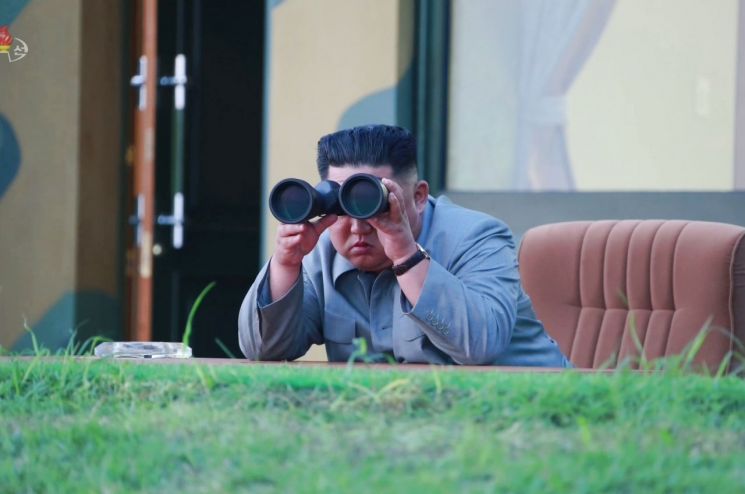
Photos released by the North show what is analyzed as the 'North Korean version of Iskander,' the KN-23, launched from a wheeled transporter erector launcher (TEL). The mention of a 'medium-range configuration' for the demonstration firing suggests that the missile's range was adjusted during launch.
Previously, in protest against the South Korea-U.S. joint exercise, North Korea fired two cruise missiles from a submarine on the 12th, one day before the drills began.
North Korea defines the South Korea-U.S. joint exercises as 'war preparations' or 'war drills.' The series of provocations following the March 11 meeting of the Party Central Military Commission, where Chairman Kim Jong-un announced "decisive practical measures to offensively utilize war deterrence," confirms this stance. It is expected that North Korea will escalate the level of provocations in accordance with the scale of our exercises.
In particular, there are predictions that North Korea will conduct a high-intensity military demonstration timed with President Yoon Suk-yeol's departure for Japan on the 16th for the South Korea-Japan summit. Given the severe food shortages and financial difficulties causing mass starvation deaths across the country, North Korea is expected to choose options that inflict maximum threat at minimal cost rather than responding proportionally to the South Korea-U.S. drills, lending weight to the 'high-intensity provocation' scenario.
Senior researcher Ellen Kim of the U.S. think tank Center for Strategic and International Studies (CSIS) stated in a report on the 13th (local time), "North Korea tends to carry out large-scale provocations during South Korea-U.S. military exercises," adding, "During the FS period, North Korea may showcase deterrence through various weapons tests or, especially ahead of President Yoon's Japan visit on the 16th-17th and the South Korea-Japan summit, may launch an ICBM at a normal trajectory (30?45 degrees) to sabotage the summit."
"North Korea Expected to Make Blatant Provocations... Countering South Korea-U.S. Joint Exercises"
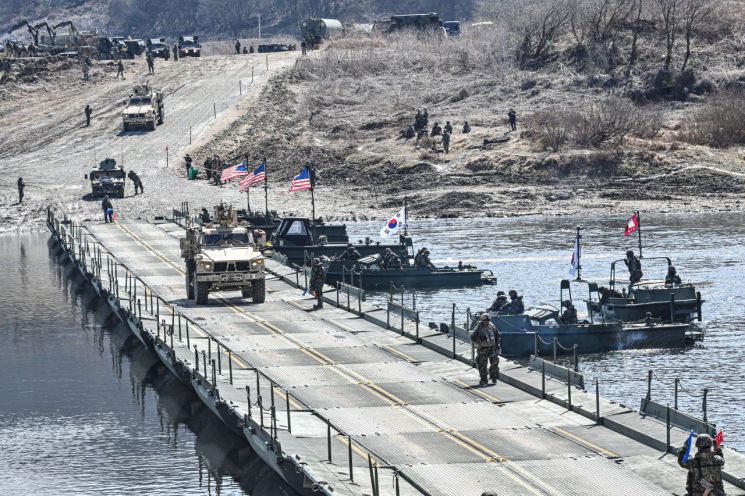 Combined ROK-US River Crossing Exercise. In the FS/TIGER combined river crossing exercise conducted by the ROK-US Combined Division's engineer battalion at a training ground in Yeoncheon-gun, Gyeonggi Province, combined equipment and vehicles are crossing the river using a combined pontoon bridge.
 [Photo by the Army]
North Korea has already heightened tensions to the maximum with two prior provocations. If the claim that the submarine-launched cruise missile (SLCM) fired from Sinpo, South Hamgyong Province, flew 1,500 km is true, it puts not only the Korean Peninsula but also Japan’s Kadena Air Base, where U.S. F-22 fighters are stationed, within range. The consecutively launched ballistic missiles can be interpreted as a threat that North Korea can carry out surprise strikes from both sea and land.
Yang Moo-jin, president of the University of North Korean Studies, analyzed, "North Korea is likely to conduct counter-training by varying missile types depending on the scale of U.S. strategic asset mobilization," adding, "Especially, training for sudden attacks on the South from unknown locations also aims to probe our military's detection capabilities." He further predicted, "As North Korea intensifies provocations with ICBMs and other means, it is expected that Kim Jong-un and Kim Ju-ae will observe these demonstrations to maximize their effect."
Yang Wook, a research fellow at the Asan Institute for Policy Studies, evaluated, "North Korea perceives itself as a nuclear-armed state following the legalization of its nuclear forces and is demonstrating military capabilities accordingly." He added, "Unlike the cautious provocations around past South Korea-U.S. joint exercises, North Korea has responded in kind since September last year and will likely try to create an image of winning without losing initiative this time as well."
Meanwhile, the FS joint exercise, which began on the 13th, will be conducted over 11 days until the 23rd. Through this exercise, the theater-level joint field training exercise (FTX), which was suspended during the Moon Jae-in administration, is being revived. In particular, the South Korea-U.S. Marine Corps will restore the joint landing exercise Ssangryong Training at the division level and conduct it in conjunction with this FS. To this end, the command units of the U.S. Marine Corps stationed in the U.S. mainland and Japan have come to South Korea.
© The Asia Business Daily(www.asiae.co.kr). All rights reserved.


















