Weekly Working Hours Reform... "No Major Changes"
"Yoon's Review Directive Means Make It Well"
Forced Mobilization Solution Is "Future Improvement, Most Important"
Prime Minister Han Duck-soo emphasized that the government's policy on flexible working hours will not change in its broad framework. He made it clear that President Yoon Suk-yeol's directive for a review was only for supplementation and that the relaxation of the 52-hour weekly regulation will continue to be pursued. Regarding the government's solution to forced labor issues, he stated that improving future Korea-Japan relations is important.
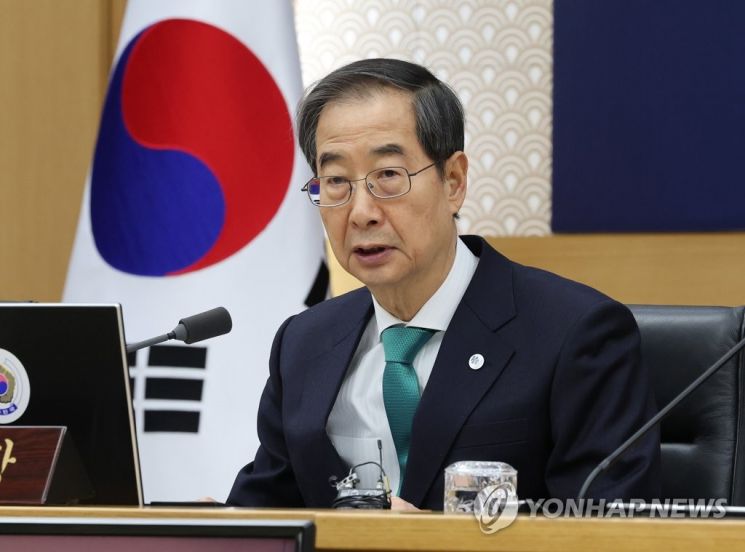
On the 14th, Prime Minister Han met with reporters at the Government Complex Sejong and was asked whether the flexible working hours policy might be reconsidered from scratch. He flatly denied this, saying, "Absolutely not." Han said, "During the legislative notice period until the 17th of next month, opinions can be freely submitted," and added, "But as the government, I can clearly say there will be no change in the big framework."
On the 6th, the government announced at an emergency economic ministers' meeting that it would relax the current regulation limiting working hours to a maximum of 52 hours per week to monthly, quarterly, semi-annual, and annual units. As labor groups and the MZ generation voiced strong opposition, President Yoon instructed on the same day to "reconsider the promotion of the flexible working hours bill." However, on the same day, Prime Minister Han evaluated the bill as a flexible and rational system during the Cabinet meeting, causing controversy over conflicting messages.
Han explained, "There is absolutely no conflict; I even called in advance," and said, "(The amendment) provides flexible options sufficiently to both workers and employers, and the government’s will is to thoroughly guarantee and implement its advantages, which is why the President said it would be helpful." He added, "I hope the government’s will is understood by many people, and if there is anything necessary, they want it to be actively reviewed and well prepared."
He continued, "If someone is supposed to get a vacation but is obstructed by the employer, or if they are made to work unpaid or holiday work under the comprehensive wage system, these issues will be strictly prevented by systems and laws," and said, "If these things are explained more clearly to workers, wouldn’t the public’s concerns be alleviated?"
"Korea-Japan Future Important, Economy in First Half More Difficult Than Expected"
Regarding the government’s cooperation plan for Korea-Japan relations, Han stated, "The most important thing is how each side implements measures to improve the Korea-Japan future." However, Han said, "There is no discussion like ‘we will do this while asking for something’ in consultations with Japan," and predicted, "Cooperative matters will naturally emerge."
The government has previously announced a plan for ‘third-party compensation’ where the government would compensate surviving plaintiffs of forced labor during Japanese colonial rule who received final court rulings for compensation from Japanese companies. Three surviving plaintiffs officially rejected the government’s plan the day before. When asked if there is a willingness to directly visit the victims, Han said, "If it helps to embrace the victims, of course, we should do so."
Regarding criticism that Japan’s attitude has not changed, he said, "There are criticisms about why the Japanese government only accepts succession and does not discuss other matters," but evaluated, "I do not want to prejudge, but it is clear that Japan has apologized in its own way." He added, "We need to watch whether the contents of the previous Obuchi-Kim Dae-jung declaration are faithfully implemented."
He forecasted that the economic outlook for this year will worsen in the first half compared to initial expectations. Han said, "It is not yet time to revise the prediction that the second half will be better than the first half," but added, "The first half may worsen as the economy overall sinks and exports do not perform, approaching a recession."
Han also said, "The government’s top priority is to prevent financial and economic crises," and stated, "Even if our growth is somewhat delayed and inflation does not stabilize as much as desired, the priority must be placed on preventing crises."
© The Asia Business Daily(www.asiae.co.kr). All rights reserved.

















