Expansion of Youth Startups and Cultivation of Young Farmers
30% Expansion of Eco-friendly Agriculture by 2030
Pohang City is focusing its administrative efforts this year on building a sustainable new growth agricultural infrastructure to create a happy rural area that grows alongside the city and to advance future new growth agriculture.
The city is strategically nurturing young farmers who will lead agricultural innovation and expanding youth entrepreneurship to transform the aging rural areas into vibrant spaces and sustainable agriculture.
Through the Young Successor Farmer Settlement Support Project, which provides a package of support from living expenses to startup funds, farmland, and education for farming startups and settlement, the city provides up to 1.1 million KRW per month in living expenses for up to three years to young farmers under 40 years old with less than three years of farming experience. It also offers startup loans up to 500 million KRW, priority support for farmland leasing, and farming technology education.
Additionally, the Young Farmer Farmland Lease Support Project provides support for farmland lease fees. Young farmers under 40 registered as agricultural management entities receive 50% of the lease fee when signing farmland lease contracts through the Korea Rural Community Corporation’s Farmland Bank project.
Along with this, the city aims to expand the proportion of eco-friendly agriculture to 30% by 2030 and reduce the use of pesticides and chemical fertilizers to 50% of current levels, transitioning to environmentally friendly agriculture to create a sustainable agricultural ecosystem.
Currently, Pohang ranks first in the province with 612 eco-friendly agricultural households and 439 hectares of certified area, and second in pesticide-free area, striving to produce and distribute safe, healthy, and high-quality food. However, to actively respond to the increasing social demand for enhanced food safety, the city plans to further expand the share of eco-friendly agriculture.
In addition to national eco-friendly agricultural direct payments and provincial organic continuous direct payments, the city provides pesticide-free continuous direct payments and eco-friendly agricultural product production incentives through its own budget. The incentives have been increased by 45% compared to the previous year, supporting from 1 million KRW to a maximum of 2 million KRW per hectare.
Moreover, various projects are being promoted to secure food security, increase farm income, and implement low-carbon agriculture in response to the climate change crisis.
To maintain a stable production base and secure competitiveness for staple crops, the city fosters high-quality rice production cooperatives through regional cluster support of 240 hectares of premium rice cultivation complexes. It also supports 13 high-quality rice production facilities and 19 types of agricultural machinery to address rural labor shortages, reduce management costs, and improve productivity.
In particular, to benefit the majority of farmers facing difficulties due to last year’s typhoon damage and rising agricultural material costs, the city has invested 2.5 billion KRW to support small and medium-sized agricultural machinery and allocated a budget of 5 billion KRW to expand support for organic fertilizers, reducing production costs and stabilizing producers’ management.
Furthermore, to stabilize rice supply and prices through adjusting rice cultivation areas and appropriate production, and to promote food self-sufficiency by expanding the conversion and production of non-rice crops in paddy fields, the city will implement this year’s strategic crop direct payment project, non-rice crop cultivation support project, and rice reduction agreement project.
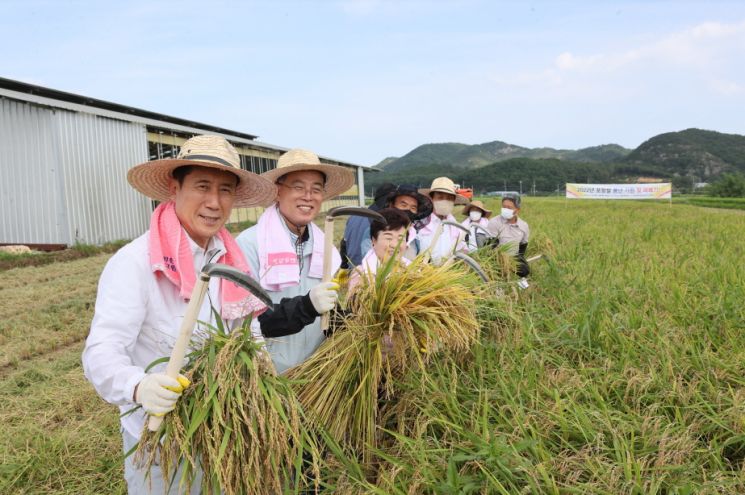 Mayor Kang-deok Lee of Pohang, who participated in the first rice harvesting event in Cheongham-myeon last August.
Mayor Lee Kang-deok said, “To enhance the competitiveness of Pohang agriculture, which has been stagnated due to the aging of agricultural workers, rural population decline, and the prolonged COVID-19 pandemic, new changes and innovations are necessary.” He added, “We will continue to discover new projects and implement various support policies to create agriculture that generates high added value and rural areas where people gather.”
© The Asia Business Daily(www.asiae.co.kr). All rights reserved.
![Clutching a Stolen Dior Bag, Saying "I Hate Being Poor but Real"... The Grotesque Con of a "Human Knockoff" [Slate]](https://cwcontent.asiae.co.kr/asiaresize/183/2026021902243444107_1771435474.jpg)
















