Trapped for Over 40 Years at a Canadian Marine Park
Self-Harm Behaviors Including Head Banging Due to Stress
Kiska, known as the 'world's loneliest killer whale,' has passed away quietly. Estimated to be 47 years old, Kiska spent over 40 years confined in a small aquarium.
According to ABC News and others on the 13th (local time), Kiska, who swam alone at the 'Marineland' marine park in Niagara Falls, Ontario, Canada, recently breathed her last. Kiska was known to have been confined in the marine park for 44 years.
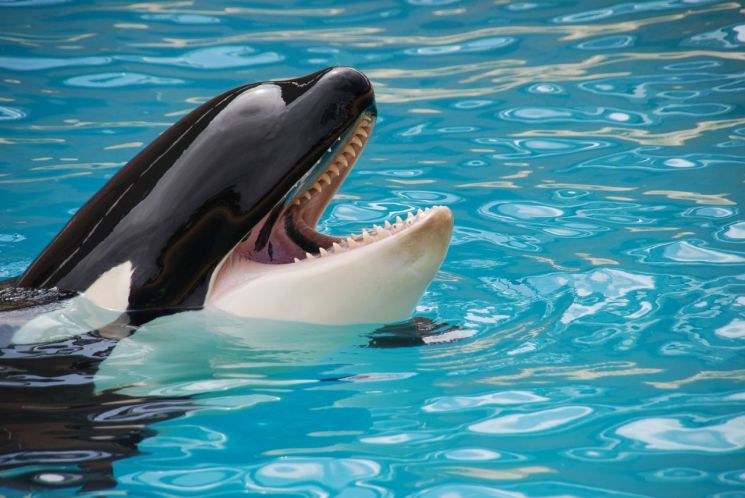
According to a statement released by the marine park, Kiska's health steadily deteriorated over the past few weeks, and she also suffered from an infectious disease. However, the exact cause related to the infectious disease has not been disclosed.
Kiska was captured off the coast of Iceland in 1979 and was held captive in the marine park ever since. She was also used in thousands of killer whale shows held at the marine park until 1992. Kiska gave birth to five calves, but sadly, all of them died, and the friends she lived with either passed away or were moved to other facilities.
As a result, Kiska became the last remaining killer whale in the aquarium since 2011 and was called the 'world's loneliest whale' among whale protection activists.
Head banging against aquarium walls as self-harm

Earlier in 2021, Kiska drew outrage from animal protection activists by repeatedly hitting herself against the aquarium walls. In the released footage, Kiska approached the aquarium wall and repeatedly struck her body and head against it.
Whale protection activist Rob Lott pointed out that Kiska's behavior at the time was "the result of stress caused by raising a wild-caught Icelandic killer whale in an artificial environment for 40 years." He added, "Sadly, the repetitive behavior shown by Kiska also appears in other killer whales that have spent years in barren and meaningless tanks."
Killer whales are known to be highly intelligent and social animals that live in groups. Experts have pointed out that the isolated environment deprived Kiska of all the social characteristics that killer whales should experience in the wild.
Phil Demers, who worked at the marine park, also said, "I observed Kiska, the last surviving killer whale at the marine park, banging her head against the wall," and appealed, "This cruelty must end."
At least 55 killer whales confined in aquariums... some show abnormal behavior
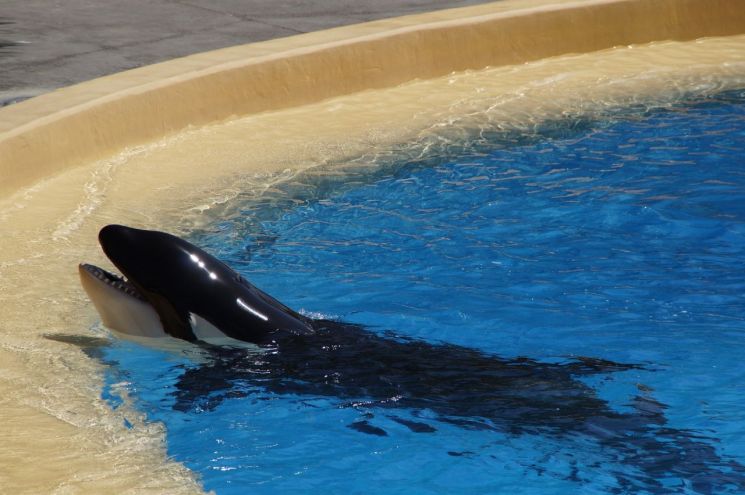
Kiska is not the only killer whale to show abnormal behavior. Morgan, a killer whale confined at Loro Parque zoo in Spain, also exhibited abnormal behavior in 2016.
At that time, Morgan lay motionless outside the water for about 10 minutes, and experts interpreted this as a 'stranding' phenomenon. This refers to a marine animal such as a whale, seal, or sea lion coming ashore on its own and dying after refusing to eat or drink.
Morgan was rescued from a strait near the Netherlands in 2010 and had been living at the zoo since 2011. Instead of the vast ocean, Morgan spent her life in a cramped tank. As a result, Morgan also engaged in self-harm by banging her head against iron doors. Animal protection groups at the time called for Morgan to be released back into the wild sea.
Meanwhile, according to the whale protection organization WDC, as of January 9 this year, at least 55 killer whales are known to be confined in marine parks worldwide.
© The Asia Business Daily(www.asiae.co.kr). All rights reserved.
![Clutching a Stolen Dior Bag, Saying "I Hate Being Poor but Real"... The Grotesque Con of a "Human Knockoff" [Slate]](https://cwcontent.asiae.co.kr/asiaresize/183/2026021902243444107_1771435474.jpg)


















