In Two Days, President Yoon's Visit to Japan
South Korea-US, South Korea-US-Japan New Cooperation System Begins
Public Opinion Depends on Outcomes of South Korea-Japan Summit
Key national agenda items of the Yoon Suk-yeol administration are facing a critical turning point. Following the government's announcement of a third-party compensation plan for forced labor, negative public opinion has spread, leading to analyses that the momentum of national governance will depend on the outcomes of President Yoon's visit to Japan. The presidential office plans to focus on the Korea-Japan summit, the starting point for establishing a new trilateral cooperation system among Korea, the U.S., and Japan, as a path to maximize the tripartite cooperation among the ruling party, the government, and the presidential office.
According to the presidential office and political circles on the 14th, President Yoon and Kim Ki-hyun, leader of the People Power Party, held a dinner at the Yongsan presidential office the previous day and agreed on holding regular monthly meetings. This was in response to Kim's proposal that regular meetings between the party leadership and the presidential office are necessary to facilitate smooth consensus between the party and the government, with about two meetings expected per month. A presidential office official explained, "These meetings will broadly discuss the progress of national agenda items, legislative status, and legislative tasks," adding, "A high-level party-government consultative body involving the party, the prime minister, and the presidential office has also been established, marking the first step toward the one-team system emphasized by the president."
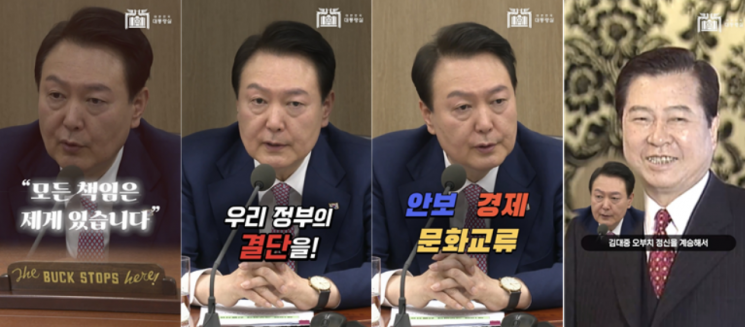
However, the efficiency of the tripartite cooperation depends on the results of President Yoon's visit to Japan, which is just two days away. The strategy is to bring back results in security and economic fields that the public can accept for national interest and the future, but the announcement of the third-party compensation plan has caused approval ratings to plummet. There is a possibility that approval ratings may fall further after the visit, and it could also negatively impact the promotion of key national agenda items that require absolute public consent, such as the three major reforms (labor, education, and pension).
The problem lies in the presidential office and government struggling to persuade domestic victims. Forced labor victim support groups and legal representatives officially stated the previous day that they have no intention of accepting third-party compensation. Earlier, on the 10th, the representatives had sent a certified letter to the foundation expressing their refusal of third-party compensation. It was confirmed that discussions about the forced labor solution and the Korea-Japan summit took place during the dinner the previous day. Some attendees also conveyed concerns raised by the public.
The presidential office plans to persuade victims by emphasizing the government's direction, but ultimately, the key will be how much President Yoon can extract progressive measures from the Japanese side during this visit. A presidential office official stated, "Many issues, including the summit agenda, are still under coordination," but some analysts predict that the summit will conclude with the formal restoration of shuttle diplomacy between the Korea and Japan leaders and a declaration of future cooperation intentions.
There is also a possibility that public opinion on the forced labor solution could change. Discussions are underway for the two governments to agree on the participation of a future youth fund (tentative name) by the Japanese defendant companies (Mitsubishi Heavy Industries, Nippon Steel). A presidential office official mentioned, "Negotiations are progressing in that direction, and we hope for such an outcome."
The results of this visit to Japan are likely to significantly influence next month's Korea-U.S. summit. Ultimately, the Yoon administration is seeking a new trilateral cooperation among Korea, the U.S., and Japan based on the restoration of Korea-Japan relations. Through a series of meetings extending from Korea-Japan and Korea-U.S. summits to the upcoming Group of Seven (G7) summit in May, the military and economic security cooperation system among the three countries is expected to change substantially. In particular, the three countries agree on the need to enhance military cooperation against North Korea's nuclear threats while jointly responding to the restructuring of supply chains, including semiconductors. If hostile relations between Korea and Japan are resolved and agreements such as the normalization of the General Security of Military Information Agreement (GSOMIA) are reached at the Korea-Japan summit, the pace of trilateral cooperation is expected to accelerate.
Separately, the government plans to continue active persuasion efforts to bring about a progressive change in the stance of forced labor victims. The presidential office stated regarding methods to persuade victims who rejected the third-party compensation plan, "The government, including the Ministry of Foreign Affairs, will continue a sincere and proactive communication process both before and after the summit."
© The Asia Business Daily(www.asiae.co.kr). All rights reserved.
![Clutching a Stolen Dior Bag, Saying "I Hate Being Poor but Real"... The Grotesque Con of a "Human Knockoff" [Slate]](https://cwcontent.asiae.co.kr/asiaresize/183/2026021902243444107_1771435474.jpg)
















