Opposition to ROK-US Joint Exercises with Short-Range Ballistic Missile Launch
Possibility of ICBM Launch if US Forces Enter Korean Peninsula This Month
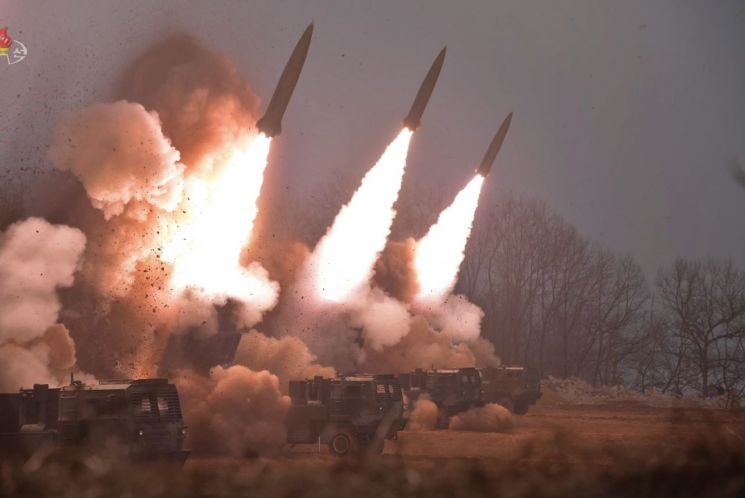 North Korean State Affairs Commission Chairman Kim Jong Un provided on-site guidance for the firepower assault training of the Hwaseong Artillery Unit on the 9th, according to a report by Korean Central Television on the 10th. [Korean Central Television screen] [Image source=Yonhap News]
On the 14th, North Korea launched two short-range ballistic missiles into the East Sea. This came just two days after it conducted a show of force by firing two cruise missiles (SLCMs) from a submarine off Sinpo, South Hamgyong Province, on the 12th. North Korea is escalating its provocations in response to the South Korea-U.S. joint military exercise 'Freedom Shield' (FS), which is scheduled to run until the 23rd of this month.
The Joint Chiefs of Staff announced that “North Korea launched two short-range ballistic missiles into the East Sea from the Jangyeon area in South Hwanghae Province between approximately 7:41 a.m. and 7:51 a.m.”
The U.S. Air Force reconnaissance aircraft 'RC-135S Cobra Ball' reportedly took off from Kadena Air Base in Okinawa, Japan, around 4 a.m. that day and tracked North Korea’s ballistic missiles in real time. North Korea’s shift from cruise missiles to ballistic missiles around the FS joint exercise, along with changes in range and launch locations, is interpreted as an attempt to increase the threat level to U.S. military forces entering the Korean Peninsula.
Considering the flight time and range of the cruise missiles launched from the submarine on the 12th, analysts believe the target was likely the Kadena U.S. military base in Okinawa, Japan, where the U.S. Air Force’s F-22 stealth fighters are deployed. The F-22 is a fighter jet capable of striking Pyongyang within 20 minutes in case of emergency.
North Korea is likely to continue various forms of military provocations. At the Workers' Party Central Military Commission meeting held on the 11th, Chairman Kim Jong Un warned that “significant practical measures will be taken to offensively utilize war deterrence,” labeling the FS exercise as “war preparation.”
Toward the end of this month, the deployment of the U.S. nuclear-powered aircraft carrier USS Nimitz (100,000 tons, CVN 68), along with strategic assets such as the U.S. Air Force’s strategic bomber 'B-1B' and Aegis destroyers during the exercise period, is expected to demonstrate deterrence against North Korea, which may prompt North Korea to respond in kind. North Korea could escalate provocations by launching solid-fuel intercontinental ballistic missiles (ICBMs), firing ICBMs at normal angles (30?45 degrees) for maximum range, or conducting a seventh nuclear test.
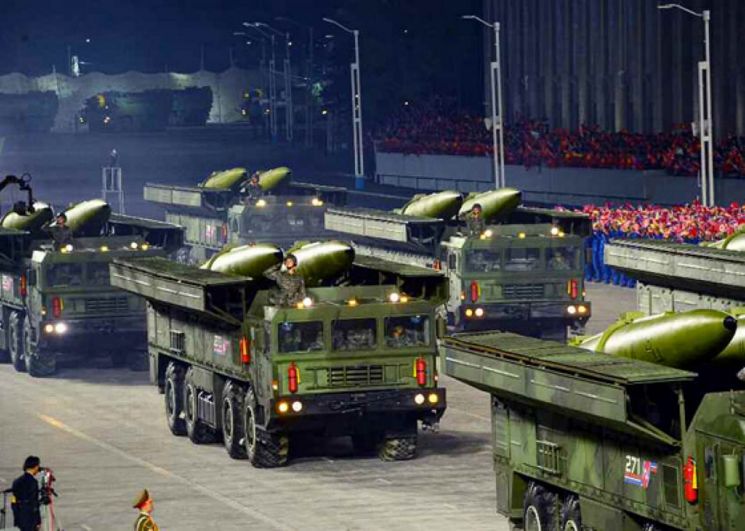
North Korea launched ICBMs presumed to be the 'Hwasong-17' on November 18 last year and on the 18th of last month. The Hwasong-17 fired at a high angle was detected flying approximately 1,000 km in distance, reaching an altitude of about 6,100 km, and traveling at a speed of about Mach 22 (22 times the speed of sound). However, if launched at a normal angle, its range could extend to 13,000?15,000 km, directly targeting the U.S. mainland.
Shin Jong-woo, Secretary General of the Korea Defense and Security Forum, said, “In response to the South Korea-U.S. exercises, North Korea may launch various missiles targeting strategic South Korea-U.S. sites, and there is a high possibility that missiles such as the KN-23 and KN-24 could be launched near maritime border areas.”
© The Asia Business Daily(www.asiae.co.kr). All rights reserved.
![Clutching a Stolen Dior Bag, Saying "I Hate Being Poor but Real"... The Grotesque Con of a "Human Knockoff" [Slate]](https://cwcontent.asiae.co.kr/asiaresize/183/2026021902243444107_1771435474.jpg)

















