Diagnosing the Type of Pitch
Check Face Angle and Swing Path
In golf, the 'ball flight' is as important as the distance. Ball flight refers to the direction in which the shot ball travels and is broadly divided into two types: 'hook' and 'slice.' A ball flight that curves to the left is called a hook, while one that curves to the right is called a slice. More specifically, it can be categorized into 'pull,' which goes straight left immediately after the shot; 'pull hook,' which starts straight left and then curves further left; 'fade,' which starts straight left and then curves right; and 'straight,' which goes straight forward. Incorrect ball flight causes a loss in distance and affects the score, making it a concern for many golfers. Here are some effective tips to correct improper ball flight.
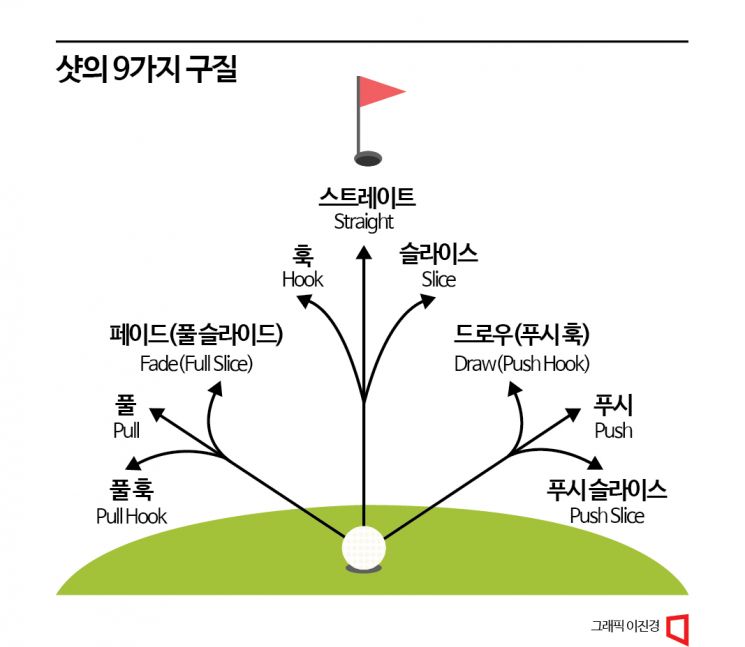
First, to correct ball flight, you need to understand the factors that influence it. Ball flight is determined by two factors: the face angle and the swing path. The face angle is the angle of the clubface when it contacts the ball at impact. The closer the face angle is to perpendicular, the more likely the ball will travel straight forward, producing a straight ball flight. Conversely, if the toe of the clubface is slightly open outward, creating a gap between the ball and the face, the ball tends to fly to the right, resulting in a slice ball flight. If the toe is closed inward, the ball flight usually curves to the left. Therefore, golfers who frequently experience slice ball flight should check whether the face angle opens at impact and focus on correcting their shots accordingly.
Next, the swing path refers to the trajectory along which the club and head move during the swing. The swing path influences ball flight as much as the face angle, so it is an essential factor to examine before correcting ball flight. Swing paths are broadly classified into three types: 'out-to-in,' where the club moves from outside to inside; 'in-to-in,' a straight path; and 'in-to-out,' where the club moves from inside to outside. Swinging with an in-to-in path increases the likelihood that the face angle will be perpendicular, producing a straight ball flight. An out-to-in path naturally closes the face, resulting in many pull shots. An in-to-out path opens the face, causing slice ball flight. To correct improper ball flight, it is important to diagnose which category your ball flight falls into and correct faulty posture focusing on the face angle and swing path.
© The Asia Business Daily(www.asiae.co.kr). All rights reserved.

















