"Repeated Efforts Over 2 Years to Reduce Stray Cat Population"
On the 13th, a heated debate unfolded over the behavior of a dog owner who feeds stray cat food left by a 'Cat Mom' (a woman who cares for stray cats) to her dog while walking it.
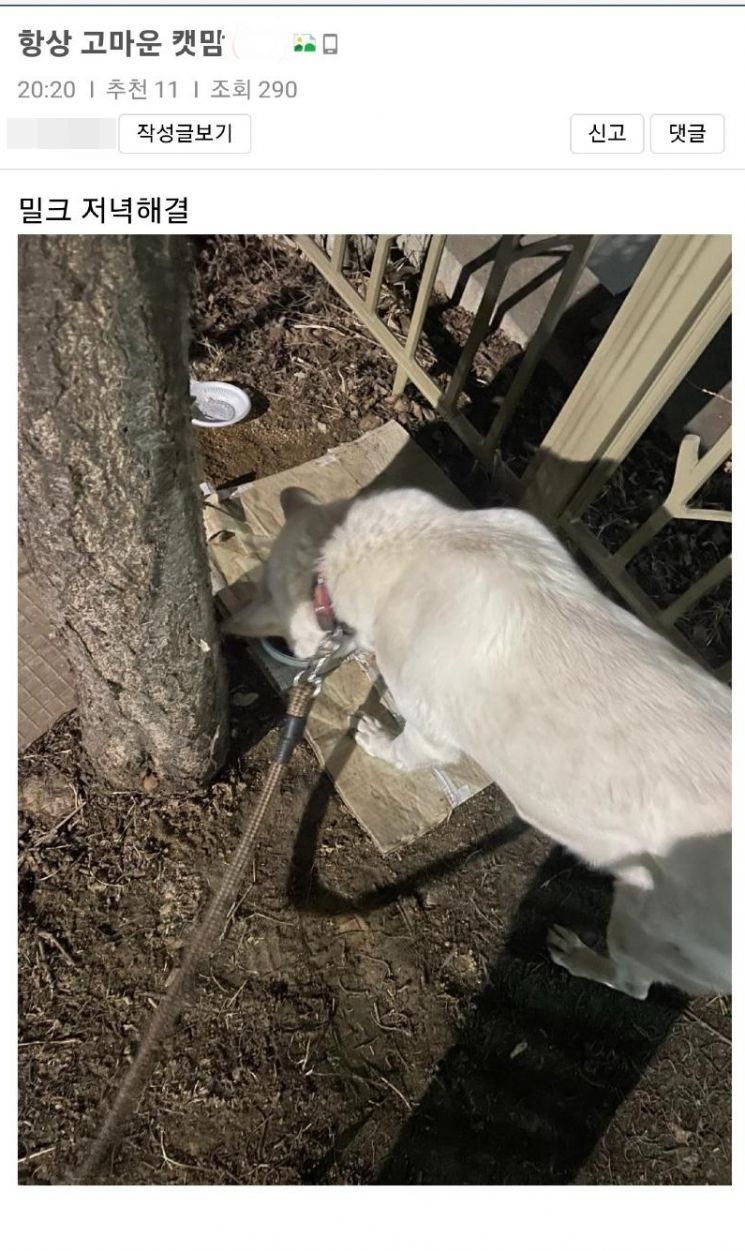
The dog owner recently posted a photo on the online community BobaeDream titled "Always grateful to Cat Mom," showing her dog eating stray cat food, with a brief caption saying, "Dinner solved! Walk every mealtime."
Stray cat haters commented, "Reducing stray cats while feeding the dog dinner is a two-birds-one-stone method," and "A novel idea."
The dog owner added a comment, saying, "For about two years, I have been feeding the food prepared for stray cats to my dog to reduce the stray cat population."
However, recently, some stray cat haters have expressed concern that cat food placed on the street may be mixed with rat poison or other harmful substances, warning against carelessly feeding it to pets.
Even if it is not rat poison, there is a risk of contamination because many cats exposed outdoors come into contact with the food. Nevertheless, the dog owner responded nonchalantly, saying, "Despite feeding it for two years, nothing has happened."
Conflicts surrounding stray cats are not new. There is a sharp divide between those who claim serious damage from cat meowing and excrement and those who argue that feeding stray cats is an act of animal protection.
Stray cat hatred has extended to hatred of Cat Moms, and last year there was an incident involving threats saying, "Stop feeding stray cats. If you don't listen, I will kill not only the cats but also the Cat Moms."
Meanwhile, online complaints regularly arise from stray cat caregivers acting without consideration for other animals or neighbors, causing discomfort. Incidents of stray cat abuse also repeatedly occur.
Last year, the Seoraksan National Park Office hung banners asking people not to feed cats in the park, which led to a barrage of complaints not only against the office but also the Ministry of Environment, its higher authority. This incident occurred because some citizens misunderstood that the national park was trying to 'exterminate' cats within the park.
However, concerns that cats cause actual 'damage' to the ecosystem continue to be raised.
The most serious problem where cats threaten the survival of other animals is Marado Island. Cats brought in by residents to catch rats have bred and are massacring the endangered natural monument, the horned grebe.
A recent study (Analysis of Cat Habitat Status, Home Range, and Survival Ability for the Conservation of the Horned Grebe Population on Marado) predicted that if there are more than 80 cats on Marado, the horned grebe will become extinct within 20 years, and currently, the number of cats exceeds this.
The same study found that from April to June 2018, over three months, 24 horned grebes were killed by 20 adult cats.
According to a paper published in the latest issue of the Journal of the Korean Ornithological Society, an analysis of 368 bird carcasses found on Heuksando Island between 2020 and 2021 showed that excluding cases with unknown causes, 75 cases (20.4%) were victims of carnivorous animals such as cats, the highest number recorded.
© The Asia Business Daily(www.asiae.co.kr). All rights reserved.

















