Exchange Rate Drops Due to SVB Crisis... US Tightening Expectations ↓
If Fed Tightening Reverses, BOK May Keep Interest Rates Steady
However, Concerns Over Foreign Capital Outflow and Won Weakness Remain
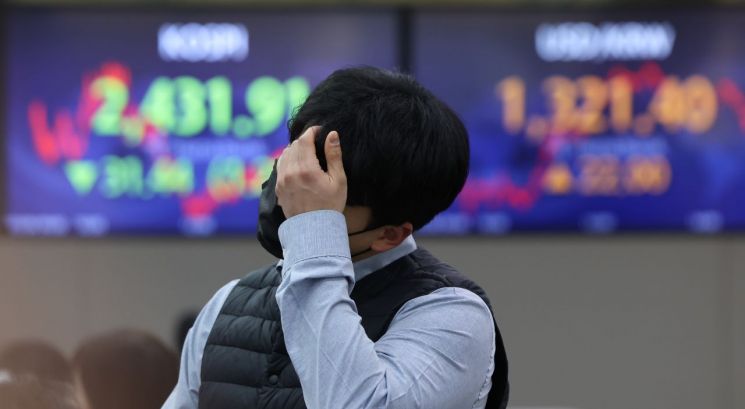
As the bankruptcy of Silicon Valley Bank (SVB) in the United States increases global economic uncertainty, attention is focused on how it will affect our financial and foreign exchange markets. Although the possibility of an immediate major problem is low as the U.S. Federal Reserve (Fed) is implementing liquidity support measures to prevent the crisis from spreading, the incident could still have some impact on the Fed's monetary policy, foreign capital flows, and the won-dollar exchange rate. Therefore, the Bank of Korea and financial authorities are closely monitoring the situation.
On the 13th, the Bank of Korea held a market situation review meeting chaired by Deputy Governor Lee Seung-heon to assess the impact of the SVB incident on international financial markets and domestic financial and foreign exchange markets. At the meeting, Deputy Governor Lee said, "We will closely monitor the effects of this incident on domestic interest rates, stock prices, exchange rates, and capital inflows and outflows, and take appropriate market stabilization measures if necessary."
The Bank of Korea and the government believe that the negative ripple effects of the SVB incident on our economy will not be significant in the short term. Considering that the U.S. Treasury Department, Fed, and Federal Deposit Insurance Corporation (FDIC) immediately implemented depositor protection measures, they judged that the SVB bankruptcy is unlikely to spread as a systemic risk and shake our economy. Deputy Governor Lee stated, "At present, the possibility that the closures of SVB and Signature Bank will spread as systemic risks throughout the banking and financial sectors is low."
Constraints on U.S. Tightening... Reduced Pressure on Korea's Rate Hikes
On the contrary, some expect that the SVB bankruptcy will constrain the Fed's tightening path, thereby reducing pressure on the Bank of Korea to raise interest rates. After the Bank of Korea's Monetary Policy Committee kept the base rate steady at 3.5% last month, concerns grew that the Fed's tightening would accelerate due to strong U.S. employment and inflation indicators. However, the mood has changed significantly due to this incident. If the Fed, considering the possibility of a financial crisis, slows down at this month's Federal Open Market Committee (FOMC) meeting, the Bank of Korea could also stop raising rates at 3.5% without the burden of widening the Korea-U.S. interest rate gap.
The won-dollar exchange rate, which had surged amid the U.S.'s strong tightening moves, is also showing weakness. In the Seoul foreign exchange market on the day, the won-dollar rate opened at 1,317 won, down 7.2 won from the previous trading day, and fell to the low 1,310 won range early in the session. Kim Seung-hyuk, a researcher at NH Futures, said, "Today, the won-dollar exchange rate is expected to decline due to the reduced possibility of prolonged tightening following the SVB incident. The market seems to be focusing on reversing hawkish (monetary tightening preference) bets."
Increased Risk Aversion... Potential for 'Won Weakness and Capital Outflow'
However, the SVB incident could also heighten global risk aversion, leading to foreign capital outflows or won depreciation. According to the Bank of Korea, foreign investment in bonds has seen net outflows exceeding 680 billion won last month, continuing a three-month streak of net outflows. If the SVB incident strengthens foreign investors' preference for safe assets, foreign currency outflows could increase further. This would also act as an upward factor for the won-dollar exchange rate.
Park Sang-hyun, a researcher at Hi Investment & Securities, explained, "The expansion of foreign net selling of stocks due to the SVB incident and others fuels won depreciation sentiment. Although the intensification of credit crisis concerns inevitably increases pressure for dollar strength, the foreign exchange market is likely to remain cautious and observe the situation for the time being."
The Bank of Korea also views U.S. monetary policy as still highly uncertain. If the U.S. Consumer Price Index (CPI) for February, released this week, does not slow down as much as the market expects, the Fed could implement a 'big step' (a 0.50 percentage point increase in the base rate) at the March FOMC despite the SVB incident. The Bank of Korea stated, "Depending on the impact of this incident on investor sentiment and the results of the U.S. CPI released on the 14th, volatility in global financial markets may increase."
© The Asia Business Daily(www.asiae.co.kr). All rights reserved.

















