Administrative Notice for Hydrogen Power Bidding Market
First Year Volume 1300GWh · Facility 200MW Class
Companies "6GW Waiting... Far from Enough"
The government will open the world's first hydrogen power generation bidding market in the first half of this year and start hydrogen power generation from 2025. On the 13th, the Ministry of Trade, Industry and Energy announced the draft notice on the annual purchase volume calculation for the hydrogen power generation bidding market. The ministry plans to conduct hydrogen power generation bidding within the first half of the year after collecting industry opinions.
When generating power using hydrogen, unlike thermal power generation using petroleum, gas, or coal, carbon dioxide is not emitted. Also, fossil fuels such as petroleum, gas, and coal will soon run out. On the other hand, hydrogen, the most abundant element in the world, is costly to extract but does not have depletion concerns. In other words, hydrogen power generation is environmentally friendly and future-oriented.
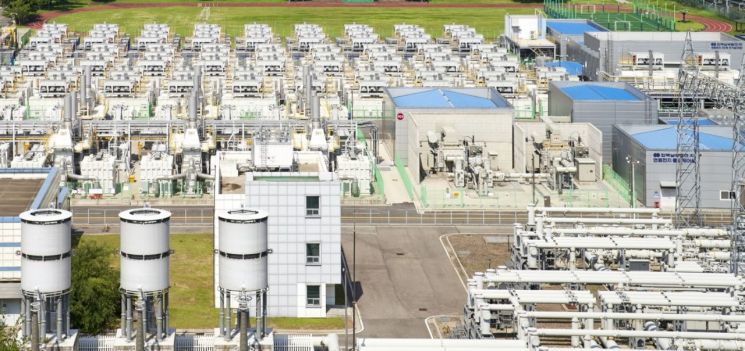
Until now, hydrogen power generation has been based on the Renewable Portfolio Standard (RPS). However, unlike solar and wind power, hydrogen power generation incurs fuel costs, indicating the need for a different support system. The Ministry of Trade, Industry and Energy separated hydrogen power generation from the RPS and established a system where various hydrogen power generation technologies such as hydrogen turbines, hydrogen engines, and ammonia co-firing can compete and be distributed, besides fuel cells.
The ministry will conduct one bidding each in the first and second halves of this year for general hydrogen power generation in 2025. The annual volume of general hydrogen power generation from 2025 to 2027 is set at 1.3 TWh (terawatt-hours). However, the ministry plans to gradually reduce the general hydrogen power generation market considering the trends in distributed energy distribution and the possibility of clean hydrogen supply. Instead, it plans to open a clean hydrogen power generation bidding market in 2024 and start power generation with volumes of 3.5 TWh in 2027 and 3.0 TWh in 2028.
However, companies that have been waiting for government announcements have not been able to hide their disappointment. Many companies, saying "hydrogen is the future," have increased investments but point out that the scale of this hydrogen power generation bidding is far too small.
The first-year bidding volume of 1300 GWh corresponds to a fuel cell capacity of 200 MW. The industry estimates that the fuel cell capacity approved by the government so far exceeds 6 GW (6000 MW). In other words, the government is saying it will only purchase about 1/30 of the power generation capacity it has already approved.
At the 274th Electricity Committee held on December 9 last year, the approved fuel cell capacity alone was 160 MW, which can fill most of the first-year bidding volume. There are concerns that bidding competition will intensify and profitability will inevitably worsen.

Companies preparing to withdraw from the business have also begun to appear. GS Power, a power generation subsidiary of GS Energy, recently decided internally not to further expand its hydrogen fuel cell business. Currently, GS Power operates fuel cell power generators of 10 MW and 5 MW in Bucheon and Anyang, respectively. However, it judged that electricity produced by fuel cells is not commercially viable.
Fuel cell operators sell the electricity produced at the System Marginal Price (SMP) and earn additional revenue by selling Renewable Energy Certificates (REC), which are subsidies. In 2021, the government lowered the REC weighting for fuel cells from 2.0 to 1.9. REC is calculated by multiplying the renewable energy generation volume by a weighting factor, so the lower weighting reduced profits. Also, due to Korea Electric Power Corporation's deficit, the SMP cap system was implemented from December last year, reducing the SMP from 250 KRW per kWh to 160 KRW, further worsening profitability.
An industry official said, "As natural gas prices rose, hydrogen prices also jumped, increasing raw material costs, but government support has rather decreased," adding, "We have been promoting the hydrogen business to respond to the government's low-carbon green growth policy, but if government support decreases, it will be difficult to continue the business."
Previously, the Moon Jae-in administration announced in the 'Hydrogen Economy Activation Roadmap' released in 2019 that it would achieve 1 GW of fuel cell power generation facilities by 2022. However, as of this month, the installed fuel cell power generation capacity nationwide is only 874 MW.
A company official said, "This market is designed focusing on the stability of the power industry rather than fostering the hydrogen industry initially through large-scale demand creation," and added, "The lack of policy consideration for expanding the hydrogen economy will dampen the will and business momentum of companies preparing investments."
© The Asia Business Daily(www.asiae.co.kr). All rights reserved.


















