Annual Effect of Planting 306 Pine Trees
Seoul City announced on the 12th that it will actively promote the distribution of ‘water thermal energy,’ an eco-friendly renewable energy using Han River water, in the water supply sector this year. The city is exploring various renewable energy sources to realize a carbon-neutral Seoul by 2050, and the introduction of water thermal energy is part of this effort.
To this end, the city will first pilot the introduction of ‘water thermal energy’ using water supply conduits (pipelines that draw raw water from the Han River and send it to water purification plants) at the cooling and heating facilities of Gangbuk and Jayang water intake stations to verify the potential of water thermal energy.
The city selected Gangbuk and Jayang water intake stations as locations for the effective introduction of water thermal energy. Since the intake stations are close to the water supply conduits that draw raw water and send it to the water purification centers, initial facility costs can be reduced, and the replacement period for existing cooling and heating systems has arrived, making the energy-saving effect significant.
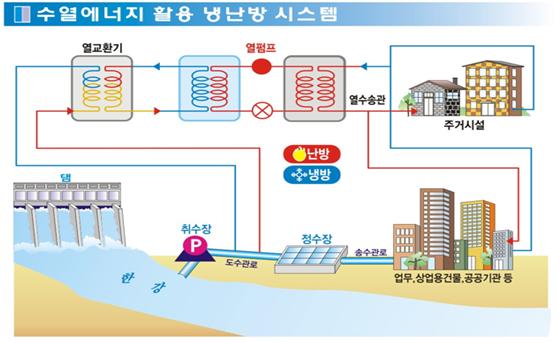
Water thermal energy will be introduced at a scale of 60RT (refrigeration tons) at Gangbuk intake station and 50RT at Jayang intake station. It is analyzed that this introduction will reduce annual fine dust by 27.8 kg and save 20.5 TOE (tons of oil equivalent) of energy.
This corresponds to a reduction of 42.5 tCO2eq (tons of CO2 equivalent) in carbon dioxide emissions, which is equivalent to planting 306 pine trees, considering that one pine tree absorbs one ton of carbon dioxide annually. The water thermal energy facilities at Gangbuk and Jayang intake stations are scheduled to be completed in August this year. Through this project, the city plans to analyze the energy-saving effects and the impact on pipelines from using water thermal energy, and actively seek demand sources to expand the distribution of water thermal energy in the private sector in the future.
The city stated that if water thermal energy is fully expanded to the water supply conduits of three intake stations available within Seoul in the future, it is expected to produce 40,000 RT (refrigeration tons) of renewable energy per hour. Converted, this would save 9,337 TOE (tons of oil equivalent) annually, reduce carbon dioxide emissions by 20,000 tCO2eq (tons of CO2 equivalent), and have an effect equivalent to planting about 150,000 pine trees annually.
Yoo Yeon-sik, head of Seoul City Waterworks Headquarters, said, “We will first introduce water thermal energy, an eco-friendly renewable energy, in the water supply sector to verify its potential and contribute to achieving a carbon-neutral Seoul by 2050,” adding, “We ask for the interest of related parties so that water thermal energy can also be expanded in the private sector.”
© The Asia Business Daily(www.asiae.co.kr). All rights reserved.

















