Debate Over AI-Drawn Artwork Exhibition at Museum
"Insult to Artists," "This Is Also Creation" Conflicting Opinions
Amid growing interest in creative works produced by artificial intelligence (AI), controversy has arisen as an AI-painted artwork was exhibited at a famous museum in the Netherlands.
According to major foreign media on the 11th, an AI-painted picture was displayed at the Mauritshuis Museum in The Hague, Netherlands.
On the 10th of last month, an exhibition of the Dutch master Johannes Vermeer (1632?1675) was held at the Rijksmuseum in Amsterdam. Among Vermeer's works, which total only 37 pieces and are scattered worldwide, 28 were gathered in one place for the first time in 200 years.
For the exhibition, the Mauritshuis Museum lent Vermeer's representative work, "Girl with a Pearl Earring," known as the "Mona Lisa of the North," to the Rijksmuseum in Amsterdam. Meanwhile, they planned an event to solicit replicas to fill the empty space left by the loaned artwork.
Julian Pandicken, a creator based in Berlin, Germany, heard about the Mauritshuis Museum's artwork exhibition event and submitted a painting titled "Girl with the Shining Earring," created using AI. Pandicken completed the work using the image generation service "Midjourney" and the image editing program Photoshop.
"Midjourney" is a program that generates images through artificial intelligence when text is input or image files are inserted. The service started in July and now has over 10 million users. It is especially praised for its excellent performance in both realistic depiction and abstract expression, making it specialized for artistic work.
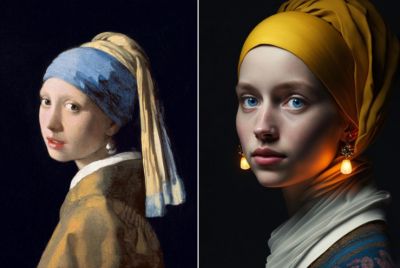 Johannes Vermeer's "Girl with a Pearl Earring" (left) and Julian Pandican's "Girl with a Shining Earring" [Image source=Wikipedia · Screenshot from Julian Pandican's Instagram]
The museum digitally exhibited about 170 of the 30,482 submissions in the original exhibition rooms. They also selected five pieces to display as physical prints, including Pandicken's work. Pandicken expressed his feelings on Instagram, saying, "Seeing my work in the museum was surreal."
The Dutch art community engaged in intense debate over this. Discussions continued over whether AI-created works qualify as art and whether they deserve to be displayed alongside other historic masterpieces in museums.
Artist Iris Komfit expressed displeasure in an interview with local media, saying, "This is an insult to Vermeer's legacy and to active artists," and added, "I felt like I was slapped in the face when leaving the museum."
She further strongly criticized, "This is an AI tool infringing on other artists' copyrights, and the painting itself feels like a Frankenstein."
However, Boris DeMunic, the public relations officer of the Mauritshuis Museum, acknowledged the controversy by stating, "What art is is a very difficult question," but explained the selection by saying, "Those who chose the works liked them even knowing they were created by AI." He also said, "Our opinion is that this is a wonderful painting that came from a creative process."
Meanwhile, in the United States last year, the AI Midjourney-created work "Theatre D'opera Spatial" won first place in the digital art category at the Colorado State Fair art competition, sparking controversy. Similarly, in Japan, a comic titled "Cyberpunk Momotaro," entirely drawn with Midjourney, was recently published and caused similar debate.
© The Asia Business Daily(www.asiae.co.kr). All rights reserved.
![Clutching a Stolen Dior Bag, Saying "I Hate Being Poor but Real"... The Grotesque Con of a "Human Knockoff" [Slate]](https://cwcontent.asiae.co.kr/asiaresize/183/2026021902243444107_1771435474.jpg)
















