[One Year Since President Yoon Suk-yeol's Election]①
Economic Moves for 'National Interest' and 'Future'
US-Korea Summit Marks Peak of Economic and Diplomatic Relations
President Yoon Suk-yeol was confirmed as the winner of the March 9 presidential election held last year by a narrow margin of approximately 240,000 votes, just 0.7 percentage points, with his victory finalized in the early hours of March 10, 2022. One year after his election victory, President Yoon, who ushered in the Yongsan era, has prioritized 'national interest' and 'future' as the foremost principles in his governance. Despite concerns from both inside and outside the country labeling him a 'novice politician,' he gained recognition for his momentum by officially launching the Presidential Transition Committee just eight days after his election. President Yoon, now entering his second year in office, is establishing new fronts on the diplomatic stage to achieve 'economic security' based on exports.
The economic policy of the Yoon administration aligns closely with its diplomatic policy. This reflects President Yoon's judgment that although South Korea has shifted from labor-intensive exports to technology-intensive exports, "ultimately, the way to survive is through exports." The president himself is taking the lead in securing supply chains and opening export routes, emphasizing the need for cooperation between the government and the private sector to expand opportunities.
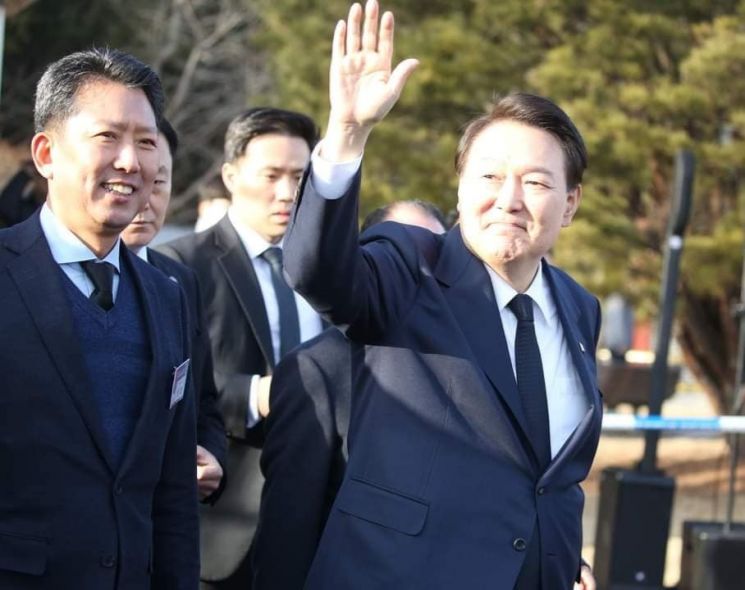
Yoon Administration Begins Full-Scale Management of 'Supply Chain' Economic Security
The reason the Yoon administration has identified 'supply chains' as the top priority in economic security management is due to the domestic industry’s prolonged suffering from the shockwaves of the global supply chain crisis. The shortage of materials in certain industries, such as semiconductors, which began with the COVID-19 pandemic, has persisted, affecting not only industries centered on logistics but also the daily lives of citizens.
In this context, the South Korea-U.S. summit held just 11 days after President Yoon’s inauguration laid an important foundation for the government’s economic security policy. The summit in May last year highlighted key agendas including North Korea’s nuclear threat response, economic security, and regional cooperation. Notably, it marked a turning point in evolving the Korea-U.S. alliance from a security-centered alliance to an economic alliance, and further into a technological alliance aimed at overcoming supply chain crises. The subsequent joint statement included practical implementation plans for a comprehensive strategic alliance based on strengthened ties in security, economy, and technology. This elevated the Korea-U.S. relationship beyond a deterrence alliance against North Korea to a global alliance encompassing security, economy, advanced technology, and supply chains.
The Presidential Office views supply chains as closely connected to citizens’ daily lives. The analysis points to a complex market shock caused by the collapse of logistics systems, production disruptions, and geopolitical crises stemming from the Russia-Ukraine conflict. It is an era where managing supply chains and enhancing capabilities at the national level to prevent disruptions to essentials like food is crucial.
The core achievements of President Yoon’s first overseas trip to the North Atlantic Treaty Organization (NATO) summit, followed by visits to the United States and Canada, also focused on 'economic' issues. The main themes of the NATO visit were 'economic security' and 'sales diplomacy between leaders,' with discussions on economic cooperation with the European Union (EU) in areas such as semiconductors, nuclear power plant construction, and renewable energy, underscoring its significance. In connection with this, President Yoon held bilateral meetings with ten countries including Poland, the Netherlands, Denmark, the United Kingdom, and the Czech Republic by splitting his schedule.
At this time, the EU was identified as an alternative market amid China’s accelerated decoupling from free democratic countries like the U.S. and EU. The administration set a policy to continue 'sales diplomacy' in advanced industries such as nuclear power, defense, and batteries. Right after concluding the Asia-Pacific four-nation meeting on the 29th, President Yoon stated, "The concept of security is changing comprehensively from political and military security to economic security including supply chains," adding, "The Ukraine crisis has further expanded this awareness."
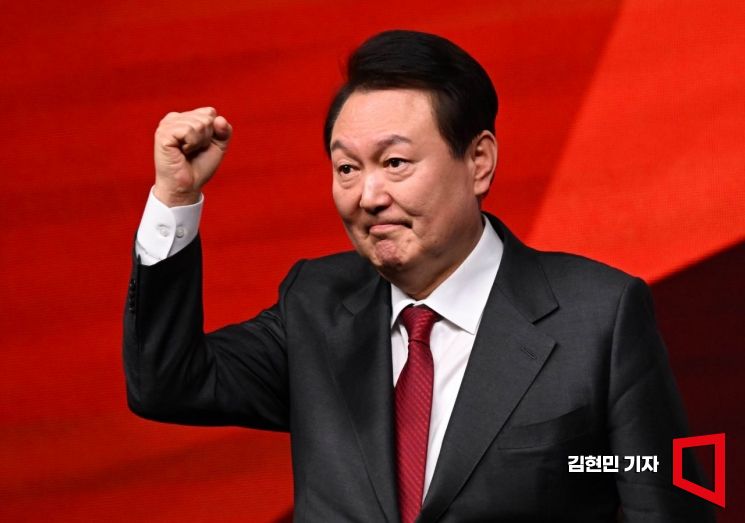 President Yoon Suk-yeol clenched his fist after delivering a congratulatory speech at the People Power Party's 3rd National Convention held on the 8th at KINTEX in Goyang-si, Gyeonggi-do. Photo by Hyunmin Kim kimhyun81@
Meeting Global CEOs as "Korea’s No. 1 Salesperson"... Emphasizing 'Exports' Across All Ministries
In January, President Yoon referred to himself as "Korea’s No. 1 salesperson" during a meeting with global corporate CEOs held in Davos, Switzerland. After returning home, he continued to emphasize attracting investment and increasing exports, urging all government officials across ministries to act as salespersons. This reflects his determination to boldly improve regulations that do not meet global standards and create a business environment conducive to expanding foreign investment.
During his state visit to the United Arab Emirates (UAE), he was accompanied by an economic delegation of 100 companies, reflecting the same approach. The economic delegation accompanying the president for the first time since his inauguration consisted of 53 small and medium-sized enterprises (SMEs), 12 mid-sized companies, 20 large corporations, and 4 public enterprises. A presidential office official explained, "We increased the proportion of SMEs and mid-sized companies to open overseas channels for competitive small and medium enterprises."
Upon returning, President Yoon held a meeting with them and proposed creating an investment cooperation platform to connect investment and exports. He said, "During the UAE visit, we achieved the largest-ever investment attraction of $30 billion and signed 48 MOUs worth $6 billion. Our companies’ technology and ideas have opened new markets." He emphasized, "The $30 billion sovereign wealth fund investment was decided because the UAE fully trusts us. We will respond by discovering various investment projects that align with the mutual interests of both countries." He also promised to support more achievements and fruitful outcomes as domestic companies are producing various tangible results such as export contracts, local market entry, and investment attraction.
The economic breakthrough for the Yoon administration entering its second year depends on exports. In his New Year’s address, President Yoon emphasized this policy by stating, "We will place the economy at the center of all diplomacy and personally oversee export strategies."
He proposed expanding exports as a breakthrough to overcome the complex global economic crisis and uncertainty. President Yoon said, "Exports are the foundation of our economy and the source of jobs," emphasizing the need to change export strategies. He added, "As the World Trade Organization (WTO) system weakens and protectionism strengthens, security, economy, and technological cooperation are being operated as a package," and "Countries sharing universal values such as freedom, human rights, and the rule of law are forming solidarity through economy and industry."
As an export strategy, he announced the launch of a '50 billion dollar overseas order project.' Alongside this, he plans to foster infrastructure construction, nuclear power, and defense sectors as new export engines. President Yoon stated, "We will mobilize all policy capabilities to expand Korea’s export territory worldwide."
At the export strategy meeting held last month, the government set this year’s export target at $685 billion (approximately 893 trillion KRW), a 0.2% increase from the previous year, and ordered an 'all-out export effort.' Although the Ministry of Economy and Finance forecasted a 4.5% decrease in exports in this year’s economic policy direction, the presidential office explained that achieving the target is possible through export growth. President Yoon said, "I have repeatedly emphasized that overcoming complex crises such as high interest rates depends solely on exports and revitalizing startups," adding, "To drive a strong export push, we must meticulously review export strategies across ministries and support export companies through inter-ministerial cooperation beyond individual ministries."
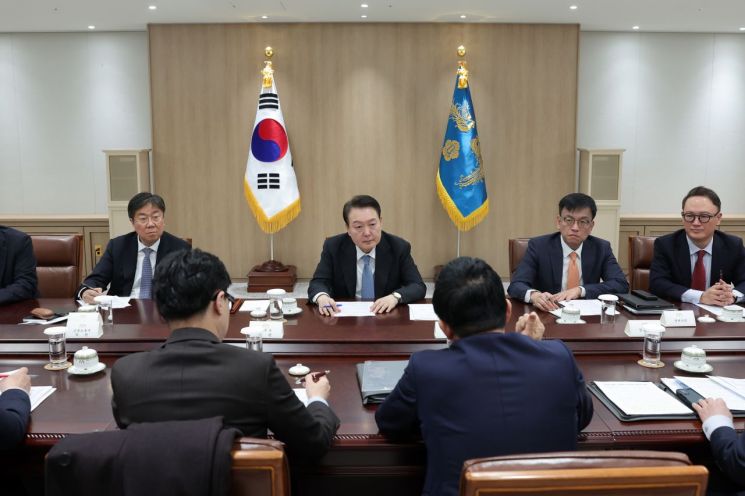
◆Next Month’s Korea-U.S. Summit... Focusing on 'Economic Security' Leveraging 70-Year Alliance= The pinnacle of the second-year economic diplomatic efforts is expected to be the summit with U.S. President Joe Biden in Washington, D.C., on the 26th of next month. The presidential office stated, "We anticipate celebrating the achievements accumulated over the 70-year Korea-U.S. alliance and having in-depth discussions on the future development direction of the alliance," adding, "In particular, based on discussions from the Korea-U.S. summits held in May and November last year, the two leaders are expected to derive concrete and practical cooperation measures across various fields including combined defense posture and extended deterrence, future advanced technology and economic security, cultural and human exchanges, and regional and international challenges."
Kim Sung-han, Director of the National Security Office at the presidential office, also said during his visit to the U.S., "At a time when economic security has emerged as the top issue, we will work together to overcome complex crises by establishing stable supply chains and strengthening cooperation in advanced fields such as nuclear power, space, clean energy, and cyber." Regarding the Inflation Reduction Act (IRA) and the Semiconductor Act, he emphasized, "We agreed to maintain close communication between Korea and the U.S. to minimize the possibility of Korean companies facing unfair treatment or unexpected uncertainties and to seek necessary measures."
The presidential office conveyed President Yoon’s determination to focus on economic and diplomatic activities for the people’s livelihood in his second year in office. A senior presidential office official said, "Domestically, the government and ruling party are pooling their efforts into the three major reforms and detailed national agenda implementation, and internationally, the president intends to lay the groundwork to find new paths for the Korean economy," adding, "The government will not hesitate in making decisions for national interest and the future."
© The Asia Business Daily(www.asiae.co.kr). All rights reserved.



















