Direct Ordering Instead of Rotation
From Hygiene Controversies to Cost Reduction
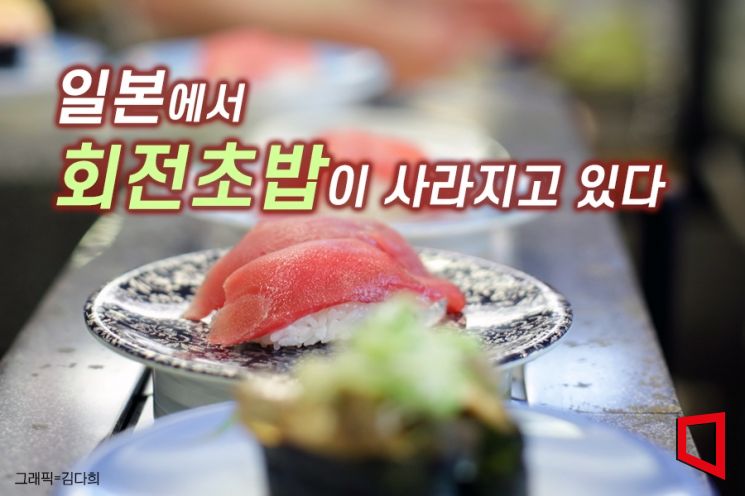
Recently, Japanese conveyor belt sushi restaurants, which have been embroiled in so-called hygiene terror controversies such as spitting on shared utensils, are gradually eliminating conveyor belts, leading to the disappearance of conveyor belt sushi itself. As major conveyor belt sushi chains stop using traditional conveyor belts and change their service methods, it is expected that it will become difficult to find conveyor belt sushi restaurants in Japan, the birthplace of conveyor belt sushi.
According to Japan's IT media outlet IT Media Business on the 9th, conveyor belt sushi franchises are moving away from the traditional method of placing sushi on conveyor belts for customers to pick up. This trend is called '? (datsu) conveyor belt,' meaning '? (?) conveyor belt.'
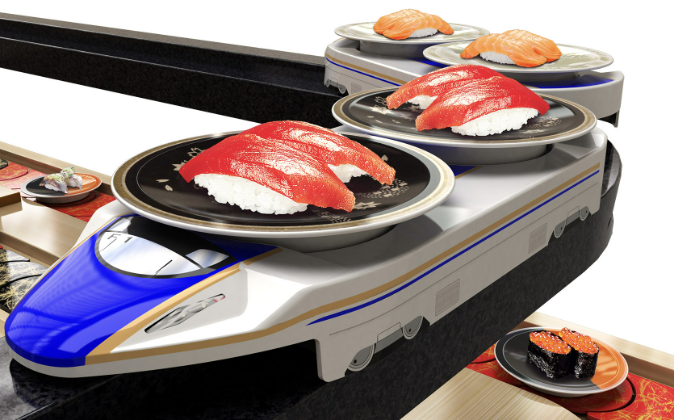 'Sushi Express Rain' delivers only the sushi ordered by the customer directly to their seat. (Photo by Ishino Group website)
Choshimaru, a sushi chain operating mainly in the metropolitan area, will operate conveyor belts only until the 26th of next month. After that, Choshimaru plans to install touch panels at all 92 locations so customers can order directly. Other franchises are doing the same. For example, Sushiro has created dedicated tracks that deliver sushi directly to each customer's seat instead of using conveyor belts.
Hamazushi has also replaced conveyor belts with straight tracks, delivering sushi ordered via touch panels directly to customers. Currently, only about 10% of the total 575 stores still have conveyor belts. The headquarters plans to convert the remaining stores to straight tracks as well.
There are cases where stopping the conveyor belt has actually increased sales. Genki Sushi introduced a system centered in Tokyo in 2012 where sushi ordered by customers is delivered via individual tracks instead of conveyor belts. As a result of changing the ordering method, sales increased by 20% compared to the traditional conveyor belt method. The president of Genki Sushi explained the reason for the introduction, saying, "Many customers did not take sushi from the conveyor belt but ordered separately. This accounted for 80% of total conveyor belt sushi sales."
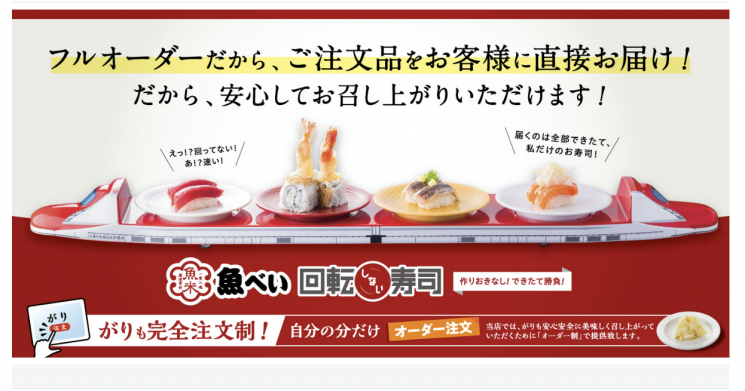 A notice from Genki Sushi's conveyor belt sushi chain 'Sakanabay'. It explains that instead of a conveyor belt, a lane that directly delivers the sushi ordered by customers to their seats is used. (Photo by Genki Sushi official website)
This '? conveyor belt' trend has emerged due to hygiene concerns raised by COVID-19 and unsanitary acts referred to as 'customer terror.' On Japanese social networking services (SNS), unsanitary behaviors such as spitting on shared soy sauce bottles or picking up and then putting back sushi on the conveyor belt have become controversial. These acts have continued sporadically until recently. Last month, an incident occurred at Choshimaru's Yokohama branch where a customer put an electronic cigarette butt into a shared container of pickled ginger, and a police investigation is underway.
From a cost-saving perspective, there is also a strong opinion that conveyor belts should be stopped. In conveyor belt sushi restaurants, sushi must be continuously made and placed on the belt without being able to predict demand, and additional staff are needed, doubling labor costs. Sushi that customers do not touch must be discarded after a certain time, resulting in a high waste rate. There are also many cases where the number of sushi plates eaten by customers is miscounted during billing. Some say that sushi on the conveyor belt loses flavor because the rice cools down while rotating, making it less tasty than sushi ordered directly.
However, some restaurants still insist on using conveyor belts. They say there is a unique enjoyment that only conveyor belt sushi can provide. Kura Sushi announced on the 2nd that it will maintain conveyor belts but install artificial intelligence (AI) cameras to monitor unsanitary behavior. At this event, a representative explained the reason for insisting on conveyor belt sushi, saying, "Because we need to provide customers with memorable enjoyment," drawing attention.
© The Asia Business Daily(www.asiae.co.kr). All rights reserved.
![Clutching a Stolen Dior Bag, Saying "I Hate Being Poor but Real"... The Grotesque Con of a "Human Knockoff" [Slate]](https://cwcontent.asiae.co.kr/asiaresize/183/2026021902243444107_1771435474.jpg)













