Reviewing North America as Site for New Battery Production Plant
Europe's largest automaker Volkswagen has completely put on hold its plan to establish a new battery factory in Eastern Europe. This is interpreted as a full-fledged move to shift battery production bases from Europe to North America in response to the U.S. Inflation Reduction Act (IRA), which provides various economic supports for investments in the U.S.
On the 8th (local time), major foreign media outlets reported, citing anonymous sources, that Germany's Volkswagen is waiting for the European Union (EU) authorities' response to the U.S. IRA subsidies before starting the construction of the new factory originally planned within Europe. The source said Volkswagen is putting its European battery factory plans on hold and is considering building a factory in North America, adding, "they have effectively moved closer to North America."
Volkswagen's shift northward is due to the U.S. government's IRA subsidy support. The IRA includes discriminatory elements such as providing up to $7,500 in tax credits per vehicle only for electric vehicles finally assembled in the North American region. Volkswagen estimates that the subsidies it can receive from the U.S. government under the IRA could reach up to 10 billion euros (approximately 14 trillion won). At a European battery manufacturers' meeting held in Brussels last week, Volkswagen stated that it expects to receive benefits such as subsidies and loans amounting to 9 to 10 billion euros from the U.S. government.
However, Volkswagen drew a line, saying that a final decision on North American construction has not yet been made. Volkswagen said, "We have plans to build more factories in Europe, but appropriate framework conditions are necessary for that," adding, "In that regard, we are watching the outcomes that the 'EU Green Deal' will bring."
The EU Green Deal is the EU's eco-friendly industrial policy that provides subsidies and tax credit benefits to companies within the region, first announced earlier last month. In response to the U.S. IRA, this plan, called the 'European version of the IRA,' includes the Critical Raw Materials Act (CRMA), aimed at strengthening the supply chain of essential key mineral raw materials for eco-friendly businesses such as electric vehicles. Although the CRMA draft is scheduled to be released on the 14th, disagreements among EU member states over funding methods have not been resolved, leading to an unwelcoming atmosphere in and outside the industry, with comments that "there are no concrete measures."
Thomas Schmall, head of Volkswagen's components division, after attending the Brussels meeting, said, "The North American battery factory plan seems likely to accelerate," adding, "Europe risks losing out to the IRA in the multi-billion-dollar investment competition that will be decided in the coming months and years."
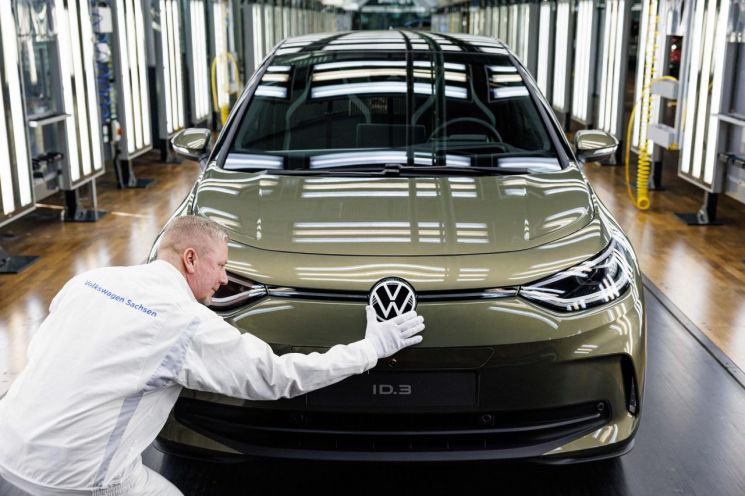
Previously, Volkswagen announced plans to build six new factories in Eastern Europe to secure an annual production capacity of 240 gigawatt-hours (GWh). PowerCo, Volkswagen's global battery business unit, plans to build five new factories in the European region by 2030, starting with the groundbreaking of its first battery factory in Salzgitter, Lower Saxony, northern Germany. At the time of the announcement, Volkswagen CEO Herbert Diess mentioned potential battery factory sites including Valencia, Spain, and Skellefte?, Sweden.
There are concerns that corporate exodus from Europe may accelerate, starting with Volkswagen. Northvolt, Europe's largest electric vehicle battery maker based in Sweden, has announced that it is considering relocating its factory establishment from Germany to the United States. The European environmental lobbying group T&E, headquartered in Brussels, reported that more than two-thirds of battery production base projects within Europe are at risk of being canceled or delayed.
© The Asia Business Daily(www.asiae.co.kr). All rights reserved.
![Clutching a Stolen Dior Bag, Saying "I Hate Being Poor but Real"... The Grotesque Con of a "Human Knockoff" [Slate]](https://cwcontent.asiae.co.kr/asiaresize/183/2026021902243444107_1771435474.jpg)











