'The 3rd High-Level Strategic Dialogue on Artificial Intelligence' Held
Lee Jong-ho, Minister of Science and ICT, "Will Announce Mega AI Industry Policy Direction in March"
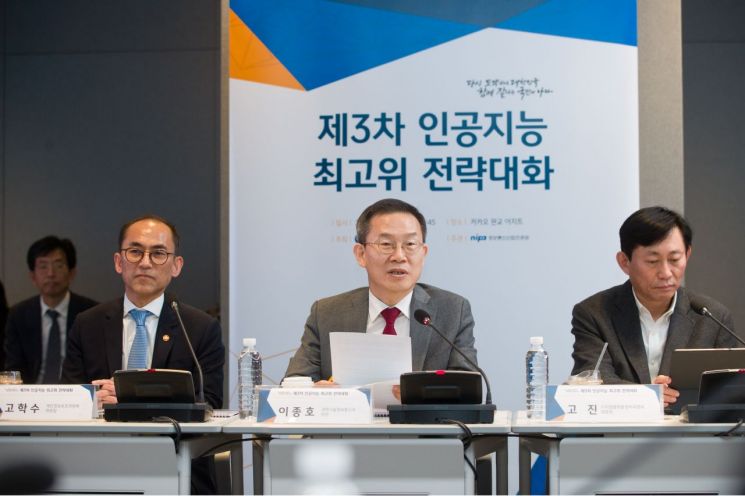
The government will announce its policy direction for the super-large artificial intelligence (AI) industry within this month. This plan is a response to the changes brought about by OpenAI's conversational chatbot 'ChatGPT,' which has recently become the world's biggest topic. The domestic related industries expressed their determination not to fall behind in global competition and demanded that the government expand support projects.
On the 8th, Lee Jong-ho, Minister of Science and ICT, discussed the policy direction for super-large AI with figures from industry, academia, and government at the '3rd AI High-Level Strategic Dialogue' held at Kakao Ajit in Pangyo, Bundang-gu, Gyeonggi Province.
Minister Lee emphasized, "Since global big tech companies are launching super-large AI services like ChatGPT and making large-scale investments, we must also pool public and private capabilities to enhance national responsiveness."
He evaluated, "Super-large AI is closely related to policies the government has been promoting, such as data construction and opening, upgrading computing infrastructure, R&D support, and securing AI ethics and reliability. These have become the foundation to enhance national competitiveness, and on this basis, domestic companies have actively started developing and utilizing super-large AI."
He added, "We will work with related ministries to announce the super-large AI industry policy direction within March. Just as Korea has been a model for many countries as a leading nation in the information age, we will do our best to become a model for the new digital order based on super-large AI."
Related ministries also agreed to share this intention. Ko Hak-soo, Chairperson of the Personal Information Protection Commission, said, "Through amendments to the Personal Information Protection Act and others, we will support the safe use of data for the development of the super-large AI industry, while minimizing privacy infringement factors throughout the entire process of data collection and use, aiming to leap forward as a trusted AI data leading country. We are preparing to establish and announce a comprehensive plan for activating the use of pseudonymous information in the first half of this year in cooperation with related ministries. We have also formed an internal task force to review ways to protect individual rights and gain trust from new AI application technologies."
Ko Jin, Chairperson of the Digital Platform Government Committee, stated, "The Digital Platform Government Committee will introduce super-large AI technology, which is gaining attention as a means to solve economic and social problems, and utilize it to address current issues such as welfare, disasters, and civil complaints. Furthermore, through digitalization of public tasks and building hyper-connected digital twins, we will create a virtuous cycle structure for the growth of AI and data industries."
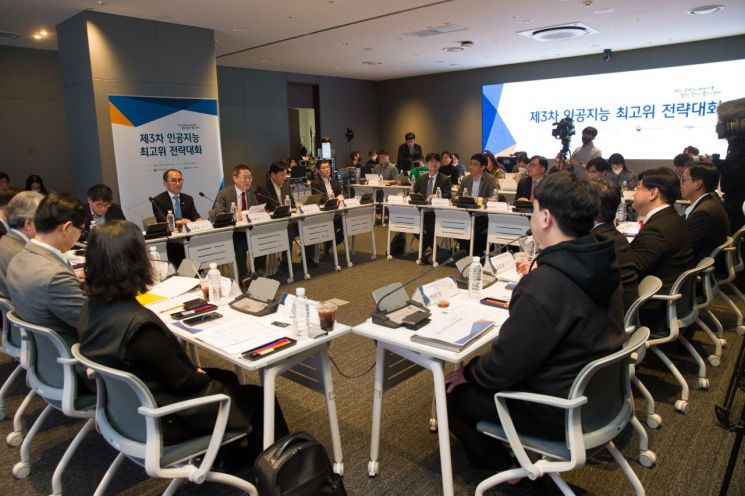
Domestic industries, including Naver and Kakao, expressed a sense of crisis over outstanding generative AI technologies like ChatGPT from overseas and demanded continuous government support. Kim Yoo-won, CEO of Naver Cloud, said, "In the past, there was almost no compatibility between Korean and English searches in search engines, but the gap is narrowing significantly in AI."
He added, "Currently, AI development is centered on the Korean language, but the technological gap will narrow further. Before that, the important stage is who creates more bold and innovative services that are actually helpful in daily life."
Baek Sang-yeop, CEO of Kakao Enterprise, also said, "Just as opportunity can turn into crisis, if we slow down the speed of AI development, we will eventually be engulfed by global companies with tremendous capital and speed that widen the gap. Global companies may initially support us, but they could raise prices to levels we cannot follow."
He emphasized, "Investment in large-scale GPU training infrastructure, especially national support and linkage with large corporations, is necessary. We need to devise many support measures on how to enable those with insufficient budgets and resources, like venture companies, to access it."
Lee Se-young, CEO of AI startup Lytton, predicted the spread of generative AI use and stressed that the domestic industrial ecosystem should become more robust. He said, "Overseas, general-purpose AI models like applied companies are created for various use cases, or companies develop expert-type AI, and these areas develop together. Besides the AI infrastructure that domestic companies focus on, the applied commercialization sector should also develop."
In response to these industry voices, Minister Lee said, "To sufficiently support private super-large AI development, we will innovate regulations, create an ecosystem foundation, discover additional R&D tasks, and examine talent cultivation in detail. We will also look into social and cultural issues such as reliability, ethics, education, and welfare arising from the spread of super-large AI based on what we have heard."
© The Asia Business Daily(www.asiae.co.kr). All rights reserved.


















