1908 Women Workers Fire Memorial as a Turning Point
South Korea, the World's 10th Largest Economy, Still Faces Glass Ceiling
On March 8, 1908, 115 years ago, a fire broke out in a clothing factory in the United States where 146 female workers lost their lives due to the lack of proper safety equipment and escape routes. In memory of their deaths, 15,000 female workers took to the streets. They marched shouting for "bread (right to survival) and roses (right to vote)," and this event became the origin of International Women's Day.
Although events commemorating International Women's Day were held nationwide on the 8th, Korean women still lack both "bread and roses." South Korea is an advanced country with one of the top 10 largest economies in the world, but it ranks 29th out of 29 advanced countries in terms of the "glass ceiling," and women's wages amount to only 65% of men's. The Ministry of Gender Equality and Family is facing dissolution, and the "non-consensual rape law" introduced by advanced countries was also thwarted due to government opposition.
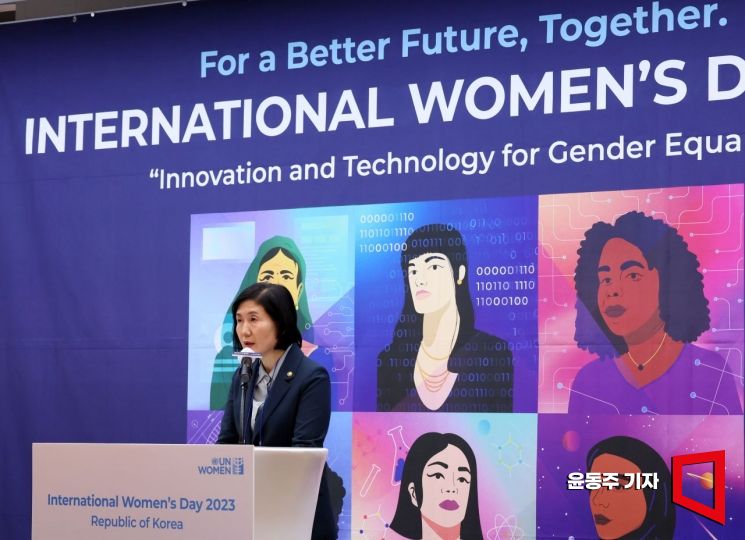 Lee Gi-soon, Vice Minister of Gender Equality and Family, is delivering a congratulatory speech at the UN Women Gender Equality Center's International Women's Day event held on the 8th at the President Hotel in Jung-gu, Seoul. Photo by Dongju Yoon doso7@
According to the report "Gender Wage Gap and Gender-Equal Wage Disclosure System" released on the same day by the Democracy Labor Research Institute affiliated with the Korean Confederation of Trade Unions, the average monthly wage of female workers last year was 2.2 million won, which was only 64.9% of the male average of 3.39 million won. The main reason for the gender wage gap is the length of continuous service. While men's average length of service is 6.92 years, women's is 4.81 years, which is 2.11 years shorter. Among low-wage workers earning less than 1.66 million won, the proportion of women is three times that of men.
The gender wage gap is also linked to the poverty issue among female workers. Jung Kyung-yoon, a research fellow at the Democracy Labor Research Institute, pointed out, "As of 2022, 73.4% of women are concentrated in the top 10 occupations with many low-wage female workers, and 81.8% in the top 15 occupations. The top 10 low-wage occupations where female workers are concentrated are jobs with a large number of non-regular workers."
Even with longer continuous service, women's wages remain low due to discriminatory employment structures. Researcher Jung said, "In the early 20s, late 20s, and early 30s age groups, women's length of service is longer than men's, but their average monthly wages are lower. Women are placed in low-wage jobs or face discriminatory employment structures in placement and promotion after hiring."
The British weekly magazine The Economist also pointed out that South Korea ranked 29th out of 29 OECD member countries in the "Glass Ceiling Index," which evaluates the working environment for women. It has been last place for 11 years since the evaluation began in 2013. The gender income gap was 31.1%, and the female labor participation rate was 18.1 percentage points lower than that of men, ranking 28th.
Women's rights are also regressing in terms of "roses," not just "bread." The Yoon Seok-yeol administration, which pledged to abolish the Ministry of Gender Equality and Family, is pushing for its dissolution through government organization law reforms, and the "non-consensual rape law" introduced by major advanced countries was withdrawn due to opposition from the Ministry of Justice and the ruling party.
The need to promote the non-consensual rape law is being raised mainly by progressive parties, and although related bills were introduced in the 21st National Assembly, no concrete discussions have yet taken place. On this day, Park Ji-hyun, former emergency committee chairperson of the Democratic Party of Korea, raised her voice through her social media (SNS), saying, "Amendment of the non-consensual rape law is also necessary. We must move toward a state that respects individual human rights through institutionalization."
Song Doo-hwan, chairperson of the National Human Rights Commission, also issued a statement on the same day urging the introduction of the non-consensual rape law. Chairperson Song said, "In 2018, the UN Committee on the Elimination of Discrimination against Women recommended in its final observations to our government that the criminal law's definition of rape should not be limited to cases involving violence or threats but should focus on the victim's consent. We will do our best to ensure that recommendations from the UN and other international organizations are properly implemented so that we can move toward a gender-equal society."
© The Asia Business Daily(www.asiae.co.kr). All rights reserved.
![Clutching a Stolen Dior Bag, Saying "I Hate Being Poor but Real"... The Grotesque Con of a "Human Knockoff" [Slate]](https://cwcontent.asiae.co.kr/asiaresize/183/2026021902243444107_1771435474.jpg)











