The volume of commercial and office building sales transactions in Seoul has reached an all-time low. The burden of loan interest has increased due to the rise in interest rates, leading to a cautious atmosphere in the investment market.
On the 8th, Real Estate Planet, a big data and AI-based commercial real estate specialist company, investigated the actual transaction price data from the Ministry of Land, Infrastructure and Transport and found that the number of commercial and office building sales transactions in Seoul in January was 48. This is a decrease of 46 transactions (48.9%) compared to 94 transactions in December last year, marking the lowest monthly transaction volume since the Ministry began disclosing actual transaction prices in 2006.
The area with the highest number of transactions was the CBD (Jung-gu, Jongno-gu) with 12 transactions. This represents a drop of about 68.4% compared to the previous month (38 transactions). Next were the GBD (Gangnam-gu, Seocho-gu) with 4 transactions and the YBD (Yeongdeungpo-gu, Mapo-gu) with 2 transactions, each showing decreases of 75% and 60% respectively compared to December last year.
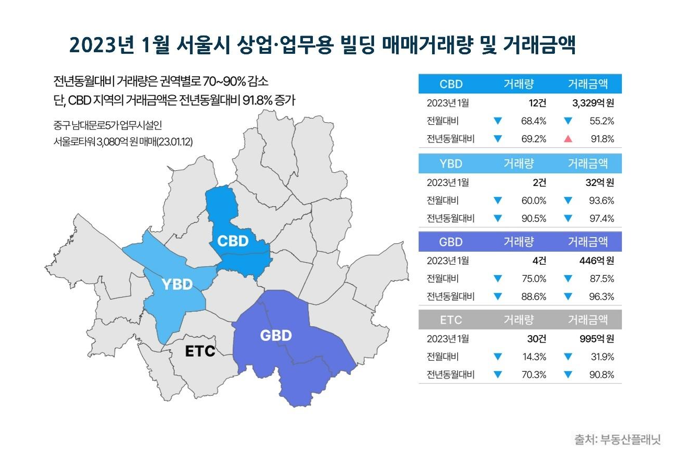
The transaction amount also plummeted. In January, the total transaction amount for commercial and office buildings in Seoul was 480.2 billion KRW, down 816.6 billion KRW (63%) from 1.2968 trillion KRW in December last year. The CBD, which had the highest transaction volume, recorded 332.9 billion KRW, a decrease of 409.4 billion KRW (55.2%) compared to the previous month (742.3 billion KRW). The GBD and YBD recorded 44.6 billion KRW and 3.2 billion KRW respectively, decreasing by 87.5% and 93.6% during the same period.
This downward trend is even more pronounced when compared to the same month last year. The transaction volume in January last year was 196, which has decreased by 75.5% over one year. During the same period, the transaction amount dropped sharply by 81.4%, from 2.5832 trillion KRW to 480.2 billion KRW.
Looking at the districts, the monthly transaction volume for commercial and office buildings in January remained in the single digits across all districts. Jongno-gu had the highest transaction volume with 8 transactions. This was followed by Dongjak-gu with 5 transactions; Jung-gu and Seongdong-gu with 4 transactions each; Yongsan-gu, Seodaemun-gu, Guro-gu, and Gangnam-gu with 3 transactions each; Dongdaemun-gu, Nowon-gu, Eunpyeong-gu, and Yeongdeungpo-gu with 2 transactions each; and Gwangjin-gu, Seongbuk-gu, Gangbuk-gu, Geumcheon-gu, Gwanak-gu, Seocho-gu, and Songpa-gu with 1 transaction each. Among Seoul’s 25 districts, Jungnang-gu, Dobong-gu, Mapo-gu, Yangcheon-gu, Gangseo-gu, and Gangdong-gu recorded no transactions at all.
The highest transaction amount was recorded in Jung-gu with 314.2 billion KRW, followed by ▲Gangnam-gu with 42.2 billion KRW ▲Jongno-gu with 18.6 billion KRW ▲Seongdong-gu with 17.7 billion KRW ▲Dongjak-gu with 16.0 billion KRW.
Jung Sumin, CEO of Real Estate Planet, said, "The decline in transactions due to the commercial real estate market downturn has continued this year, resulting in an extreme drought in transaction volume. Although the Bank of Korea held the base interest rate steady last month, bank interest rates continue to rise. Therefore, when considering commercial real estate investments involving loans, it is especially important to carefully examine financing costs and yields and approach with caution."
© The Asia Business Daily(www.asiae.co.kr). All rights reserved.


















