[Hydrogen Economy at a Crossroads]
Lotte SK Receives Approval for Ulsan Fuel Cell Power Project
Hydrogen-Electric Hybrid Energy Charging Stations Expected
Accelerated Research on Liquefied Hydrogen Fuel Cell Ships
Lotte SK Eneroot recently received government approval for a fuel cell power generation project in Ulsan. The plan is to operate two fuel cell power plants starting February 2025, utilizing by-product hydrogen produced at Lotte Chemical's Ulsan plant located in Sanggae-dong, Nam-gu, Ulsan. A total investment of 320 billion KRW will produce 500,000 MWh of electricity. This amount is enough to supply power to 120,000 households for one year, based on a four-person household. It is expected to become the largest power plant in South Korea led by a private company, excluding power generation operators.

Hydrogen fuel cells, which have been widely used for homes, buildings, and transportation, are expanding their application areas to power plants and ships. Petrochemical companies and shipbuilders are entering the hydrogen business, discovering various demand sectors and fostering the hydrogen ecosystem.
Lotte SK Eneroot is a joint venture. Lotte Chemical and SK Gas each hold 45% of the shares. The remaining 10% belongs to Air Liquide Korea. In December last year, Lotte Chemical and Air Liquide established 'Lotte Air Liquide Enerhigh' to promote hydrogen distribution business. All these companies focus on utilizing by-product hydrogen.
By-product hydrogen is produced from mixed gases containing a high amount of hydrogen, which are by-products generated during petrochemical processes. The gas is purified by applying high pressure and adsorption methods to increase hydrogen purity. High-purity hydrogen is supplied to fuel cells to generate electricity. Lotte SK Eneroot also plans to build hydrogen charging stations at major locations nationwide to supply hydrogen to hydrogen vehicles.
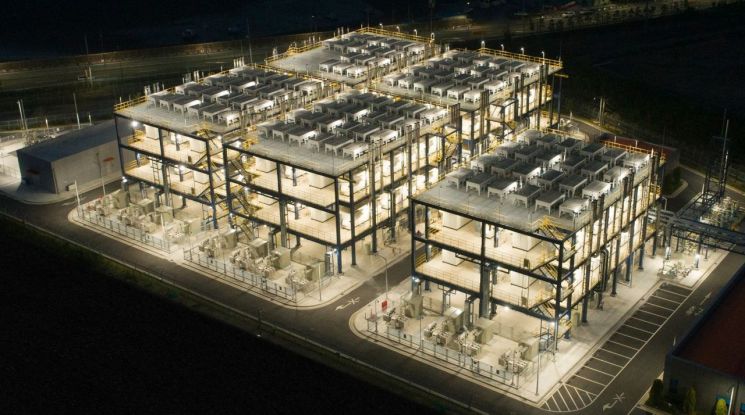
Enerhigh is also constructing a large-scale high-pressure hydrogen shipping center using by-product hydrogen at Lotte Chemical's Daesan plant and plans to start distribution business in the second half of 2024. It will have the largest domestic production capacity of over 5,500 tons annually. This amount is enough to refuel 4,200 passenger cars daily.
Fuel cell manufacturer Doosan Fuel Cell and SK Energy are exploring entry into the combined energy charging station business that supplies hydrogen and electricity. They plan to use Doosan Fuel Cell's fuel cell system 'TriGen' and SK Energy's hydrogen purification facilities. TriGen is a fuel cell system capable of producing electricity, hydrogen, and heat simultaneously.
Using SK Energy's purification facilities, the hydrogen produced by TriGen will be refined to 99.99% purity. If this technology is successfully implemented, gas stations will be able to produce hydrogen and electricity and supply them to hydrogen and electric vehicles.
LG Chem plans to build a hydrogen plant with an annual capacity of 50,000 tons at its Daesan site in Chungnam to use hydrogen as fuel for the naphtha cracking process (NCC). SK E&S will also produce 30,000 tons of liquefied hydrogen annually starting this year, utilizing by-product hydrogen from SK Incheon Petrochemicals, and sell it to charging stations.
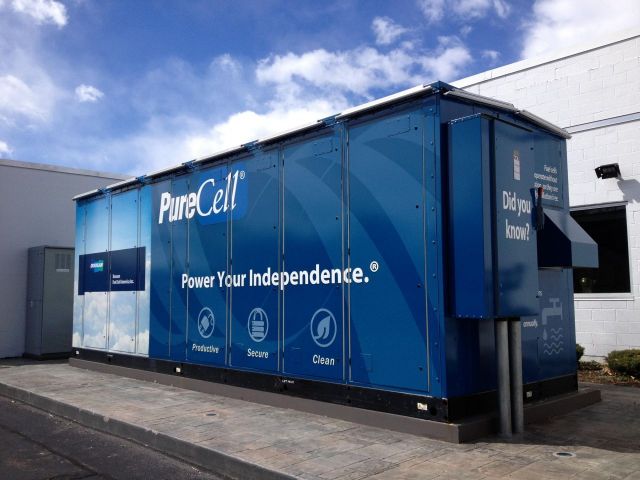
Shipbuilders are focusing on commercializing fuel cells for ships. Korea Shipbuilding & Offshore Engineering established a European research and development (R&D) center in D?sseldorf, Germany last year. They are working on detailed design of large-capacity solid oxide fuel cell systems (SOFC) for ships and power generation in collaboration with Germany's Fraunhofer Institute, the largest European research organization, and fuel cell component manufacturer Elcogen. Prototype testing has also begun.
SOFC generates electricity by reacting various fuels such as hydrogen, natural gas, or ammonia with oxygen. It has high power generation efficiency and can recycle high-temperature (600~1000℃) waste heat generated during operation, making it suitable for ship engines and combined heat and power generation. It is currently regarded as the most advanced fuel cell technology. Korea Shipbuilding & Offshore Engineering plans to conduct a shipboard SOFC demonstration project with Doosan Fuel Cell starting in 2025.
Samsung Heavy Industries has also succeeded in developing a liquefied hydrogen fuel cell ship propulsion system. This system generates power using liquefied hydrogen and polymer electrolyte membrane fuel cells (PEMFC) to be used as the ship's propulsion energy source, and has obtained basic certification from the Norwegian ship classification society DNV.
© The Asia Business Daily(www.asiae.co.kr). All rights reserved.
![Clutching a Stolen Dior Bag, Saying "I Hate Being Poor but Real"... The Grotesque Con of a "Human Knockoff" [Slate]](https://cwcontent.asiae.co.kr/asiaresize/183/2026021902243444107_1771435474.jpg)


















