The government will expand the 'Shipbuilding Industry Hope Savings' program, which helps form assets of 6 million KRW, to all age groups to improve the treatment of subcontracted workers in the shipbuilding industry, and will also increase the scale of the shipbuilding welfare fund by up to twice.
On the 8th, the Ministry of Employment and Labor reported the promotion plan for the 'Shipbuilding Industry Win-Win Package Support Project' at the Emergency Economic Ministers' Meeting. This plan was prepared to support the win-win agreement signed by the shipbuilding industry and to help resolve the recent severe labor shortage in the shipbuilding sector.
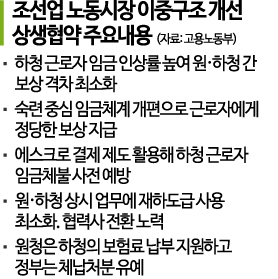
Earlier, on the 27th of last month, the five major domestic shipbuilders including Hyundai Heavy Industries and Samsung Heavy Industries signed a win-win agreement to minimize the wage gap between primary contractors and subcontractors to resolve the dual structure of the labor market.
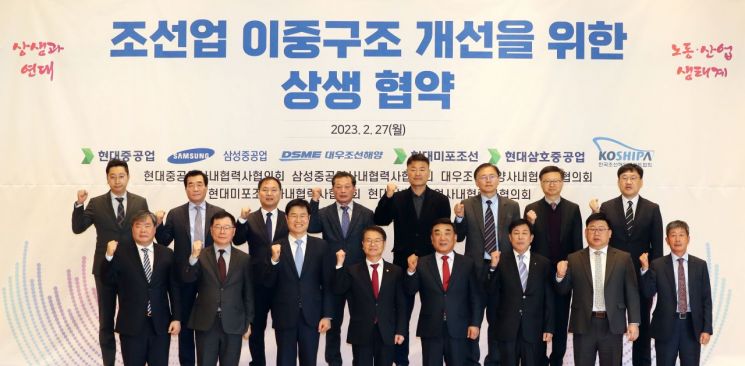 On the morning of the 27th of last month, at the Hyundai Heavy Industries Guesthouse in Dong-gu, Ulsan City, Lee Jeong-sik, Minister of Employment and Labor, Kim Doo-gyeom, Mayor of Ulsan, and representatives of the five major shipbuilding companies and their subcontractors took a commemorative photo after signing a win-win agreement to improve the dual structure of the shipbuilding industry. [Image source=Yonhap News]
First, to reduce the wage and welfare gap between subcontracted and primary contracted workers in the shipbuilding industry, the government decided to further expand the 'Shipbuilding Industry Hope Savings' program for new employees of partner companies, which was piloted last year. This program helps workers form a total asset of 6 million KRW by having the worker pay 1.5 million KRW, the local government pay 1.5 million KRW, and the government pay 3 million KRW over a one-year term. Previously, only workers under 45 years old were eligible, but going forward, the age requirement will be removed, and the target regions will be expanded to include Busan and Gunsan in addition to Ulsan and Geoje.
Also, considering that it is not easy to raise subcontracted workers' wages immediately next year, the support conditions for the Shipbuilding Industry Hope Savings will be temporarily expanded for two years from new employees to current workers. The Ministry of Employment and Labor expects this to encourage long-term employment of subcontracted workers and to alleviate difficulties in workforce management faced by partner companies due to frequent job changes and transfers.
The government will increase the government support limit for primary contractors' contributions to the 'In-house Partner Company Joint Labor Welfare Fund,' a major source of welfare projects for subcontracted workers, from 1 billion KRW to 2 billion KRW by 2025. Through this, the scale of the shipbuilding welfare fund can be additionally expanded by up to 17 billion KRW annually over the next three years. The total scale is expected to increase to about twice the 19.3 billion KRW recorded last year.
The government will additionally select the 'Shipbuilding Industry Industrial Transition Joint Training Center,' which provides job training related to low-carbon and eco-friendly ships whose order volume is increasing due to recent global environmental regulations, and will increase the training allowance from the current 200,000 KRW to 1 million KRW to promote participation by local youth. A new 'Shipbuilding Industry Job Leap Incentive' will also be established, which provides partner companies with a hiring incentive of 1 million KRW per month for up to 12 months if they newly hire workers aged 35 to 49 and pay wages at least 120% of the minimum wage.
On the same day, the government also announced institutional support measures to assist the management normalization of shipbuilding partner companies. The deferral of payment for employment and industrial accident insurance premiums for shipbuilding partner companies for the period from January to June, announced in December last year, will be extended until the end of this year, and government support restrictions on businesses with sincere installment payment delinquencies will be lifted. Additionally, a bill to amend the Foreign Employment Act to grant 'long-term employment exceptions' to skilled foreign workers who have worked at the same business for a certain period will be submitted to the National Assembly.
Lee Jung-sik, Minister of Employment and Labor, said, "We expect primary and subcontractors to provide appropriate compensation and consideration, such as wage increases, to subcontracted workers who have endured a long recession as promised in the win-win agreement," and emphasized, "We will strive to make the shipbuilding industry win-win cooperation model a best practice that can quickly spread to other industries and sectors facing dual labor market issues."
© The Asia Business Daily(www.asiae.co.kr). All rights reserved.

















