Director of Japan Research Center Jin Chang-su, in early this month’s paper
"Difficult to achieve solutions desired by victims"
"Efforts to improve Korea-Japan relations should be acknowledged"
"Considering that the previous administration diplomatically used Japan as an excuse while domestically failing to provide relief to the victims, we must give credit to the current Yoon Seok-yeol administration's efforts to improve Korea-Japan relations."
Jin Chang-su, a Japan expert and head of the Japan Research Center at the Sejong Institute, stated this in a planned paper published in the latest issue of the Sejong Institute's publication 'Jeongse wa Jeongchaek' (Current Affairs and Policy).
Jin's paper is based on the presentation by Seo Min-jung, Director of the Asia-Pacific Bureau at the Ministry of Foreign Affairs, at the 'Public Discussion on the Forced Labor Resolution' held at the National Assembly on January 12, and was released earlier this month. Seo's presentation at the time centered on the Ministry of the Interior and Safety-affiliated Foundation for Victims of Japanese Forced Mobilization paying court-ordered compensation for three Supreme Court confirmed rulings (15 people). This aligns with the forced labor victim compensation solution announced by the government on the 6th.
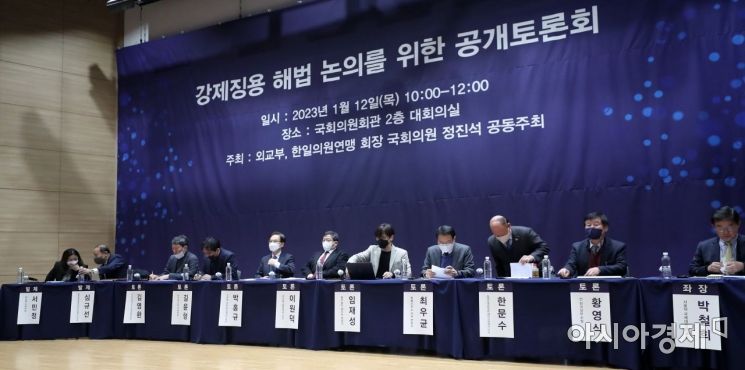 On the 12th, a public forum for discussing solutions to forced labor was held at the National Assembly. Photo by Dongju Yoon doso7@
In his paper, Jin described the government's decision to prioritize payment of court-ordered compensation to victims as a "second-best choice." He reasoned that as long as Japan insists on adhering to the 1965 Korea-Japan Basic Treaty, it is practically difficult to expect an apology or even minimal sincerity from Japanese companies, which the victims desire.
Jin noted that this solution emerged through procedures reflecting public voices by promoting a private council and public discussions. He said, "The significance lies in the Yoon administration breaking the deadlock in dialogue with Japan, which had been severed during the previous government, and publicly informing the people of the results of negotiations with Japan," adding, "This contrasts with the previous administration, which, despite advocating victim-centered policies, was indifferent to victim relief."
However, Jin predicted that it would take some time for the forced labor resolution to be accepted domestically. He explained, "Opposition parties and victim groups criticize it as humiliating diplomacy and emphasize only Japan's apology," and "Many obstacles are expected as the government tries to accommodate victims' dissatisfaction while seeking a forced labor resolution."
Jin analyzed that the reason the forced labor issue, which became a political controversy since October 2018, has not been resolved is that both the Korean and Japanese governments stuck to principled stances. He said, "Until now, Korea-Japan relations have inevitably deteriorated due to the Moon Jae-in administration's principle of respecting judicial decisions and Prime Minister Abe's revisionist historical views," and "This showed that blaming only the other side without making the 'best choice' cannot resolve historical issues."
In his paper, Jin included recommendations for Korea-Japan relations, emphasizing that "both countries should deeply reflect on the spirit of Kim Dae-jung and Obuchi." He said, "The spirit of the Kim Dae-jung-Obuchi Declaration started with Japan facing its past history honestly and Korea recognizing postwar Japan," and "Japan needs to face the profound reflection and apology regarding historical issues, and Korea needs to make efforts to change the other's perception with the perseverance of 'Ugong isan' (the foolish old man who moved mountains)."
© The Asia Business Daily(www.asiae.co.kr). All rights reserved.

















