Yoon "Respecting Victims' Positions While Achieving Results Aligned with Development"
Japanese Local Media Reports G7 Invitation Following Korea-Japan Summit
Diplomatic Speed, Aggressive Drive on Domestic Issues Including Three Major Reforms
President Yoon Suk-yeol is adopting an aggressive stance both domestically and internationally as his government enters its second year. Starting with the implementation of the government's core national agenda of the 'three major reforms' (labor, education, and pensions), he is also prioritizing the logic of 'national interest' in diplomacy to establish new fronts with allied countries. With a series of talks expected with Japan, the United States, and others by May, marking the first anniversary of the government's launch, evaluations of the achievements in the first year of his administration are expected to be sharply divided.
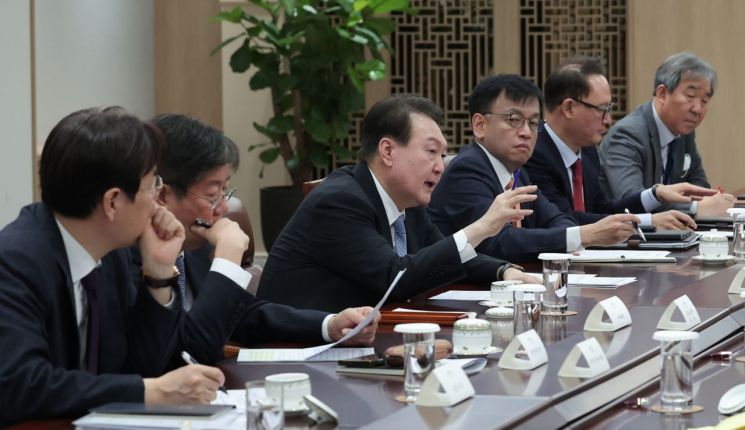
At the Cabinet meeting held on the 7th, President Yoon stated, "After seeking measures that respect the victims' positions while aligning with the joint interests and future development of both Korea and Japan." This was a reiteration of the government's justification following the announcement of a solution to the forced labor compensation issue the previous day, which sparked strong backlash from the Democratic Party of Korea and some victims, who labeled it as 'humiliating diplomacy.' In particular, he emphasized, "Japan has transformed from a militaristic aggressor in the past to a partner that shares universal values with us and cooperates in security, economy, science and technology, and global agendas," reaffirming his commitment to economic cooperation following his March 1st Independence Movement Day speech.
Japan's Kyodo News cited Korean and Japanese diplomatic sources the day before, mentioning specific dates and even reporting the possibility of President Yoon visiting Japan. Although the timing of the visit is earlier than initially discussed within and outside the presidential office, the office stated, "Discussions on a summit have not yet begun," but left the possibility of restoring 'shuttle diplomacy' wide open. Shuttle diplomacy between the two heads of state was suspended after then-Prime Minister Yoshihiko Noda visited Seoul in October 2011 and President Lee Myung-bak visited Japan in December of the same year.
With talks of a Korea-Japan summit, the likelihood of addressing various issues in succession, starting with forced labor, has increased. Regarding semiconductor export regulations, relevant ministries have already begun handling detailed matters, and there is potential consensus on expanding exchanges of specialized personnel and stabilizing supply chains for batteries and critical minerals, as well as cooperation in emerging and core technology fields such as biopharmaceuticals and space.
At the end of next month, a visit to the United States is expected to mark the 70th anniversary of the Korea-US alliance. Kim Sung-han, Director of the National Security Office, is currently visiting Washington to finalize discussions on the timing, format, and agenda of a summit between President Yoon and US President Joe Biden. Before departure, Director Kim said, "We plan to carefully examine economic security issues, including the Inflation Reduction Act (IRA) and semiconductor laws, to assess their positive and negative impacts from an economic security perspective."
Nihon Keizai Shimbun reported that the Japanese government is also considering inviting South Korea to the Group of Seven (G7) summit to be held in Hiroshima in May. If the Korean government attends as an observer, President Yoon would meet with the US and Japanese leaders again within just a month or two, where detailed discussions on trilateral economic and security cooperation among Korea, the US, and Japan could take place.
The government expects that the outcomes of President Yoon's consecutive diplomatic activities will significantly influence national governance. Since the president himself is set to take the lead in resolving issues with Japan and the US, such as semiconductors and the Inflation Reduction Act (IRA), it is analyzed that this will translate into favorable conditions for the industrial sector.
The presidential office also plans to swiftly address domestic issues in line with the accelerated pace of diplomacy. Although the labor, education, and pension reform proposals continue to face strong opposition from opposition parties and civic groups, the administration intends to demonstrate decisive action for 'national interest' and 'future' following its diplomatic efforts.
Regarding labor reform, President Yoon has repeatedly emphasized transparency in union finances, and accordingly, the Ministry of Employment and Labor has begun promoting 'activation of union financial disclosure.' The day before, the ministry also presented a plan to revise the working hours system to manage total working hours on a monthly, quarterly, semiannual, and annual basis at the Emergency Economic Ministers' Meeting. As for pension reform, President Yoon has issued additional instructions to "prepare extraordinary measures to increase the fund management yield so that the National Pension can protect the precious retirement funds of the people." This follows last year's record low fund management yield of -8.22%, and the reform is seen as encompassing institutional changes as well as improving fund management yields to reduce the burden on citizens.
The presidential office acknowledges that all three major reforms require legislation and thus cooperation from the National Assembly, but plans to focus first on raising public consensus. Since President Yoon has presented the three major reforms as 'epochal tasks,' the administration intends to build momentum for implementation even if the process takes time. A senior official from the presidential office explained, "All reforms and diplomatic policies pursued by the government are judgments for national interest and the future, as emphasized by the president. During this process, we will establish and present the Yoon administration's standards based on law and principles."
© The Asia Business Daily(www.asiae.co.kr). All rights reserved.
![Clutching a Stolen Dior Bag, Saying "I Hate Being Poor but Real"... The Grotesque Con of a "Human Knockoff" [Slate]](https://cwcontent.asiae.co.kr/asiaresize/183/2026021902243444107_1771435474.jpg)










