Lack of Smuggled Animal Protection Facilities
Additional National Ecological Institute Under Construction
1061㎡ within Chungnam Ecological Institute
Accommodates 400 Animals Including Strays
The National Institute of Ecology has taken steps to secure additional habitats to address the euthanasia issue of internationally endangered animals illegally imported. It is expected that the problem, which previously forced the disposal of smuggled endangered species due to a lack of protection facilities, will be significantly improved.
According to the Ministry of Environment on the 8th, the National Institute of Ecology is constructing a 'CITES Protection Facility' with the goal of completion this year. The facility, located within the ecological institute in Seocheon-gun, Chungnam, covers an area of 1,061㎡ and is expected to accommodate up to 400 individuals of internationally designated endangered species as well as abandoned or neglected wild animals. This marks the second CITES protection facility built within two years since the first one, covering 2,162㎡, began operation in August 2021.
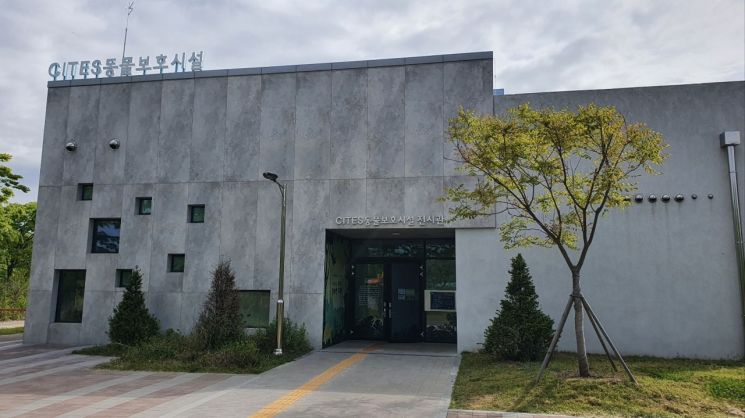 Exterior view of the international endangered species (CITES) protection facility located within the National Institute of Ecology in Seocheon-gun, Chungnam. (Photo by National Institute of Ecology)
CITES is the Convention on International Trade in Endangered Species of Wild Fauna and Flora, adopted at the Washington Conference in 1973 to regulate illegal trade and excessive commercial international trade of endangered wild animals and plants. The protection facility being built this year plans to protect not only internationally endangered animals confiscated after smuggling or abandoned during illegal breeding but also abandoned or neglected wild animals such as raccoons, Arctic foxes, and prairie dogs.
The National Institute of Ecology has taken the lead in protecting endangered animals due to a recent increase in demand for raising rare exotic animals, which has significantly reduced their populations. According to the Ministry of Agriculture, Food and Rural Affairs, the number of households raising companion animals in Korea surpassed 6 million in 2020, and smuggling of rare exotic animals is also increasing. As demand for endangered species rises, the problem of abandonment is also expanding.
The government has three main ways to handle smuggled animals. First, they can be returned to their country of origin or managed in protection facilities such as zoos. The problem is that cases of returning animals to their exporting countries are extremely rare, and the capacity of zoos and other facilities to accommodate animals is limited, so most smuggled endangered species are euthanized. Even animals that are critically endangered worldwide cannot be properly protected if they are illegally imported.
To protect animals disappearing due to euthanasia, the Ministry of Environment amended the 'Wildlife Protection and Management Act' and the 'Act on the Management of Zoos and Aquariums' last year to establish a legal basis for creating protection facilities. Accordingly, the National Institute of Ecology has built a CITES animal protection facility and is currently protecting and managing endangered species. An operating committee composed of civic groups and experts has been established, and animal distribution projects are being conducted in cooperation with domestic and international related organizations and associations.
The protection facility built two years ago can accommodate up to about 580 endangered animals from approximately 140 species. Last year, it housed one illegally bred and abandoned red-tailed boa and one African wildcat called a serval. Three Japanese macaques, illegally bred in the Gyeongbuk region and protected in Uljin-gun, are also under protection. From August to December 2021, a total of 36 individuals from 7 species were protected, and last year, the number increased significantly to 276 individuals from 39 species, including saltwater crocodiles. Among these, smuggled animals totaled 229 individuals from 15 species, showing a steady increase.
For effective operation of the protection facility, the National Institute of Ecology is strengthening cooperation by forming a CITES consultative body with related agencies such as the Ministry of Environment, Korea Customs Service, and Animal and Plant Quarantine Agency. Additionally, separate quarantine guidelines have been established for the protection of smuggled primates, and regular meetings are held to exchange information among agencies to eradicate illegal imports. Cho Do-sun, director of the National Institute of Ecology, said, "Wild animals are happiest in the wild. They should not disappear because of individual greed," and added, "We will continue to make greater efforts to protect and conserve wildlife centered on ecology."
© The Asia Business Daily(www.asiae.co.kr). All rights reserved.
![Clutching a Stolen Dior Bag, Saying "I Hate Being Poor but Real"... The Grotesque Con of a "Human Knockoff" [Slate]](https://cwcontent.asiae.co.kr/asiaresize/183/2026021902243444107_1771435474.jpg)
















