Visiting Traditional Markets in Seoul
Widespread Illegal Dumping and Poor Facility Management Found
On the afternoon of the 6th, around 4 p.m., at Ahyeon Market in Mapo-gu, Seoul, the yellow solid lines drawn on both sides of the road to secure a 'fire lane' seemed purposeless amid the bustling crowd from early hours. Dozens of street vendors' goods and facilities lined up on the yellow lines inside the market. Fixed fixtures such as stalls and tables protruding toward the road made it difficult for vehicles or even pedestrians to move in a straight line. Fire extinguishers were not properly maintained either. Although fire extinguishers were placed throughout the market, many had passed their expiration dates.
At around 6 p.m. the same day, the situation at Jungang Market in Jung-gu, Seoul, was not much different. It was easier to find stores that did not observe the yellow lines than those that did. The stored goods of tenant stores even filled one side of the underground shopping center passageway, which also serves as an evacuation route. Despite the entire traditional market being a no-smoking zone due to its vulnerability to fire, merchants and citizens were seen smoking in various alleys. There were even many who carelessly discarded cigarette butts without properly extinguishing them on the ground.
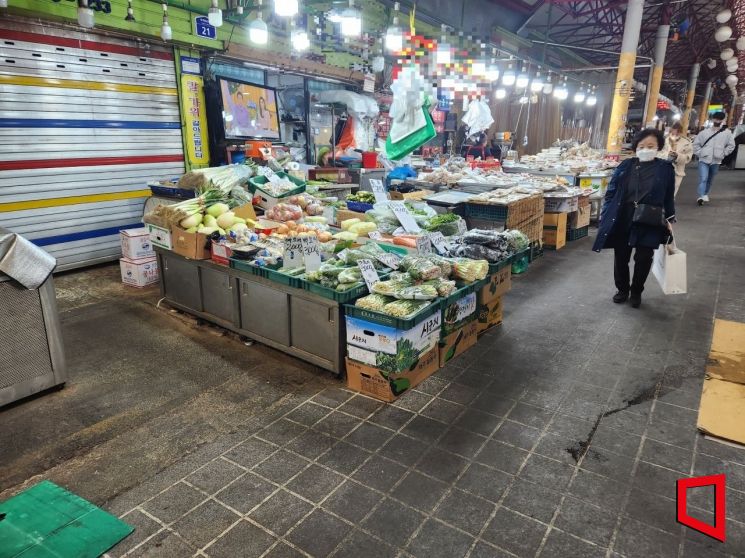 Around 6:30 PM on the 6th, Jungang Market in Jung-gu, Seoul. Merchants are setting up stalls and selling goods beyond the yellow boundary line for piled-up items.
 Photo by Tae-won Choi skking@
Although there are nearly 370 traditional markets under the jurisdiction of Seoul City, concerns have been raised that fire prevention measures are insufficient and fire safety facility management is inadequate, exposing these markets to fire risks.
Traditional markets are representative areas with a high risk of large-scale fires. Shops with old electrical wiring are packed closely together, and flammable materials such as Styrofoam and sandwich panels are scattered around, making it easy for fires to start and spread. On the 6th and 4th, fires broke out at Beongae Market in Samcheok-si, Gangwon Province, and Hyundai Market in Dong-gu, Incheon, respectively, resulting in nearly 70 stores being burned down in a disaster.
According to Seoul City on the 7th, there are a total of 369 traditional markets within Seoul. However, many stores within these markets were found to be vulnerable to fire due to widespread illegal storage, poor management of fire extinguishers, and evacuation routes.
On market roads accessible to fire trucks, yellow solid lines mark the boundaries for securing fire lanes. These lines indicate that no illegal storage or other obstructions should block vehicle passage. If a fire occurs and fire trucks cannot enter the market, firefighters must connect multiple fire hoses and run directly to the site.
However, most stores inside the markets did not observe these storage boundary lines. It was common to see stalls set up beyond the lines with goods piled up, as well as fixed facilities like refrigerators and tables installed beyond the boundaries.
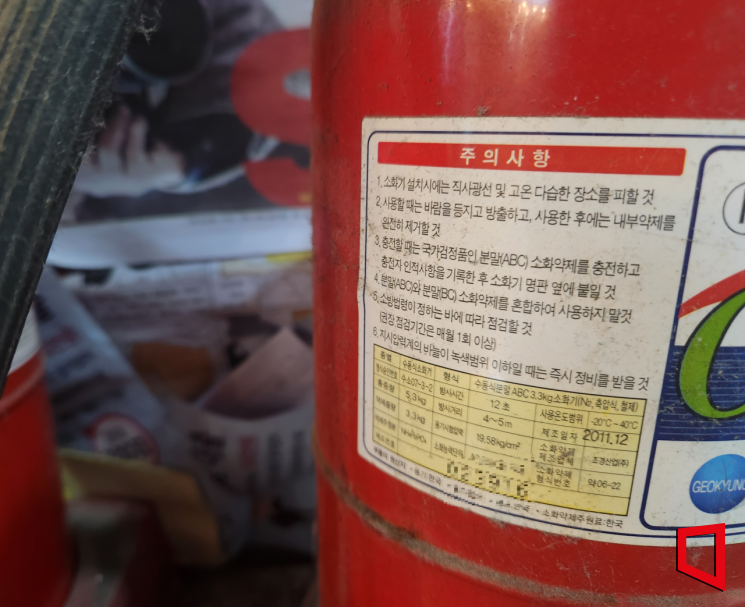 Around 4 p.m. on the 6th, Ahyeon Market in Mapo-gu, Seoul. Fire extinguishers past their expiration date are placed in the market.
 Photo by Taewon Choi skking@
Management of fire extinguishers and evacuation routes, which should be proactively utilized in case of fire, was also inadequate. Many fire extinguishers at Ahyeon Market were manufactured in 2011, far exceeding the 10-year expiration period from the manufacturing date. According to the revised Fire Safety Facilities Act of 2017, fire extinguishers older than 10 years must be replaced. If performance checks confirm no issues, the usage period can be extended once for up to 3 years.
Moreover, even fire extinguishers within their expiration dates had corroded and crumbling handles, with layers of cobwebs and dust accumulated. Fire extinguishers with pressure gauge needles not in the central green normal range were also easily noticeable.
Market merchants and citizens also expressed the need to strengthen fire safety facility management. Shin (30), who runs a restaurant in Jungang Market, said, “I usually didn’t worry much, but hearing about fires in traditional markets makes me concerned. It seems necessary to strengthen inspections of fire prevention facilities in the market.”
Housewife Chu (65) expressed concern, saying, “Even though the alleys are narrow, goods are all out, and the fire extinguishers are covered in dust, so I doubt they would work. It would be strange if a fire didn’t spread widely. Something needs to change.”
Experts also pointed out that the biggest problem is the lack of awareness about fire risks.
Professor Choi Don-mook of the Department of Fire Protection Engineering at Gachon University said, “Even when hearing about fires, people think ‘It won’t happen to me,’ which is a dangerous complacency. The merchants’ association should continuously engage in self-regulation activities and share information about fire risks.” He added, “There are still parts where regulations are not well followed. Only after merchants’ awareness changes will actions taken by local governments be effective.”
© The Asia Business Daily(www.asiae.co.kr). All rights reserved.
![Clutching a Stolen Dior Bag, Saying "I Hate Being Poor but Real"... The Grotesque Con of a "Human Knockoff" [Slate]](https://cwcontent.asiae.co.kr/asiaresize/183/2026021902243444107_1771435474.jpg)

















