"Due to Excessive Reflection of Expectations for Base Interest Rate Cut"
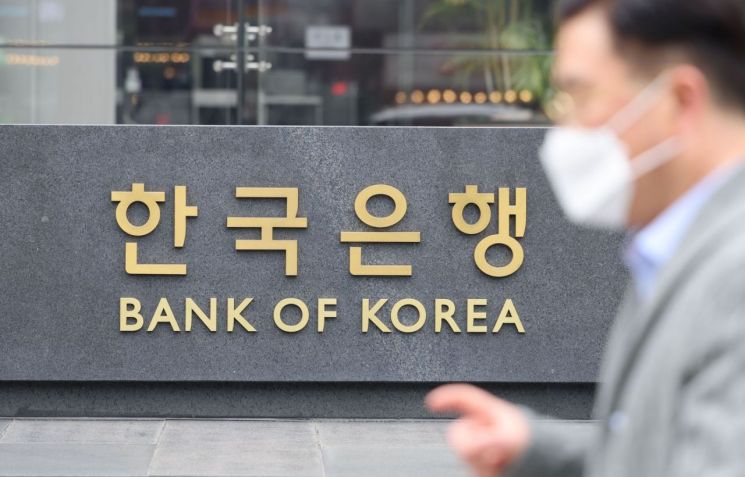
Despite the Bank of Korea (BOK) indicating a tightening stance in its monetary policy, the phenomenon of inverted yields?where government bond yields have been below the base interest rate since mid-January?persisted for 21 business days as of the 21st. This has led to criticisms that the monetary policy is ineffective, prompting the BOK to actively refute such claims. The BOK emphasized that temporary declines in government bond yields reflecting market expectations of monetary policy have occurred in the past, and caution is needed before concluding that the effectiveness of monetary policy has weakened.
On the 6th, Park Sung-jin, head of the Bond Market Team at the BOK’s Financial Market Department, posted an article titled "Understanding the Recent Inversion Between Government Bond Yields and the Base Rate" on the BOK blog. He stated, "It is important to be cautious when interpreting short-term interest rate expectations extracted from the 3-year government bond yields as actual changes in expectations for monetary policy and linking them directly to the effectiveness of monetary policy."
Theoretically, the 3-year government bond yield reflects expectations of future growth, inflation outlook, and anticipated base rate cuts over the medium to long term. The BOK estimated that on January 3rd, when the inversion was at its peak, the 3-year government bond yield incorporated expectations that the base rate would decrease from the current 3.5% to around 3.25% in the first half of the year and further down to 3.00% by year-end.
Park emphasized, "It is necessary to pay attention to the fact that the base rate expectations embedded in the 3-year government bond yield during the inversion period are likely exaggerated compared to actual expectation changes." Comparing with the BOK’s own survey-based base rate expectations, bond market participants at that time generally expected the base rate to remain stable around 3.50% until year-end. Their expectations reflected only a slight cut to about 3.40% around November this year and a 0.25 percentage point cut around February next year, showing a significant gap from the rate cut expectations embedded in the 3-year government bond yield.
Park further noted, "Considering that on January 17th, shortly after the inversion resolved, the expectations embedded in government bond yields rose sharply, bringing the two expectations back to similar levels, it appears that the base rate cut expectations were temporarily over-reflected in government bond yields during the inversion period."
The BOK analyzed that global factors significantly influenced the large fluctuations in base rate expectations embedded in government bond yields. Since mid-October last year, international financial markets increasingly anticipated a slowdown in the pace of rate hikes by the U.S. Federal Reserve (Fed). This expectation intensified after the U.S. Consumer Price Index (CPI) growth rate sharply decelerated in mid-January, spreading expectations of a monetary tightening pivot. Despite the Fed signaling continued tightening through tools like the dot plot, market expectations diverged significantly, causing U.S. Treasury yields to fall sharply.
This trend, amid intensified global interest rate synchronization, pushed down major countries’ yields substantially, causing yield inversions between government bonds and policy rates not only in Korea but also in other countries. Additionally, foreign investors’ large-scale net purchases of domestic government bond futures, based on expectations of global rate declines, temporarily increased downward pressure on yields.
Despite no significant changes in domestic growth, inflation outlook, or monetary policy communication since February, the gradual resolution of the domestic short- and long-term yield inversion after the strong U.S. employment data release on January 3rd?accompanied by rising global yields and foreign investors turning to net selling of government bond futures?supports this analysis. Empirical analysis by the BOK showed that from November last year to January 2023, when the short- and long-term yield spread (government bond minus base rate) rapidly narrowed, nearly half of the influencing factors were foreign: changes in U.S. monetary policy expectations (27% contribution) and reductions in U.S. Treasury term premiums (19%).
Park stated, "Major short-term interest rates such as the 91-day Monetary Stabilization Bonds and Negotiable Certificates of Deposit (CDs), which temporarily fell below the base rate in early February, have recently resolved their inversion, fully reflecting the effect of the 3.0 percentage point base rate hike." He added, "It is true that the interest burden on households and businesses has significantly increased due to the base rate hikes, causing growing difficulties especially in vulnerable sectors. Conversely, this issue should be understood as an inevitable phenomenon resulting from the smooth transmission of monetary policy effects to the financial market."
He continued, "If the yield inversion was mainly driven by overseas factors such as changes in the U.S. Fed’s monetary policy and global rate declines, careful interpretation is required. I hope the effectiveness of monetary policy will be evaluated over a broader and longer time horizon."
© The Asia Business Daily(www.asiae.co.kr). All rights reserved.

















