Ministry of Foreign Affairs Officially Adopts 'Third-Party Subrogation Proposal' for Forced Labor Compensation
Civil Groups in Gwangju Condemn 'Humiliating Diplomacy' as Treating Victims Like 'Unfortunate Neighbors'
The South Korean government’s push to resolve compensation for victims of forced labor under Japanese colonial rule has sparked strong opposition from civic groups in the Gwangju region.
The Association of Citizens for Forced Mobilization under Japanese Imperialism and the Gwangju-Jeonnam Historical Justice and Peace Action held a press conference on the afternoon of the 6th at the 5·18 Democracy Square in Dong-gu, Gwangju Metropolitan City, stating, "This government solution is a forfeiture of judicial sovereignty by the South Korean executive branch that nullifies the judiciary’s rulings, and a 'second Eulsa Treaty' that abandons diplomatic protection rights for its own citizens."
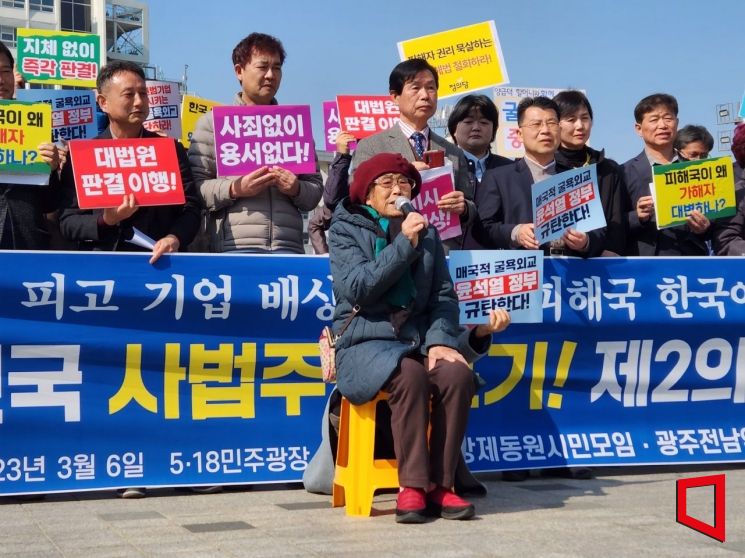 Grandmother Yang Geum-deok, a victim of forced labor under Japanese colonial rule, is speaking at a press conference on the afternoon of the 6th.
 [Photo by Min Hyun-gi]
This followed the Ministry of Foreign Affairs’ official announcement earlier that morning of a 'third-party compensation plan' to collect funds from the South Korean government instead of the defendant Japanese companies regarding compensation for forced labor victims under Japanese rule.
The groups argued, "The Yoon administration’s forced labor solution tramples on the legitimate rights of victims who have fought for over 30 years, and it is a secondary harm that brings humiliation rather than a solution. The government’s humiliating approach treats the victims of human rights violations under Japanese imperialism as unfortunate neighbors."
They further pointed out, "Meanwhile, the Japanese war crime companies, the perpetrators, receive a perfect exemption by not having to do anything despite being ordered to compensate by South Korean courts."
They added, "In the name of normalizing Korea-Japan relations and completing the Korea-US-Japan military alliance system, the victims of Japanese imperialism have been sacrificed. This government’s announcement strengthens the claim that Japan’s colonial rule was legal."
The civic association also claimed that the Ministry of Foreign Affairs’ statement that it had obtained consent from victims’ families when formalizing the subrogation payment plan was false.
Lee Guk-eon, director of the Association of Citizens for Forced Mobilization under Japanese Imperialism, said, "According to government materials, they claim to have gathered victims’ opinions through various channels, but the 'private council' launched last July did not include victim support groups or litigation representatives. When Foreign Minister Park Jin visited Gwangju in September last year to meet with grandmother Yang Geum-deok, she delivered a letter saying, ‘If money was the goal, I would have given up long ago. I cannot close my eyes even in death without receiving Japan’s apology and compensation,’ pleading earnestly."
He added that not only grandmother Yang but also the Ministry of Foreign Affairs failed to meet with plaintiffs Kim Seong-ju and Park Young-ok due to family refusal, and that when they visited the bereaved family of elder Kim Jung-gon living in Ulsan without prior contact, the only interaction was a 10-minute conversation outside the door.
At the press conference, grandmother Yang Geum-deok, a victim of forced labor under Japanese rule, also appealed, saying, "Even if I die soon or starve to death, I will not accept money from Korean companies," and "At 95 years old, I cannot die in peace because of this injustice."
© The Asia Business Daily(www.asiae.co.kr). All rights reserved.

















