Competition to Attract AI Developers Amid ChatGPT Craze
Talent Concentrates in Big Tech... Companies Recruiting 365 Days a Year
The ChatGPT craze has intensified the competition to attract artificial intelligence (AI) developers. As AI technology evolves, companies' hiring demands and expectations have risen, but the supply has not kept pace. The limited pool of experts is concentrated in a few big tech companies, leaving other firms struggling due to a lack of personnel.
Steady AI Hiring at Naver, Kakao, and Game Companies
According to a request made to the recruitment platform WantedLab on the 6th, AI-related positions accounted for 38.7% of development job postings in January. This is a slight increase from 35.5% at the end of last year. Including data-related roles closely linked to AI, the proportion rises to 48.5%.
The trend is similar in IT industry job postings. Although Naver and Kakao have adopted a conservative overall hiring stance this year due to the economic slowdown, they continue to recruit AI personnel steadily. The number of job postings in Naver's tech division, which used to be in the dozens, has dropped to six, five of which are in the AI field. Kakao has only three technical job postings, but its AI subsidiary KakaoBrain has more than ten openings.
Game companies such as Nexon, NCSoft, and Netmarble are also actively hiring AI engineers. The fields are diverse, ranging from chatbot engineers based on deep learning models like ChatGPT, computer vision developers who implement emotion-based facial expressions for game characters, to voice AI developers who create virtual human voices.
Ha Jung-woo, head of Naver Cloud AI Lab, explained, "The reality is that the AI talent pool itself is small, making it difficult to hire developers. Nowadays, with the shift to generative AI and ultra-large AI models, there is a higher demand for outstanding engineers and researchers rather than mediocre programmers, but the supply is insufficient."
71% of AI Businesses Face Talent Shortages
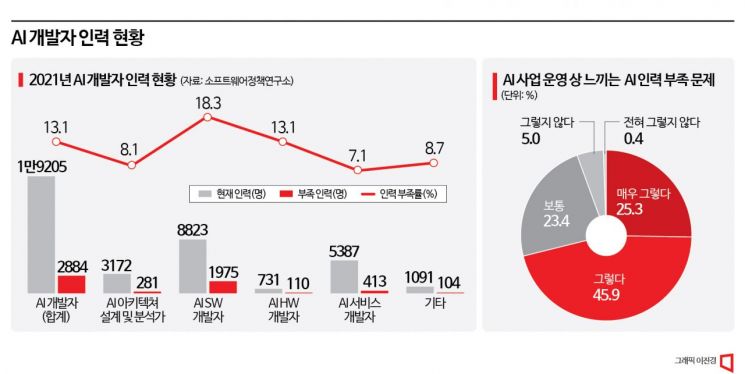
The shortage of AI talent is not a new issue. According to the "2021 AI Industry Survey" released by the Software Policy Research Institute under the Ministry of Science and ICT, 71.2% of AI businesses are struggling due to a lack of personnel. In particular, AI developers are in short supply. Although about 20,000 AI developers are working, approximately 3,000 more are needed. Among developers, the shortage rates for AI software (SW) engineers and hardware (HW) engineers were high at 18.3% and 13.1%, respectively. The shortage rate refers to the ratio of the number of personnel needed compared to those available.
The chronic nature of the talent shortage stems from the limited supply itself. Although departments such as data science and AI graduate schools have recently been established at universities, they have yet to produce a significant number of professionals. Companies report that while the number of entry-level AI developers has increased, the "immediately effective" talent they seek is still lacking.
Moreover, the available talent tends to prefer overseas companies. This is because development environments are better, such as access to big data or unlimited cloud services. Compensation also differs by four to five times compared to domestic companies. Although there has been a wave of large-scale layoffs at overseas big tech companies recently, AI personnel have remained unaffected.
The situation is even more difficult for startups overshadowed by domestic and international big tech firms. Riding the ChatGPT wave, they set aggressive hiring plans this year but cannot recruit due to a lack of people. Regardless of company size, there is a preference for candidates with a master's degree or experience, leading to fierce competition for talent. Kim Jin-woo, CEO of AI startup Liner, said, "Liner is in its eighth year, so it is somewhat better off, but startups with low recognition really struggle to find engineers. Since we only hire people with more than three years of industry experience, it is no exaggeration to say we are recruiting 365 days a year."
Professor Jeon Sung-min of Gachon University’s Department of Business Administration (a visiting researcher at Seoul National University AI Institute) pointed out, "In Korea, there is a lack of playgrounds where AI researchers can thrive, such as data and computing infrastructure, so talent is concentrated in a few companies that have these resources. Companies also prefer experienced personnel, causing a mismatch with universities."
© The Asia Business Daily(www.asiae.co.kr). All rights reserved.

















