Small Payment Fraud and Voice Phishing Abuse Cause Continuous Damage
Urgent Need for Victim Cooperation in Investigations and Blocking of Counterfeit Product Ads
#Kang Mo (40, Paju-si, Gyeonggi-do), who urgently needed money, recently saw an advertisement offering cash for activating a prepaid SIM card and managed to raise 100,000 won through this method. As a low-credit individual with a credit score in the 500s, all loans from primary and secondary financial institutions were blocked, leading to this decision. However, four days after activation, Kang received a call from the police informing him that his mobile phone number had been used for voice phishing, putting him at risk of criminal charges.
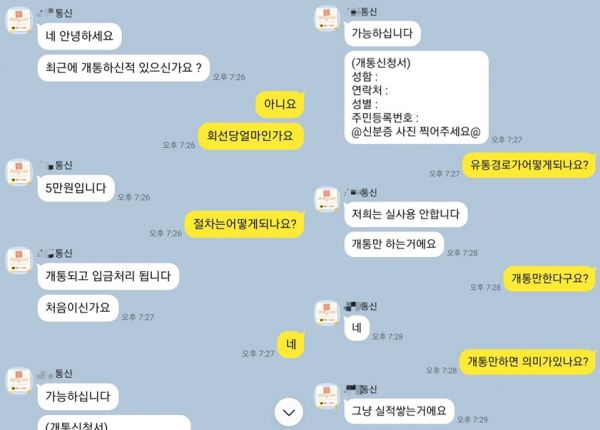
Durable loan scams targeting low-credit individuals have become rampant, resulting in numerous cases of damage. Durable loans involve activating prepaid SIM cards and then transferring the ownership in exchange for 50,000 to 100,000 won per line, sometimes up to 1 million won, making it a form of illegal private lending. The scammers ask for personal information such as name, contact number, and ID photos, then handle the activation and deposit the money. Although there are no separate statistics on durable loans, according to the National Police Agency, the number of seized burner phones (including burner SIM cards) reached 53,104 last year, more than five times the 9,343 units seized in 2018.
Durable loans literally mean ‘loans that save me,’ but in reality, they are exploited for mobile phone micropayment fraud and voice phishing, causing massive damage. Kang revealed, “Before paying the money, the scammers sometimes requested messenger profiles or phone numbers of acquaintances under the pretext of credit verification.” They then use this information for threats, debt collection, and even assault.
Scammers advertise that even those with bad credit or overdue payments can use their services, enticing low-credit individuals who have been rejected by commercial banks and savings banks. Currently, advertisements for durable loans are openly posted on portal sites such as Naver Cafes, making them easily accessible to anyone.
Although the police have launched special crackdowns since last year, arrests remain difficult. Scammers evade police investigations by operating in a so-called ‘grasshopper-style business’ or by hosting servers overseas. Most victims do not report or actively cooperate with investigations. Selling prepaid SIM cards activated under one’s name to others violates the Telecommunications Business Act and can result in imprisonment of up to one year or fines up to 50 million won. Seung Jae-hyun, a senior researcher at the Korea Institute of Criminology and Justice, advised, “You must clearly recognize that this is a crime and never hand over your phone no matter how urgent the situation. Because criminals exploit victims’ reluctance to report, actively informing investigative or intelligence agencies is essential to prevent further damage.”
The government is focusing on prevention. In August last year, the Prime Minister’s Office led the formation of an ‘All-Government Task Force (TF) to Eradicate Illegal Private Lending,’ including the Financial Services Commission, Financial Supervisory Service, Korea Communications Commission, Ministry of Science and ICT, Ministry of Justice, and National Police Agency, to discuss countermeasures. They plan to preemptively block advertisements and chat rooms on portals and messengers like KakaoTalk. The financial authorities will monitor illegal private lending advertisements, while the Ministry of Science and ICT and Korea Communications Commission will handle blocking illegal sites and deleting advertisement posts. A Financial Supervisory Service official stated, “We plan to collaborate with private companies such as portals and telecom operators to effectively block these activities.”
© The Asia Business Daily(www.asiae.co.kr). All rights reserved.
![Clutching a Stolen Dior Bag, Saying "I Hate Being Poor but Real"... The Grotesque Con of a "Human Knockoff" [Slate]](https://cwcontent.asiae.co.kr/asiaresize/183/2026021902243444107_1771435474.jpg)
















